When Someone You Know Is Afraid of Dogs: What Helps, What Doesn't, and How to Stay Safe
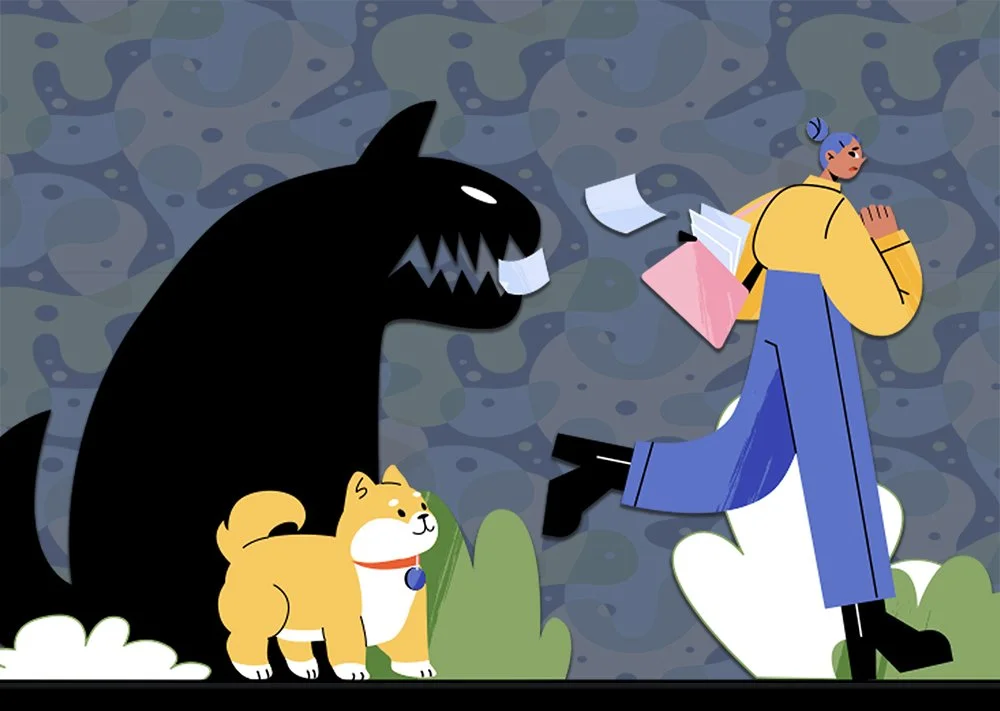
Cynophobia is an overwhelming fear of canines. illustration: AdobeStock
More than half of American households have a dog, which is lovely news if you like dogs - but a real problem if you're afraid of them. For some, that fear has a name: cynophobia, an intense and persistent fear of dogs. But others may experience a milder version, a wariness or discomfort rather than outright panic.
Chances are if you’re reading Bay Woof, you’re already a dog lover. But you may have people in your life who don’t share that love. This article is to help you help them.
To be clear, this isn’t about overcoming dog fear through therapy or exposure. Your dog-averse friends don’t need to work toward loving dogs or even feeling comfortable around them. The goal is to give them - and you - practical tools for staying safe and calm in everyday encounters with dogs, whether that's at a public park, a barbecue, or at a friend's house.
When we're afraid, we tend to react instinctively: shouting, running away, waving our arms, or trying to appear threatening in hopes that the scary thing will back off. Those reactions are completely normal and stem from the same survival instincts that help us avoid danger in other situations.
Unfortunately, many of those same behaviors are the ones most likely to increase a dog's agitation, arousal, or aggression. Dogs also make noise, jump around, and act erratically when they're scared; when a fearful person meets a fearful dog, both can escalate the situation without meaning to.
It's a lot like a car accident. You hope it never happens, but when stress hits, people tend to do exactly what they shouldn't. After a fender bender, they argue emotionally, forget to take photos, or even drive away when they should stay calm and exchange information. Knowing what to do ahead of time is what lets you override those first counterproductive instincts. That’s true for dog encounters, too.
Understanding Why Dogs Approach People
It may help your dog-averse friends to understand why dogs approach people in the first place. In many cases, a dog approaches to sniff and gather information. Dogs use their noses the way humans use their eyes. An approach does not automatically mean a dog wants to bite you, and most dogs, like most humans, prefer to avoid conflict whenever possible.
Despite what you or they may have heard, there's no need to stick a hand or fist out for a dog to smell. Doing so puts your smallest digits right next to the bitey end of the dog. Dogs can smell you perfectly well without having a hand pushed into their face. Allowing them to sniff your pant leg or shoes is both safer and more natural.
In most cases, the best thing you can do when approached by a dog is nothing at all: stand still, keep your hands to yourself, and let the dog finish their investigation. If you stay calm, many dogs will get the information they need and move on, and you’ll both continue with your day. The encounter often ends on its own within seconds if you wait it out.
Trouble tends to start when a dog feels threatened or trapped. In those situations, something that began as curiosity can quickly turn into a defensive response.
What To Say To Dog Owners
If a dog is approaching and the owner is present, it's okay to speak up. Say calmly and clearly: "Please call your dog," or "I'm not comfortable with dogs; can you get them?" Most owners will respond, though you may need to repeat yourself. You don't owe anyone an explanation, and you're not being rude by setting a boundary. If the owner says, "Don't worry, they're friendly," you can respond with "I still need you to call them away from me." Your comfort matters, regardless of the dog's intentions.
How To Act If a Dog Approaches You
If someone is worried about a dog approaching them, the following guidelines apply, whether the dog is fearful, aggressive, or overly friendly.
What To Do:
Stand still with your hands still or behind your back and avoid direct eye contact. This helps reduce pressure from the dog's perspective.
Turn your body sideways instead of facing the dog head-on. Dogs tend to read direct, frontal posture as confrontational - not what you want.
Move away slowly if needed, maintaining a sideways position. Try to avoid sudden movements, loud noises, shouting, or arm waving, all of which can increase a dog’s arousal.
Speak softly and calmly if you choose to speak. Even if it feels like play-acting, a gentle, steady voice can lower the overall intensity of the situation. Speak softly and calmly. If you feel comfortable doing so, try asking the dog to "Sit" in a calm voice; most dogs know this cue, and it can redirect their energy into something familiar and non-threatening.
Yawn deliberately and obviously, and then look away. Dogs yawn when they're trying to calm themselves or others, so they often recognize this as a non-threatening signal from humans.
What Not to Do:
Don't stare directly into the dog's eyes. This can feel threatening to a dog.
Don't run away suddenly. This can trigger a chase response, as many dogs are hardwired to pursue fast-moving objects.
Don't shout or try to act intimidating. This just raises everyone’s stress levels, including the dog’s.
Don't swing or brandish objects at the dog. If you're holding something like a stick, an umbrella, or a bag, avoid swinging it at the dog. While it may feel protective to you, from the dog's perspective, a human shouting and waving an object can look like you're trying to hit them.
Don't hide and then pop out suddenly. You can, however, calmly place an object between you and the dog to create space without adding movement or threat.
Don't reach over a dog's head to pet them. Many dogs dislike this, especially from strangers. If you think you want to touch a dog, wait for them to initiate contact rather than reaching for them first.
You may have seen mail carriers with a tennis ball attached to the end of a pole, but that isn't actually how the postal service teaches carriers to handle dogs. Swinging or waving objects can make some dogs more worked up rather than less and can escalate a situation. USPS training emphasizes avoidance whenever possible, using the mail satchel as a passive barrier and relying on dog repellent in true emergencies when a dog is actively attacking.
Some dogs have much stronger startle responses than others. If you're in a park or another area where dogs are present and you know they're coming, it may be tempting to hide behind a tree or in the bushes. This happens more often than you'd think. But dogs may hear movement and rustling and go to investigate, assuming it might be a bird, squirrel, or other animal. When a person suddenly pops out of hiding, the dog may bark in surprise (humans do the same thing, calling out when something appears unexpectedly). If their startled bark is then followed by a human yelling, arm-waving, and panicking, the situation can escalate quickly.
If you're helping a child who's afraid of dogs, the above rules still apply. But a scared kid needs a simplified version: stand still like a tree, don't run, don't screech, and don't wave your arms around. A good way to practice is with a game of red light/green light, in which the child freezes on “red” so they know how to be still when a dog approaches, jumps, barks, or growls. Someone standing still is boring to a dog, so they generally sniff and move on.
Reading Dogs’ Body Language
Research shows that many dog owners who love their pets still struggle to read dog body language accurately. No one has studied how well people who are afraid of dogs can do this, but it's reasonable to assume their learning curve would be much steeper.
Even if you don't like dogs, it’s helpful to have a basic understanding of their body language in a world where humans and dogs share space. This is similar to understanding traffic signals, even if you don't drive. You don't need to love cars or plan to get behind the wheel to benefit from knowing how to stay safe around them.
Here are some signs a dog is stressed or nervous:
Stiff posture or freezing in place
Lip licking or yawning
Leaning away from you
Tucked tail
Raised hackles (hair standing up on their neck or back)
Whale eye (showing whites of eyes)
Heavy panting (when not hot or exercising)
Intense staring
Sudden stillness
And here’s another thing that might surprise people who don’t spend a lot of time with dogs: barking doesn't necessarily mean a dog wants to bite you. This can feel counterintuitive, but a barking dog is often less dangerous than a silent one. Barking or growling is a form of communication. It's a dog's way of saying they're uncomfortable and want space. In many cases, barking is an attempt to avoid conflict, not to initiate it. In fact, the dogs that concern me the most are those who become very quiet, stiff, or still, especially if they're circling slowly and moving with visible tension.
It's tempting to judge a dog's risk based on breed, but body language and context are far more reliable indicators. A cute, fluffy dog can bite just as readily as a larger, more intimidating-looking one. Your discomfort is valid regardless of how the dog looks or how harmless the owner insists they are.
Fear of Dogs Is Reasonable
There is nothing wrong with being afraid of dogs. Maybe you were bitten in the past, or perhaps you didn't grow up around them. Being cautious around unfamiliar animals with sharp teeth is reasonable.
Cultural background also plays a role. In some cultures, dogs are primarily working animals kept outside rather than as household companions. If you didn't grow up around dogs as pets, or if dogs were viewed differently in your community, your caution is understandable and valid. The expectation that everyone should be comfortable with dogs can feel alienating when your experience has been different.
No one should belittle your fear, and it doesn't matter how friendly someone claims their dog is. You are not obligated to interact with any dog, even a happy, wiggly golden retriever puppy.
Sharing space with dogs you didn't choose is a lot like sharing the road with drivers you didn't choose. You can't control them and you don't have to trust them, but you do have to know the rules well enough to keep yourself safe.
A Message for Dog Lovers and Dog Owners
Finally, let’s end with some timely reminders for dog owners.
First, don't assume other people will like your dog as much as you do. If someone appears hesitant or uncomfortable around your dog, respect that. You may think your dog is the friendliest creature on earth, but the other person doesn't know that, and they're not required to trust your assessment.
If you're walking on a narrow sidewalk and notice someone is uncomfortable, step aside and give them space to pass. These small acts of courtesy make shared spaces work better for everyone.
If you have a dog who is anxious around strangers, keep your distance, especially from people who might also be afraid. Dogs pick up on human tension easily, and pushing an anxious dog toward a nervous person rarely ends well for anyone. Dogs who are nervous around strangers should have excellent, reliable recall, or not be off-leash in public.
Avoid handing a friend a pile of treats and asking them to feed your nervous dog. For many dogs, this creates a conflict where they want the food but have to move closer to something that scares them. A better approach is for the owner to reward the dog for calmly observing the person from a safe distance, or have the person toss treats away from themselves so the dog can retreat to get them, reducing pressure rather than forcing proximity.
If you love dogs, please consider sharing this information with friends or family members who don't like them or are afraid of them. Knowing how to act - and why - can help make our dogly world a little more comfortable for everyone.