The Case for Quiet: Why Your Dog's Jingling Tags Are Doing More Harm Than You Think
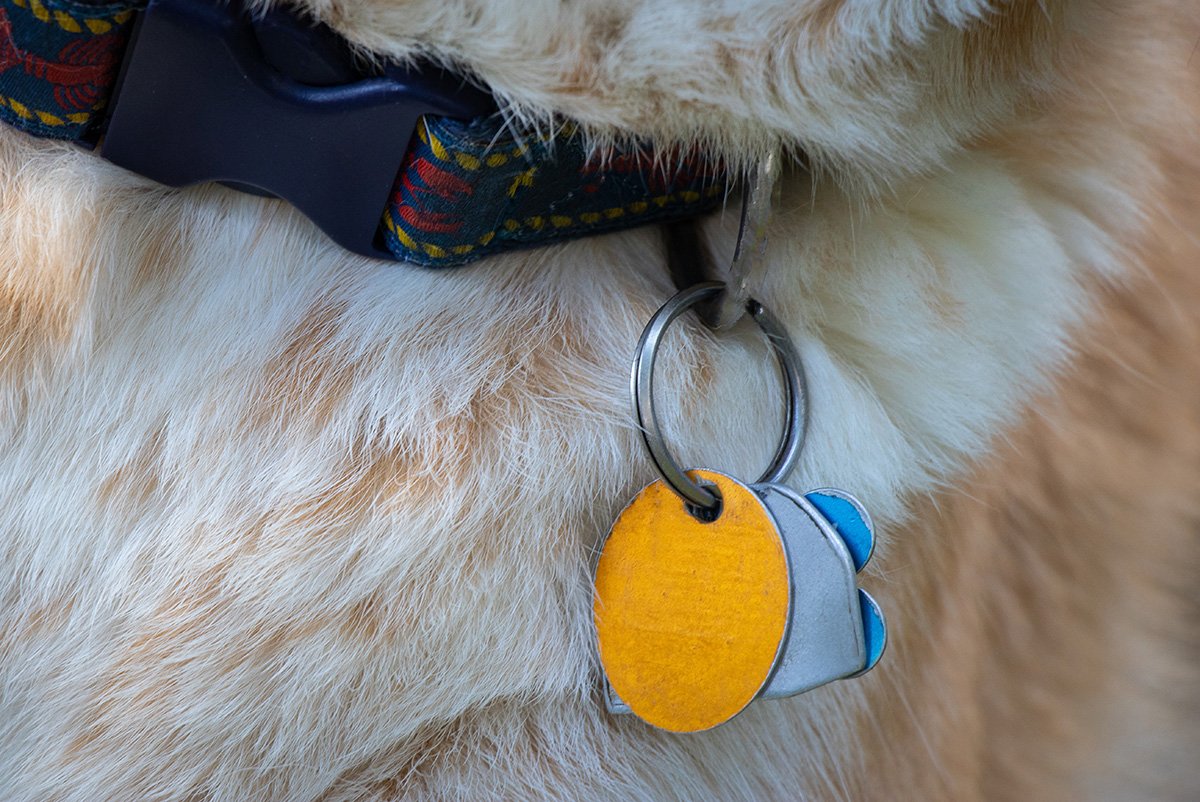
Sometimes the tags’ cacophony can drive a dog (and you) up the wall. photo: AdobeStock
You probably don't think much about the sound your dog's collar tags make. For most dog owners, it's just background noise. But that constant jingle-jangle is doing more than you realize. And if you have a reactive dog, it might be actively making your life harder.
Here's why silencing your dog's tags is one of the easiest upgrades you can make and how to do it.
Jingling Tags Announce Your Dog Like a Town Crier
Every time you walk down the street, your dog's tags are broadcasting their arrival to every dog within earshot. Dogs hear high-pitched sounds much better than we do.The rhythmic clinking travels through windows, over fences, and into backyards, giving every territorial dog advance notice that someone is approaching their turf.
What happens next is predictable: the dog behind the fence loses it. Then the dog in the front window two houses down joins in. Now there's a chain reaction of barking, and your dog is walking through a gauntlet of neighborhood dogs, all screaming the canine equivalent of "F•CK YOU, GET OFF MY LAWN!"
If your dog is reactive, this is a nightmare. Every one of those barking dogs is a trigger, and your dog can't even see most of them. They just hear aggression coming from behind walls and fences with no way to assess the threat. Your reactive dog already has enough on their plate without you essentially ringing a dinner bell for every dog on the block.
One More Thing on the Pile: Trigger Stacking
Maybe your dog handles the first barking dog behind a fence or window just fine, but by the fourth one, they’re past their limit. That’s because jingling tags can contribute to trigger stacking, which happens when multiple stressors pile up, lowering your dog’s threshold until they react to something they’d normally ignore.
When I’m working with dog-reactive dogs, I use desensitization and counterconditioning (DS/CC) to change how they feel about their triggers. Often, the first trigger isn’t the sight of another dog but the sound. Barking and noisy tags act as early warning signals that another dog is coming.
For some dogs, those sounds alone are enough to get them worked up before they’ve even seen another dog. Frequently, we’ll work on changing the dog’s reaction to the sound of barking and jangling tags separately from the visual of another dog, especially when reacting to dogs passing by the house is a problem.
Your Neighbors Will Thank You
If you've ever lived with a dog who barks at every sound outside, you know how it is. For many reactive dogs, closing the blinds isn’t enough to stop outbursts inside the house, because they’re still reacting to the sound of the dog walking by. And once the inside dog starts barking, that’s often enough to get the outside dog chiming in, too. So much for a peaceful neighborhood.
By silencing your dog's tags, you're doing a small favor for every dog owner on your walking route whose dog goes ballistic at the sound of an approaching dog. It costs you nothing, and it might save someone else from a barking meltdown.
Imagine Wearing a Bell Around Your Own Neck 24/7
Think about this from your dog's perspective. Those tags are hanging near to their very sensitive ears, clinking together whenever they move. Every head turn, every step, every shift in their sleep. It's a constant, low-level noise.
Try this. Clip a jangly keychain to your shirt collar and wear it for a day. By hour two, you'll want to throw it in the ocean. But your dog can't take their annoying noise-maker off. They've just learned to live with it - which isn't the same as not being bothered by it..
Marc Bekoff, Professor Emeritus of Ecology and Evolutionary Biology at the University of Colorado and Fellow of the Animal Behavior Society, suggests that jingling tags might be a dog's number one noise complaint if they could voice one. In his book, Unleashing Your Dog, he dedicates an entire chapter to how dogs experience sound and the importance of maintaining quiet environments for their wellbeing. What we register as a slight background clinking, they hear as a sharp, high-frequency sound happening inches from their ears.
Some dogs are specifically sound-reactive. For these dogs, a jingling tag isn't just annoying. It’s a low-grade trigger they carry with them wherever they go.
It Might Even Save Your Love Life
A friend of mine was in the early stages of dating someone she liked. After a couple of dates at her place, he told her - as diplomatically as he could - that the constant jingling of her two dogs’ collar tags was driving him nuts. The relationship didn’t go much further after that. I’m not saying the tags were the reason it ended, but it did come up on the second date.
Tag Noise Can Mess With Training
When you're working on focus or engagement exercises, you want your dog tuned into you, not distracted by their own soundtrack. Jingling dog tags during a training session is one more competing stimulus. If your dog is already struggling to focus around distractions, this is one you can eliminate simply in about 10 seconds.
And all this goes double for fearful dogs. If your dog is shy or nervous around strangers or other dogs, a jingling collar announces them before they've had a chance to assess a situation from a comfortable distance. Fearful dogs benefit from being able to observe quietly before being noticed, and noisy tags take that option away.
Your Dog Still Needs to Wear a Collar
Here's where things get a little more complicated. Everything above is a solid argument for ditching tags, but your dog still needs ID on them at all times, including inside the house.
Escape happens. A delivery person leaves a gate open, a kid doesn't latch the front door, a screen pops out of a window, or a contractor props open a side gate for "just a second." A dog who slips out without ID is just a stray. A collar with your phone number on it is the difference between a neighbor checking the tag and calling you in five minutes versus your dog ending up at the shelter.
The Hidden Danger of Tags at Home
Traditional dangling tags indoors can be a safety hazard for unsupervised dogs. Tags can catch on heating grates, floor vents, crate wire, and furniture hardware. There are documented cases of dogs injuring themselves (or worse) after a tag or collar loop snagged on something while they were home alone.
Your dog should always wear an ID tag, but dangling metal tags pose real risks inside the house. The goal isn’t to remove identification but to eliminate dangling, noisy hardware.
What About Rabies Tags?
Most people assume their dog is legally required to wear a rabies tag on their collar, but the rules are local and vary more than you'd think (even within the Bay Area, the requirements differ from county to county). In San Francisco, the law requires your dog to wear a city license tag. Since you need proof of rabies vaccination to get the license, it serves double duty, so there's no separate dangling rabies tag requirement. In San Mateo County, the license tag must be on the collar at all times, but if your dog is microchipped, they're exempt from wearing a tag or collar entirely.
The point is: check with your city or county animal control before you assume you need a jangling rabies tag on your dog's collar. In many places, all that's legally required is that your dog is vaccinated and that you can produce a current rabies certificate (a photo on your phone works). If your jurisdiction does require a physical tag on the collar, a rubber tag silencer keeps you in compliance without the jingle.
Solutions: From Free to Foolproof
There are multiple ways to solve this problem, ranging from free to inexpensive. When choosing a solution, think beyond just noise. The best option is one where your dog's name and phone number are visible without anyone having to grab your dog, flip a tag over, or unwrap anything.
This is important if your dog might shy away from a stranger's hands. A skittish dog who slips out the front door is not going to stand still while a well-meaning neighbor fumbles with a rubber pouch to read a phone number. You want an ID that someone can read from a short distance. (Pro tip: if you ever find a lost dog who won't let you get close enough to read their collar, try snapping a photo with your phone and zooming in).
Here’s a rundown of some practical solutions.
The rubber band trick (free, immediate). Wrap a small rubber band around your dog's tags to hold them together so they don't clink against each other. It's not elegant, but it works in five seconds. Downside: the tags are still dangling, just quieter, and depending on how you wrap them, the info can be harder to read.
Rubber tag silencers (~$2-$10). These are rubber frames that fit around standard round or bone-shaped tags, acting like a bumper so tags can't clink against each other. You can find them on Amazon for a couple of dollars (search "dog tag silencer"). Cheap and easy, but they add bulk, your dog still has dangling hardware, and some cover the tag face, which brings us back to the readability problem.
Tag silencer pouches (~$8-15). Products like the Quiet Spot and WoofHoof Dog Tag Silencer are neoprene or nylon pouches that wrap around the D-ring and encase your tags completely. They're durable, weather-resistant, and do a great job eliminating noise. The tradeoff: someone has to open the pouch to read the tag, which isn't ideal for a dog who won't let a stranger handle them.
Slide-on tags (~$5-12). These are flat metal tags that slide directly onto the collar strap and sit flush against it. No dangling, no jingling, and the engraved info is visible right on the collar. GoTags makes a version in eight colors with room for four lines of text. One thing to watch for: depending on where the tag sits relative to the buckle, adjusting the collar for fit can sometimes push the tag into a spot where part of the engraving gets hidden by the buckle. Also note that the standard slide-on style only fits open-ended buckle collars, not quick-release snap collars (GoTags makes a stainless version for those).
Embroidered or personalized collars (~$15-30). This is my favorite long-term solution. Your dog's name and your phone number are custom-stitched or printed directly into the collar. No tags, no hardware, nothing to catch on a crate or heating vent, and the information is visible at a glance. A nervous dog who's trotting down the sidewalk after escaping through an open gate is wearing their ID in plain sight, and no one needs to get close enough to grab them in order to read it. Companies like DogIDs make collars with built-in nameplates, including their ScruffTag, which sits on top of the collar for easy visibility. You can also find embroidered collars from dozens of brands on Amazon and Etsy. This option eliminates every problem at once: no noise, no snag risk, and fully readable ID on a hand-shy dog. The one drawback: when you adjust the collar to fit, the buckle or excess strap can cover part of the embroidered text. Make sure your full name and phone number are visible after you've tightened it to your dog's neck size. Some brands handle this better than others by strategically placing the text, so read reviews before you buy.
Riveted or stamped collar plates. These are small metal plates riveted directly onto the collar. They sit flat, make no noise, and are extremely durable. DogIDs sells standalone rivet-on nameplates in brass or stainless steel, and Gun Dog Supply has been doing stamped brass plates for hunting dogs for years. They're harder to transfer between collars, but if your dog wears the same collar for a long stretch, they're a great permanent option.
The Easiest Upgrade You'll Ever Make
Silencing your dog's tags is one of those tiny changes that punches well above its weight. It reduces trigger stacking for reactive dogs, removes an unnecessary source of constant noise, makes you a more considerate neighbor, eliminates a safety hazard at home, and - with the right collar setup - keeps your dog identifiable without any of the downsides.
Try it today and give your dog’s ears a break. The sounds of silence were never sweeter.