The Domino Effect in Dog Training: How Finding Your One Thing Makes All the Difference
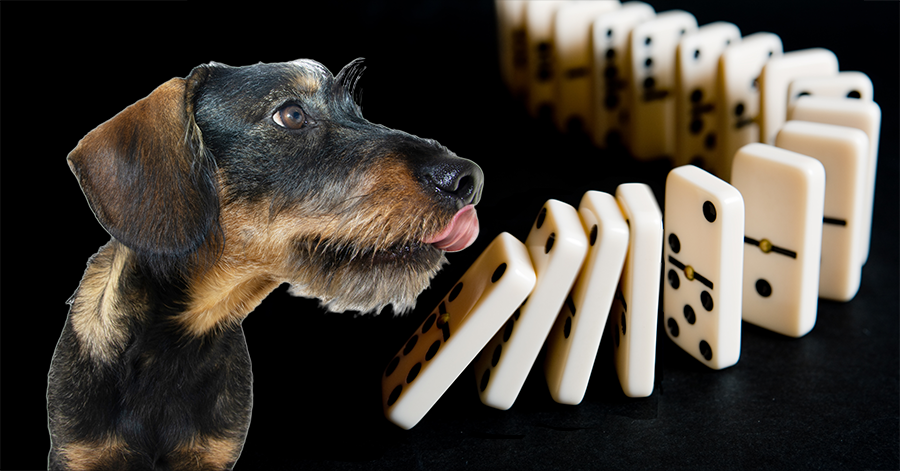
Sometimes working on one singular thing can help speed progress. photo: AdobeStock
Fast forward a moment to the middle of February. Remember that ambitious training plan you made on January 2? The one where you were going to work on recall and leash manners and door dashing and that thing where your dog barks at the neighbor’s cat? Right. You practiced leash walking twice, worked on recall for like four days, and now you’re back to just…managing. Again.
What if the problem isn’t your dedication or your dog’s capacity to learn? What if the problem is that you’re trying to do too much at once? There’s a bestselling book called The One Thing by Gary Keller that challenges the entire premise of goal-setting as we know it. Instead of asking “What are all the things I want to accomplish?,” Keller asks what he calls a focusing question: “What’s the one thing I can do, such that by doing it, everything else will be easier or unnecessary?”
Applied to dog training, this isn’t about lowering your standards or giving up on your goals. It’s about finding your leverage point - the single domino that, once toppled, makes everything else easier.
The Domino Effect
Keller explains that a single domino can knock down another domino that’s 50% larger than itself. If you arrange dominoes that grow in size incrementally, that initial small domino can ultimately generate the force to bring down something huge. Your one thing is that leading domino - the action that seems manageable right now but triggers a chain reaction of effects.
For a reactive dog, your one thing might be learning to manage your dog’s environment to keep them under threshold: choosing quieter walking routes, crossing the street before you get too close to triggers, strategically using food to create positive associations. That’s the first domino. When that falls, it knocks down the next domino, which is that your dog’s nervous system gets more practice being calm instead of constantly rehearsing reactivity.
That, in turn, knocks down the next domino; they start to recover from triggers faster. Which knocks down the next one; you can gradually decrease distance from triggers because their baseline stress is lower. Eventually, the behavior that seemed impossible to change starts shifting, not because you tried to train “don’t react” in a dozen different scenarios at once, but because you focused on that first domino.
Success Is Sequential, Not Simultaneous
Keller argues that extraordinary results don’t come from doing everything at once. Rather, they come from doing the right things in the right order, one after another. In short, you can’t successfully pursue multiple priorities simultaneously and expect breakthrough results on all of them.
For an anxious dog, this plays out when people try to work on everything at once: desensitizing to the doorbell, counter-conditioning to strangers, managing car anxiety, practicing vet handling, maybe even addressing reactivity on walks. They’re exhausted, your dog isn’t improving, and nobody knows what’s working or what isn’t.
In fact, the one thing that needs to happen first is establishing a daily relaxation protocol and routine. That’s the foundation. Once the dog has a baseline ability to regulate their own nervous system and you’ve built in predictable moments of calm, then you can start tackling specific triggers. You can’t effectively desensitize an already dysregulated dog to a dozen different things simultaneously. The relaxation work is step one in your sequence. The other work comes after.
The Focusing Question
Keller’s focusing question gives you a practical tool for identifying your one thing: “What’s the one thing I can do, such that by doing it, will make everything else easier or unnecessary?” The key is applying this question using different time horizons (a day, a week, a year) so that your actions align and build on each other.
For a dog with separation anxiety, that might look like this. Today, arrange to stop leaving your dog home alone beyond their threshold. Get dog sitters, enlist family, arrange daycare, whatever it takes. This week, practice 30-second absences systematically, building these into your daily routine. This month, work up to 1-minute absences. This year, resolve the separation anxiety so your dog can be left alone for your work schedule. Long-term, have a confident, resilient dog who’s comfortable being alone.
Each answer nests inside the next. Your initial daily action - that first domino of never leaving them over their anxiety threshold - is what makes everything else possible.
Finding Your One Thing
So how do you identify your one thing? Start by asking yourself some questions. What do you envision your life with your dog looking like six months from now? What would you love to be able to do with your dog that you can’t do now?
Then get honest about impact. What’s your dog’s one behavior that affects your daily life the most? If you could wave a magic wand and change one thing about your dog, what would it be?
Then get practical. What are you avoiding doing because of your dog’s behavior? Walks, having guests over, leaving the house? What would make the biggest difference in your day-to-day life?
Sometimes the answer is that you need professional help to identify the first domino. Hiring a trainer might actually be your one thing. But once you’ve identified it, apply that focusing question at different time scales: what’s your action right now? This week? This month? This year? Let each answer build on the last.
So this January, resist the urge to make a list of Top 10 training goals. Pick one. Find your lead domino. The progress you make by going deep on that one thing will surprise you. And I promise it’ll feel a whole lot better than that mid-February moment when you’re back to just managing.
Here’s to a new year of focused, meaningful change for you and your pup!