Paid to Save Them, Accused of Killing Them: The Investigation of Miranda’s Rescue
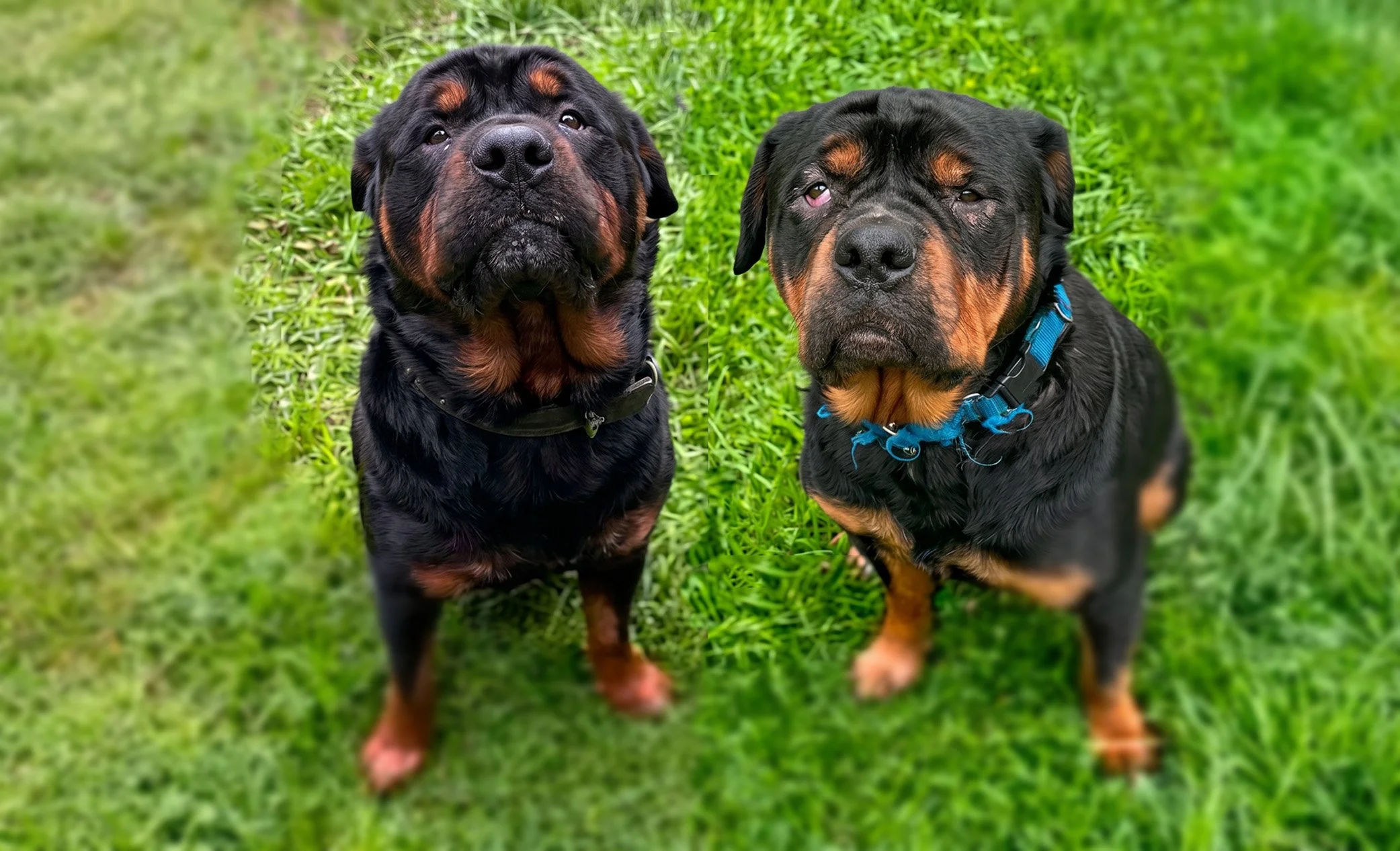
Peter and Tinkerbell are two of the hundreds of dogs sent to Miranda’s Rescue who rescuers have been unable to locate since the news broke. photo: edited version from the original article
Publisher’s Note: This article originally appeared on 5/22/26 in Redheaded Blackbelt and is reprinted here in its entirety with their permission. Click here for the original piece and for future updates.
When a woman died, her family was left with two dogs they couldn’t keep. Someone had to decide what to do with Peter and Tinkerbell.
The family didn’t surrender the dogs to a municipal shelter, where large-breed dogs face long odds. They didn’t want to abandon them. So they did what people in impossible situations do when they want to believe there is a better answer — they called Miranda’s Rescue.
According to posts on a community tracking group, Shannon Miranda charged the family $3,500 to take both dogs. The family paid it. Peter and Tinkerbell — listed as entries 315 and 316 in the group’s growing database — were surrendered on April 8, 2025*. They were never posted on Miranda’s Rescue social media as available for adoption. They were never listed as having been adopted out.
That was a year before the Humboldt County Sheriff’s Office executed a search warrant at the rescue’s Sandy Prairie Road property in Fortuna amid allegations of abuse and fraud.
Nobody has confirmed where Peter and Tinkerbell are.
The Rescue
For over three decades, Shannon Miranda was the answer people found when they ran out of other options.
The dog that nobody else would take. The pit bull with a bite record that no shelter would hold and no rescue would touch. The aging Rottweiler whose owner had just died. The animal that had been part of a family until the family changed and there was simply no room left. These are not rare situations. They happen every day across California, in every city with a shelter and every neighborhood with a dog. What is rare is someone who says yes to all of it — who builds a 50-acre operation, hires staff, opens four thrift stores to fund the work, files as a nonprofit, and tells the world he will take any animal that needs saving and will not kill a single one to make room for the next.
Shannon Miranda said yes. For years, people believed him.
Miranda says he started his rescue thirty-one years ago, incorporating as Miranda’s Rescue For Large and Small Animals in 1998 — a no-kill rescue, adoption, and sanctuary facility on 50 acres at the corner of Drake Hill and Sandy Prairie Roads in Fortuna. According to the rescue’s own website, Miranda got his start rescuing animals after a fall at a lumber mill in 1994 left him wheelchair-bound with a broken neck and back. He defied a prognosis that said he would never walk again. Working with animals, the website says, became his recovery.
By the time investigators arrived at his property on May 1, 2026, Miranda’s operation had grown into something substantial. The rescue holds 501(c)(3) nonprofit status and an IRS tax exemption number. It operates four thrift stores in Fortuna, McKinleyville, Eureka, and Arcata — proceeds, the website states, go directly to the animals. Donors can give by PayPal, GoFundMe, credit card, check, or Amazon wish list. The website features sponsors. It solicits bequests, asking supporters to consider leaving a percentage of their estate or naming the rescue as a beneficiary of a pension plan or life insurance policy.
Miranda’s website states the rescue has been “recognized by the California State Assembly as the ‘Best Sanctuary For Abused Animals in Northern California'” and that the Red Cross named Miranda “one of Humboldt County’s Heroes.”
The rescue’s stated mission drew in not only private donors and surrendering pet owners but also government agencies. The cities of Fortuna, Rio Dell, and Ferndale each held formal contracts with Miranda’s Rescue, paying monthly fees to the organization to handle stray animals. Beyond the local contracts, Miranda’s had built formal transfer agreements — memoranda of understanding — with animal shelters across California, including Oakland Animal Services, Berkeley Animal Care Services, Solano County Animal Services, Stockton, Napa County, Santa Clara County, Contra Costa, and Palm Springs, according to the search warrant affidavit.
The dogs Miranda’s accepted from these shelters were largely the hardest to place — large-breed dogs, pit bulls, animals with behavioral histories or bite records, according to transfer records and the search warrant affidavit.
Miranda’s took them. And for years, the community helped him do it.
The community showed up for him. Volunteers came on weekends to walk dogs and clean kennels. Local businesses signed on as sponsors. People dropped off furniture at the thrift stores, donated dog food, dropped checks in the mail. Donors updated their wills. Supporters showed up at Costco on the first Saturday of every month to hand over supplies. For around three decades, Miranda’s Rescue was the kind of place that made people feel like they were doing something good.
“Thank you to our great community for supporting our cause,” the rescue’s website reads.
The website also draws a careful distinction between what Miranda’s claimed to be and what it was not.
“WE ARE AN ANIMAL RESCUE AND SANCTUARY,” it states in capital letters. “An animal rescue/sanctuary takes on the expense at full cost and also doesn’t euthanize just because an animal becomes ill or to make room for new animals. When our rescue is full, we don’t take in any new animals.”
Any humane euthanasia performed at the rescue, the website states, “is performed and approved by licensed veterinarian clinics who are very well known and respected in our community.”
The Doubts
Not everyone was convinced.
People in the local and statewide animal rescue community say concerns about Miranda’s operation surfaced years ago — whispered at first, then louder. The numbers didn’t add up. A rescue in a relatively unpopulated area of Northern California, taking in hundreds of large-breed, hard-to-place dogs from shelters across the state, and somehow finding them all homes?
“For years there have been rumors,” a volunteer with the Contra Costa SPCA wrote on social media after the investigation became public. “I can never understand how a rescue in an unpopulated area could adopt out dogs. A lot of rescues and shelters transfer them to Miranda’s because of aggressive behavior or behavioral issues.”
The organization All About the Animals posted this month that it had co-rescued dogs from Miranda’s back in 2013 and subsequently raised money to hire a private investigator to look into allegations that Miranda was shooting the dogs he accepted after collecting surrender fees. That was 13 years ago.
According to reporting from KSBW, Monterey County’s Hitchcock Road Animal Services contacted Humboldt County in 2024 to verify Miranda’s Rescue’s status after rumors surfaced about its nonprofit standing. Humboldt County confirmed the nonprofit status and reported no concerns. A hold on transfers was lifted, and dogs continued to be sent to Miranda’s Rescue.
That response came despite complaints about Miranda’s Rescue logged by the Humboldt County Sheriff’s Office dating back years — including a 2023 report that Miranda was accepting surrender fees and “just putting the animals down under false pretenses of rehoming.” The following year, in February 2025, another person reported surrendering three healthy dogs to Miranda’s Rescue, at least two of which ended up dead. Miranda’s explanation at the time, according to sheriff’s records cited in the affidavit: one died in the kennel, one was euthanized by an adoptive owner, and one died in foster care.
No investigation was opened on either complaint.
In February 2026, the advocacy group Fix Our Shelters says it served a cease-and-desist letter on Humboldt County Animal Care Services after learning that Miranda’s Rescue was a contracted service provider for local jurisdictions, citing what it described as years of reports about conditions at the facility.
A former veterinary technician with decades of animal rescue experience, Jenna Moore says she began noticing a pattern years ago: veterinarians, she says, were declining to continue performing euthanasia for Miranda’s Rescue. The reason, as she understood it, was the volume, the frequency, and the apparent condition of the animals — dogs that, to trained eyes, looked healthy and adoptable. The refusals, she says, were a red flag she could not shake.
Moore knew Miranda personally. She had raised a camel named Tonka for years before selling him to Miranda for $10,000 — the same price she had paid for him. Moore says Miranda asked her not to tell anyone he had paid for the animal because of the rescue’s nonprofit status.
When Tonka developed what appeared to be a bacterial infection, Moore says she offered to transport him to UC Davis, where exotic animal veterinarians could treat him. Instead, she says Miranda never notified her before having him put down, as she says they had agreed. According to a 2023 report by the Lost Coast Outpost, Miranda said Tonka had been born with a bacterial issue for which there was no cure and that he did not know the name of the bacteria.
Whatever doubts she had held about the operation hardened after that, she says, into something closer to certainty. She vowed to get the evidence.
Proving it was another matter. Moore says she raised her concerns with authorities and was dismissed — her claims, she says, were characterized by the community as the product of a personal dispute with Miranda and her credibility was undermined by the history between them. What she says she knows is that nobody acted.
Around a year ago, Moore says, she joked with her friend Jennifer Raymond about buying the property next door to Miranda’s Rescue when it came up for sale — a perch from which someone could actually watch what was happening. Raymond, founder of the nonprofit Humboldt Spay/Neuter Network, did not treat it as a joke. She bought it.
Over the following year, Moore says she installed trail cameras on Raymond’s property and documented what she says was a pattern: transport vehicles arriving at the facility on days it was closed to the public, large numbers of dogs coming in, and almost none of those animals appearing afterward in adoption listings or social media posts, Moore claims.
With the information, Moore and Raymond began building a case on their own. They contacted shelters, filed public records requests, and cross-referenced transfer numbers against Miranda’s social media adoption posts. Moore says she reached out to over 90 shelters across California. Of the 17 that responded, records showed more than 650 dogs transferred to Miranda’s in 2025 alone — the large majority of them large-breed pit bulls with behavioral or medical histories.
For comparison, Moore noted, the Humboldt County Animal Shelter adopted out 260 dogs in all of 2025, 96 of them puppies. Dogs like the ones Miranda was accepting in bulk don’t move easily in a market this size.
“So how is Shannon doing all of this?” Moore said in an interview with Redheaded Blackbelt.
The answer to that question may have been caught on cameras.
Footage Moore says she captured in April showed a man she identified as Miranda, on a red Polaris, dump what appeared to be dog carcasses into one of several large, open holes on the property, before scooping dirt on top but not filling the hole entirely. The women, she says, entered the property that night and climbed into the hole, digging into the freshly turned dirt until the head of a German Shepherd was uncovered.
The dog was dead.
Horrified, she turned her findings over to the sheriff’s office. But Moore says investigators told her the footage was not clear enough to act. She pleaded with animal control to visit the property, she says, to prevent more deaths. That visit had not happened when the cameras alerted her to new activity in the field just a few days later.
Her heart sank.
On the evening of April 26, Moore alleges the cameras captured Shannon Miranda returning to the same field and dumping eight more dead dogs into the hole — on top of the animals already buried there. Moore and Raymond were not leaving without proof this time, planning on photographing and scanning any micro-chip identifications. As soon as Miranda was gone, Moore says they went into the hole. Once inside what they claim is a mass grave, emotion, Moore said, overcame them. She told Raymond, “[W]e can’t leave them here.”
“I knew going into it that I’d probably get sued for trespassing, property damage, stolen property,” Moore told Redheaded Blackbelt. “If he sues me, it will just allow my attorney more access to more of his wrong doings, I hope he does!”
They removed the bodies of eight dogs. A ninth dog, wrapped in a sheet with a leash around its neck, Moore said, had to be left behind — the women too exhausted to finish hefting the last dog from the hole. According to the search warrant affidavit filed by Humboldt County Sheriff’s Detective Julian Aguilera, the dogs were described as warm to the touch and bleeding, some with holes in their heads that resembled gunshot wounds. Moore says some were as young as four months old. She dragged the bodies to Raymond’s property, then transported them to her own home and stored them, as evidence, in a 20-cubic-foot freezer she purchased the next morning.
Moore says she, Raymond, and an Oakland volunteer cross-referenced microchip numbers against shelter databases, identifying each animal from intake records and photos — the task taking several nights to complete. One was Zora, a large black female with clipped ears who had been transferred from Oakland Animal Services less than a month earlier. On April 25 — the day before the women found the bodies — Miranda had sent a text message to an Oakland shelter employee with a photo of Zora on a leash. The message read: “Zora adopted.” Zora had been the featured dog in April at a local bank.
The bodies of the eight dogs showed what appeared to be bullet holes in their heads, according to Aguilera’s affidavit. Due to the amount of blood and dirt on the bodies, investigators were unable to locate a gunshot wound on Zora specifically, the affidavit states. Six of the eight had microchips; two did not.
The next morning, Moore contacted the Humboldt County Undersheriff. County officials retrieved the deceased animals several days later. Detectives examined the bodies that night. A search warrant for Miranda’s property was obtained and executed May 1.
In the affidavit, Aguilera stated his conclusion: “It is my belief that Shannon intentionally killed Zora in order to receive more dogs and the funds that came with the dogs.”
The Money
The search warrant affidavit lays out the financial architecture of what investigators allege was happening at Miranda’s Rescue.
According to Aguilera’s affidavit, shelters or their nonprofit partner organizations paid between $400 and $1,000 per dog transferred to Miranda’s, depending on the dog’s behavioral history. Private owners paid surrender fees ranging into the thousands — Spuds, a pit bull-Aussie mix surrendered in April 2024, cost his owner $1,000. Peter and Tinkerbell, the Rottweilers whose family paid Miranda after their mother died, cost $3,500 for the pair. Municipal governments paid flat monthly fees: $450 per month from Ferndale, $800 from Fortuna, and $1,450 from Rio Dell, according to the affidavit. Of the contracts reviewed by investigators, Solano County’s was the only one that explicitly prohibited euthanizing a dog to create space for additional animals, according to the affidavit.
In the past year alone, investigators estimate Miranda’s took in more than 600 dogs from shelters statewide — a figure consistent with Moore’s own independent public records research, which found more than 600 dogs transferred from the shelters that responded. The vast majority of the roughly 90 shelters contacted had not yet responded. Neither figure accounts for privately surrendered animals like Peter and Tinkerbell. Investigators estimated Miranda’s total revenue from documented shelter transfers in the past year at approximately $510,000, according to the affidavit.
Tax filings for Miranda’s Rescue Inc., reviewed by Redheaded Blackbelt, show the organization’s gross receipts more than tripled over a decade, from $580,811 in 2011 to $1,894,274 in 2023. The filings show that three individuals drew salaries from the organization: Shannon Miranda, listed as president and founder, who reported compensation of $98,601 in 2024; Brian Paris, listed as treasurer and the person the rescue’s website directs donors to call with credit card donations, who reported $106,321; and Brigg Paris, listed as director and thrift store district manager, who reported $67,588. The organization ended 2024 with net assets of just $28,789 against total liabilities of $422,230 — effectively insolvent for an operation of its size. Miranda acknowledged to investigators during the April 27 interview that record-keeping “was not a strong area for him,” according to the affidavit.
Clark County, Nevada assessor records show that Miranda and his partner purchased a six-bedroom, 4.5-bathroom home in the Las Vegas area in February 2024 for $1,050,000. The roughly 5,000-square-foot home, which includes a pool and spa, is listed in assessor records at Miranda’s Fortuna rescue address. The Las Vegas home purchase came the same year Miranda’s Rescue fiscal year ended with net assets of just $28,789. The source of funds used to purchase the Las Vegas property is not known.
What Miranda Said
On the morning of April 27, Detective Aguilera interviewed Shannon Gene Miranda at his Fortuna property. Miranda was cooperative, opening his home and offering a tour, according to the affidavit.
He denied killing and burying the eight dogs. When Investigator Taylor showed him a photo of the deceased dogs found by the women, Miranda began to cry and said he did not own those dogs and that they were not housed at his rescue, the affidavit states.
Miranda told the detective he was “not truly a no-kill shelter” and that he did “the best he could with the resources available,” according to the affidavit. He said he typically employed a veterinarian to euthanize animals but occasionally had to shoot one himself when “immediate action was required to prevent further suffering.” He described that as standard practice only in cases where a licensed veterinarian was not available in time.
He told investigators that a dog had recently attacked another dog and that he’d had to shoot it because the dog’s neck was nearly severed. He said he had also recently had to euthanize multiple horses, a goat, and some dogs, and that he regularly buried animals — including those euthanized for health or behavioral reasons — in the field that neighbors Raymond’s property.
He admitted to being over capacity — 69 dogs on the property despite a conditional use permit capping him at 60.
On May 1, the day of the search, Miranda spoke by phone with an Oakland Animal Services official and again told her that Zora had been adopted, according to the affidavit. Later that day, in a call with Oakland Animal Services Director Joe DeVries, Miranda said several dogs he had recently received had to be ‘put down’ or had ‘jumped out of cars,’ DeVries told the Times-Standard.
He eventually acknowledged that he had lied about Zora — but said he had done so “to spare the transport officer’s feelings,” the affidavit states. He told an animal control officer he had put Zora down because the dog had killed a cat and bitten him.
“Shannon told [the animal control officer] that he was guilty of lying” Aguilera’s affidavit states.
A records check conducted by investigators revealed a misdemeanor embezzlement conviction from 1993, expunged from Miranda’s record earlier this year, according to the affidavit.
The search warrant return inventory shows investigators seized a Ruger 10/22 rifle with ammunition, a Beretta .380 pistol with 11 boxes of ammunition, a Remington 870 shotgun with ammunition, a pellet gun, a BB gun, an air rifle, adoption records, electronics, and a flash drive.
Oakland officials requested a full accounting of every dog transferred to Miranda’s Rescue, according to the Times-Standard. The rescue never responded they claim.
“He told us that dogs were being adopted out and led us to believe that there was a positive outcome, and appears to have been completely misinforming us on at least four or five dogs,” DeVries told the Times-Standard. “It gives us a very sick feeling in our stomachs that many more of them met death by Shannon’s hands than we were originally told.”
Of all the dogs Oakland had transferred to Miranda’s, investigators found only one still alive on the property — a dog named Redwood, transferred in October.
On Wednesday, Miranda broke his silence with a post on Miranda’s Rescue’s Facebook page.
“Many of you, like me, have been appalled by allegations we’ve read in the media and online,” Miranda wrote. “Not everything we’re seeing is true. A legal process is now underway to sort the facts from the lies, and I’m asking you to please hold fire until that process works its way through.”
Miranda said he had devoted 31 years of his life to the rescue and intended to “vigorously defend” himself and continue the work. He said he had been advised by counsel not to comment further.
Is Any of It Criminal?
Miranda’s Rescue is still operating.
The fields at the Sandy Prairie Road property have not been excavated by law enforcement. No charges have been filed. The Humboldt County Sheriff’s Office, in a press release issued this week, said the investigation remains active and asked the public to “avoid speculation.”
“Our investigators are committed to thoroughly examining all evidence and pursuing every credible lead,” said Lt. Jesse Taylor in the agency’s statement.
The legal questions surrounding the case are layered. The investigation centers on California Penal Code 597(a) — intentional animal maiming or killing — as well as PC 487(e), grand theft of a dog, and PC 532(a), fraud, according to the affidavit. Shooting a dog is not inherently illegal in California — the law does not require a licensed veterinarian to euthanize animals at a private rescue operation. Whether the method constitutes cruelty under PC 597 would be a question for prosecutors to argue.
The fraud allegations may sit on firmer legal ground. Telling shelter officials and pet owners that animals were adopted when they were not, while continuing to accept payment for new animals, tracks with California’s theft by false pretenses statutes, as well as potential federal wire fraud exposure if electronic communications were used. Miranda’s status as a registered 501(c)(3) nonprofit adds a potential layer of civil and regulatory liability if donations were solicited for the care of animals that had already been killed.
“There is no regulatory body that oversees Miranda’s Rescue,” Aguilera noted in his affidavit.
That absence of oversight, advocates say, is the wider story. California has no statewide legal definition for “no-kill.” The term is marketing, not law. Private rescue organizations that hold 501(c)(3) status are required to file annual tax returns and maintain registration with the state, but there is no licensing requirement, no inspection regime, and no authority charged with verifying that a rescue’s outcomes match its public claims.
Shelters that transfer dogs to rescues like Miranda’s count those transfers as live outcomes in their statistics — a higher save rate that can drive larger grants and better public perception. The incentive to transfer is structural. The incentive to verify what happens afterward is not.
“It does seem more like a commercial operation,” the Oakland Animal Services Director told the Times-Standard.
The Community
A Facebook group dedicated to locating dogs previously surrendered or transferred to Miranda’s has more than 2,000 members and grows daily. Moore is an administrator of the page, “Where Are the Dogs Sent to Miranda’s Rescue in Fortuna, CA?” where she posts new dogs one by one. Each entry carries a number, a name, a breed, a surrender date, and whatever story is known.
“I’m not only gathering records and information,” Moore wrote this week on the page. “I’m also going through each shelter page trying to locate photos and information on these dogs one by one. It has been heartbreaking and overwhelming at times.”
For some, the disbelief is personal. One woman who says she visited Miranda’s property regularly and considered him a friend wrote publicly that she was struggling to accept what she was reading.
“I thought Miranda and I were friends,” she wrote. “It absolutely breaks my heart to think that someone I thought I knew since 2018 could be adding to the problem in rescue.”
Not everyone has turned away. As of this week, Miranda’s Rescue website still lists nearly 30 sponsors — among them local veterinary clinics and pet supply businesses — though it is unclear whether those relationships remain active or simply have not been removed from the page. Online, some supporters have pushed back against the allegations, arguing that Miranda was doing the best he could with an impossible volume of animals in a system that gives rescues no good options. The defense of a man many describe as a big-hearted local fixture — someone who took the calls nobody else would answer — has been as loud in some corners as the outrage has been in others.
One pet owner, who says she paid $1,000 to surrender her dog Spuds to Miranda’s in April 2024, wrote on the tracking group’s page: “The reason we paid $1,000 instead of dumping him or leaving him at a shelter was because we believed this was a sanctuary that would protect him and give him the chance he deserved. I’m so scared that I accidentally sent him to his death. I’m clinging onto the hope that he’s out there still.”
That feeling — of having unknowingly funded something that may have harmed the very animals it claimed to save — cuts to the heart of what makes this investigation so unsettling. For three decades, people were around — employees, volunteers, shelter partners, city contractors, donors. The rescue was busy, visible, and apparently thriving. And yet, according to investigators, dogs were being shot and buried out back. The question of how that goes unnoticed for so long — or whether it truly did — is one this investigation has not yet answered.
The cities of Fortuna, Rio Dell, and Ferndale have all suspended their contracts with Miranda’s Rescue. Ferndale City Manager Kristene Hall wrote to the city council that the city is now working to build dog runs at the police department to house strays on its own while a longer-term solution is developed.
Miranda’s Rescue, as of this week, appears to still be operating. Even as the investigation unfolds, the rescue continues to post dogs listed as adopted on social media — though it is unclear whether those adoptions are occurring the same day the posts go up or represent older placements. Meanwhile, shelters attempting to reclaim animals still in the rescue’s custody say those efforts have not gone smoothly.
The question of who knew what and when — among volunteers, officers, shelter administrators, and government agencies that contracted with Miranda year after year — has not been answered. Despite years of rumors and speculation, no one was tasked with making sure the rehoming claims Miranda made were true, according to the affidavit. The investigation that finally opened did so only after two women say they climbed into a hole in the ground on an April evening and pulled out the bodies of eight dogs.
And if the allegations are true — if the dogs were killed not because they were suffering or dangerous but to make room for the next paying transfer — the question that follows is bigger than Shannon Miranda.
Maybe it was easier to believe in Miranda’s Rescue than to face the harder truth — that there are simply more unwanted dogs than there are homes for them, that the cycle of acquisition and abandonment fills shelters faster than any rescue can empty them, and that the feel-good story of the no-kill sanctuary was something many people needed to be true.
The rescue that promised to bridge that gap — to absorb the consequences of an overstretched, underfunded, and largely unregulated system — collected hundreds of thousands of dollars a year to do it. Whether it ever really did is what investigators are now trying to determine.
The fields have not been excavated. The investigation continues. Peter and Tinkerbell are still unaccounted for.
──────────────────────────
*Correction: An earlier version of this article stated the surrender date as 2026. The date has been corrected to 2025 based on documentation provided after publication.
──────────────────────────
Shannon Miranda did not respond to requests for comment from Redheaded Blackbelt prior to publication. On Wednesday, Miranda posted a public statement on the Miranda’s Rescue Facebook page saying he intends to vigorously defend himself and that he has been advised by counsel not to comment further.
──────────────────────────
Shannon Miranda has not been charged with any crime. Miranda’s Rescue remains in operation. As with anyone under investigation, Miranda is presumed innocent unless proven guilty in a court of law. Anyone with information about the Miranda’s Rescue investigation is asked to contact the Humboldt County Sheriff’s Office tip line at (707) 268-2539 or submit anonymously at hso@co.humboldt.ca.us.
──────────────────────────
• Reporter Ryan Hutson contributed to this article.