From Stone Engravings to Warhol: How Dogs in Art Evolved Across Centuries
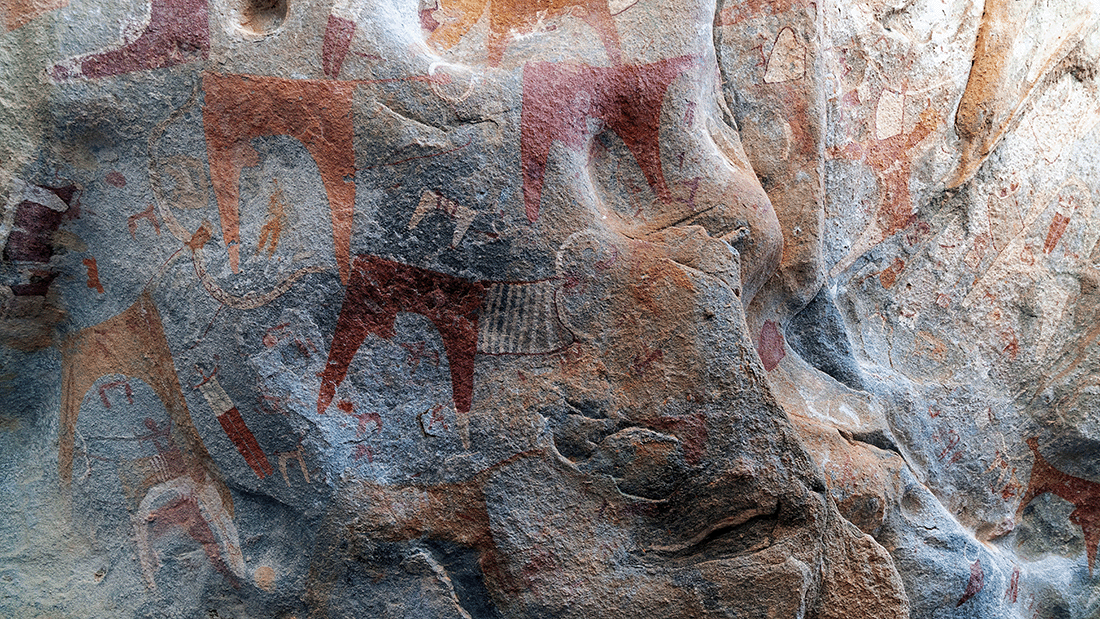
The Laas Geel cave formations offer some of the oldest and best preserved rock art in the Horn of Africa. Estimated 5,000-year-old paintings depict cattle, wild animals, humans, and domesticated dogs. photo: AdobeStock
We now believe dogs were domesticated at least 15,000–30,000 years ago. But it took a bit longer before our furry friends began showing up in art.
As documented in 2017 by archaeologist Maria Guagnin, the oldest known depictions of canines are now thought to be stone engravings found in the Shuwaymis and Jubbah regions of Saudi Arabia. Dating back roughly 8,000–9,000 years, these engravings show groups of dogs accompanying hunters across a landscape. Some dogs even appear to be connected to humans by leashes, suggesting not only domestication, but an already sophisticated working partnership between humans and dogs. These early images emphasize cooperation, movement, and shared purpose.
By around 5,000 years ago, dogs had begun to take on a symbolic meaning in ancient Egypt. The god Anpu, sometimes spelled Inpu, but known more widely by the Greek name Anubis, is one of the earliest deities depicted with canine features. Early representations in carvings and seals show him as a black jackal or dog. This black coloration symbolized both the resin used in mummification and the fertile, dark silt of the Nile, linking death with regeneration and renewal.
Later depictions show Anubis with a human body and a canine head, including examples from the reign of Ramesses II (1279–1213 BCE) at Abydos. Whether reclining in a watchful pose or standing as a guide, Anubis appears as the guardian of the necropolis and conductor of souls into the afterlife. Rather than representing fear, he embodied protection and continuity, reinforcing the idea that death was not an end, but a transition into another state of being.
Dogs also appear frequently in ancient Egyptian and Mesopotamian art beyond religious symbolism, showing up on pottery, in tomb paintings, and as small protective figures placed near entrances. In Mesopotamia in particular, dogs were associated with healing and protection, sometimes linked to the goddess Gula, whose sacred animals were dogs. Small dog figurines were buried beneath thresholds to guard households from harm, suggesting that dogs were believed to provide protection even in symbolic form. Across these early civilizations, dogs are consistently depicted as companions, hunters, and guardians.
During the medieval and Renaissance periods in Europe, dogs began to take on a more intimate, domestic role in art. They appear in portraits of saints, noble families, and aristocratic households, often symbolizing loyalty, fidelity, and vigilance. In religious paintings, a dog at a figure’s feet could represent faithfulness or moral integrity. While most dogs still lived as working animals - herding livestock or guarding property - the 16th century marks the rise of the companion “lap dog” among the elite.
Artists such as Lavinia Fontana helped popularize portraits of women accompanied by small dogs, a motif that communicated both status and virtue. These dogs were carefully positioned within compositions, often reinforcing ideas of devotion and attentiveness rather than serving as purely decorative elements.
By the 17th century, dogs began to emerge as subjects in their own right rather than symbolic additions to human portraits. English painter John Wootton became known for specializing in animal portraiture, particularly sporting and hunting dogs. His work reflects a growing interest in animals as individuals, capturing both their physical form and their roles within human life.
In the 20th century, dogs took on new roles in modern and pop art, reflecting not only companionship but identity and persona. Andy Warhol famously had a dachshund named Archie, who accompanied him almost everywhere and became part of his public image. Archie appeared in photographs and media, blurring the line between pet and persona. Warhol sometimes humorously deflected interview questions to him.
Later, Warhol and his partner Jed Johnson added a second dachshund, Amos. While Archie thrived in the spotlight, Amos was more reserved, highlighting the fact that dogs, like people, have distinct temperaments and social preferences.
One of the most recognizable contemporary representations of dogs in art is Puppy by Jeff Koons. Created in 1992 and installed at the Guggenheim Museum Bilbao in 1997, Puppy is a monumental West Highland White Terrier sculpture standing over 40 feet tall. Unlike a traditional sculpture, it is a living work composed of tens of thousands of flowering plants, supported by a steel structure and sustained through an internal irrigation system.
This piece changes with the seasons, cycling through different colors and plant varieties during the year. Maintaining Puppy requires a dedicated team to replace and care for the plants, ensuring the sculpture remains vibrant and alive. During the COVID-19 pandemic, it was even adorned with a floral mask, reinforcing its role as a responsive and evolving artwork.
Koons has described this sculpture as a symbol of love, optimism, and connection, qualities often associated with dogs themselves. By enlarging a familiar companion to monumental scale, Puppy transforms an intimate relationship into a collective one.
From ancient hunting companions carved into stone to monumental living sculptures, dogs have maintained a continuous presence in human artistic expression for thousands of years. Their roles may have shifted - from practical partners to spiritual guides, from symbols of loyalty to independent subjects - but their significance remains constant.
Across cultures and centuries, dogs in art reflect not only what dogs are but what they mean to us: loyalty, protection, companionship, individuality, and connection.