Small Pup Makes Big Save, Putting the Nose in Diagnose, Missing Dog Found After 8 Years, and More!
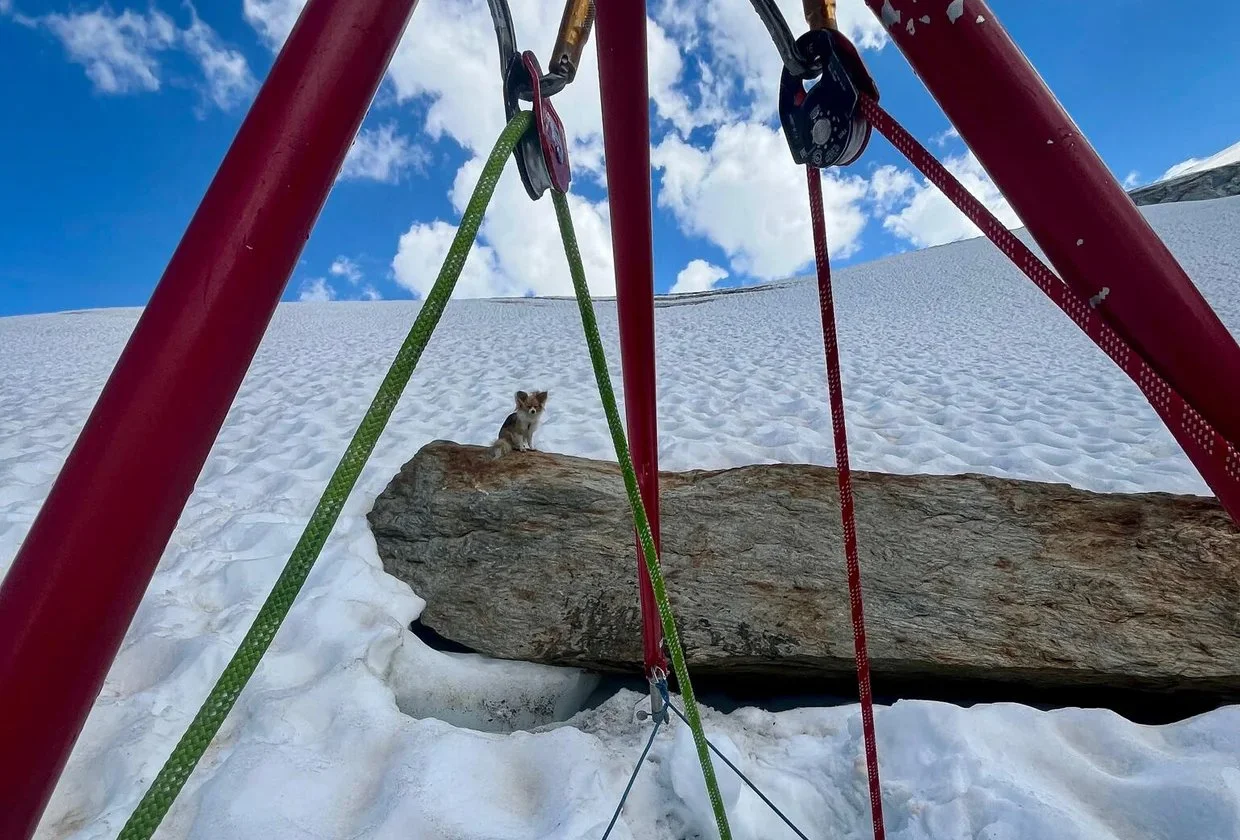
The Chihuahua marks a hole in the glacier where his human disappeared. photo: Air Zermatt
Who Needs St. Bernards?
Chihuahua Helps Rescue Owner on Icy Glacier
If you think hero dogs only come in big packages, think again. An unnamed hiker in southern Switzerland was saved recently after his intrepid companion - a tiny, long-haired Chihuahua - used his yappy super powers to alert rescuers to his owner's location down a deep hole on a massive glacier.
The man had been hiking with his small pup when he suddenly plunged into an icy 26-foot-deep crevasse, leaving the dog alone on the glacier's surface. The hiker used a walkie-talkie he'd been carrying to call for help, but when the Air Zermatt helicopter rescue team arrived, they were unable to pinpoint his location, noting that "the glacier surface was wide and the hole was barely visible."
"Then a decisive moment," according to Air Zermatt. "One of the rescue specialists spotted a small movement on a rock: the Chihuahua!" The little brown-and-white dog was perched right next to the hole where his human had fallen, a tiny visible marker in an otherwise frozen landscape.
"The little dog did not move during the entire operation and closely followed every movement of the rescue specialists," said Air Zermatt. "The dog is a four-legged hero who may have saved his master's life."
Okay, we do wonder who in their right mind would take a long-haired Chihuahua on a glacier hike (minus dog booties if the photos are accurate). But, in this case, it was clearly the right call. Hope this pair's next adventure is to a more dog- and human-friendly climate.
Source: cbsnews.com

Dogs’ noses can detect Parkinson’s before symptoms show. photo: Shutterstock
They Put the Nose in Diagnose:
Four-legged Researchers on the Case
Scientists continue to find new uses for dogs' amazing noses.
In a double-blind study at the University of Bristol, a Golden Retriever named Bumper and a Black Lab named Peanut correctly identified skin swabs from people with Parkinson's Disease with 98% specificity, even when other health conditions were present.
The findings offer hope for a simple diagnostic test that could identify biomarkers for the disease years before traditional symptoms appear, potentially allowing for earlier treatment and a slower progression of the disease. Currently, there is no early diagnostic test for Parkinson's and subtle symptoms may start up to 20 years before they become pronounced enough to lead to a confirmed diagnosis.
Says one researcher, "I believe that dogs could help us to develop a quick, non-invasive and cost-effective method to identify patients with Parkinson's disease." To which we say, "Give those four-legged researchers a cookie."
Source: sciencedaily.com

Blue reunites with her owner. photo: Pet Circle Waco/Instagram
Reunited!
Missing Dog Found After 8 Years
Back in 2017, a chunky two-year-old brindle mix named Blue went missing from her family's home on the Texas coast as Hurricane Harvey swept through the region. Efforts to find her in the storm's aftermath failed and her family assumed the worst.
But last month, the family received an unexpected call. Blue had been discovered in a public bathroom at a park in Waco, Texas, nearly 300 miles away. The person who found her brought her to a local shelter where she was scanned for a microchip. Miraculously, the contact info for the chip was still good, leading to a joyful reunion with her original family.
Where was Blue for the past eight years and how did she end up in a park's restroom? She's not telling. But if the photos are any indication, she's more than happy to be back where she belongs.
Source: people.com
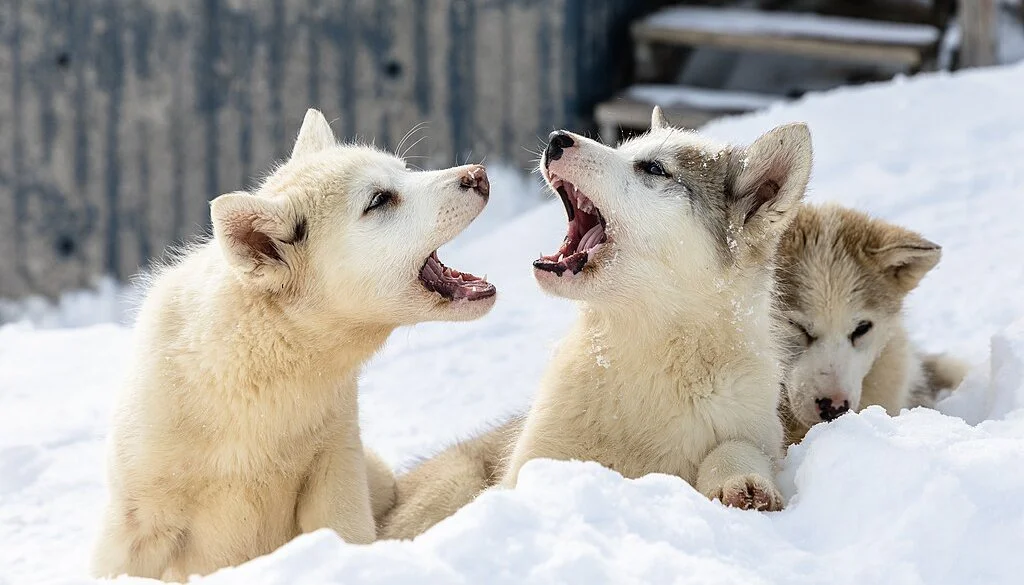
Greenlandic sled dogs, also known as Qimmit, play while resting. photo: Markus Trienke, Wikimedia Commons
Great White North:
Sled Dog DNA Holds Clues to Human Migration
New DNA analysis of Greenland's sled dogs, known as Qimmit, may have changed what we know about human migration in that region. A recent study of modern and ancient canine DNA suggests that these dogs, along with the ancestors of today's Inuit, arrived in Greenland centuries earlier than previously believed, perhaps before the arrival of the Vikings.
Like other Arctic people, the Inuit have kept dogs for hunting and sledding for almost 10,000 years. Because of this close relationship, researchers are able to track human migration based on the dogs' DNA.
Today, Qimmit are geographically separated into four distinct genetic populations across Greenland. However, these four groups shared a common ancestor 1,000 years ago, meaning the first Inuit people likely migrated to Greenland around that time, several centuries earlier than researchers had believed.
These findings underscore the importance of our relationships with our canine friends, not just for companionship and work but for scientific research. As one evolutionary biologist put it, "If we have any curiosity about ourselves, about us as humans, we have to understand dogs."
Source: smithsonianmag.com

PETA is suing to try to end breed standards they say cause suffering. image: AdobeStock
End "Deformed" Breeding:
PETA Sues American Kennel Club
People for the Ethical Treatment of Animals last month filed a state lawsuit in New York against the American Kennel Club. If successful, the group hopes their case will force an end to the AKC's breed standards for Bulldogs, French Bulldogs, Pugs, Dachshunds, and Chinese Shar-peis, which PETA claims "cause deformities, great suffering, and premature death."
As the suit notes, flat-faced breeds, including Bulldogs, French Bulldogs, and Pugs, experience chronic breathing problems due to their short snouts, while the long, low bodies of Dachsunds make them prone to painful back issues. The prominent eyes and shallow eye sockets of Pugs often give rise to serious ocular conditions, and the unique skin folds of Shar-Peis are highly prone to irritation and infection.
While the dangers of overbreeding are widely known, the AKC contends that it does not itself create the breed standards but instead works to ensure classifications are "clear, consistent, and continue to reflect the breed's health, function, and type." They further state that the AKC is "firmly committed to the health, well-being, and proper treatment of all dogs."
Stay tuned to see how this legal dog fight ends.
Source: nbcnews.com