The Solitary Confinement of the American Pet Dog
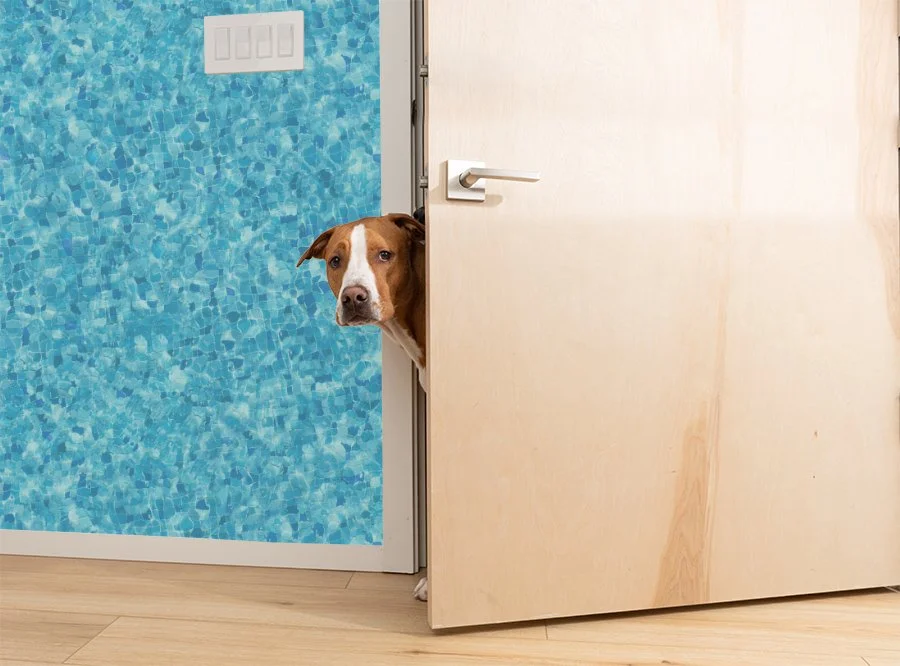
Their reaction at being excluded is not a disorder; it's attachment working exactly as it's supposed to. photo: AdobeStock
Most dog owners have felt that twist of guilt as they leave the house, their dog watching with an impossible-to-misread look. We've been told to brush it off ("They just sleep all day," "They don't have a concept of time," "They're fine"). But it's hard to ignore the fact that much of modern dog ownership requires animals built for companionship and social connection to spend large portions of their lives alone.
I have three dogs, and I feel that pang every time I walk out the front door without them. I'm a dog trainer and behavior consultant who gives my dogs the best life I can, and I still haven't made peace with it.
In fact, a law review article published last year, “Powerless Beings: Solitary Confinement of Humans and Nonhumans in America,” explored how solitary confinement causes nearly identical psychological and physical harm to both humans and nonhuman animals. The article noted that 122,000 people and millions of animals are currently alone in prisons, labs, zoos, and aquariums. Yet the authors never addressed the issue of pet dogs, millions of whom are crated or left by themselves in empty houses most days, staring out the window or waiting by the door for their human companions to return.
Why Your Dog Follows You to the Bathroom
New dog owners are often surprised or even alarmed when their dog panics behind a closed door. If the dog scratches, whines, or barks when shut in a room, their first instinct is often to treat it as a behavior problem (frequently by buying a crate) rather than recognizing it as a normal response when a social species is separated from its social group.
Dogs don't understand doors. They understand that the beings they're bonded to have disappeared, and they can't reach them. Their reaction at being excluded is not a disorder; it's attachment working exactly as it's supposed to.
Dogs who follow their owners everywhere or panic when left alone are often labeled "hyper-attached," as if the problem is the dog, not the conditions they're living in. But hyper-attachment doesn't develop in a vacuum. It develops in dogs who have no agency, no choices, and no social life beyond whoever is home. More exercise, getting another dog, or adding more enrichment won't cure separation anxiety, but the fact that so many dogs develop it should tell us something about how their lives are structured around being alone.
I had a client who called me because they wanted help getting their dog to sleep in another room. They had an entire extra bedroom set up for her with a twin bed, water bowl, chews, and a basket of plush toys. Every night they spent 30-60 minutes trying to get their dog to settle, but she just wasn't having it. They tried letting her in their bedroom, but she'd sneak onto the bed in the middle of the night, which they didn't want.
With a little convincing, they agreed to try an exercise pen (x-pen for short) next to their bed. The dog could see, hear, and smell them, but she had her own contained space. It solved the problem practically overnight, and the 60-minute bedtime battles disappeared. This dog just needed to be near her people.
A Cage by Any Other Name
Every pet dog should know how to be comfortable in a crate, because it's a legitimate life skill. Dogs may have to use a crate at the vet, during travel, or after surgeries. A dog who has never seen the inside of a crate and then has to spend the night at an emergency vet clinic will have a far worse experience than one who’s been gradually introduced to it and has positive associations with containment. As a dog trainer, I teach crate comfort to most dogs I work with.
The problem isn't using a crate in specific situations where it’s needed; it’s crating as a way of life. Locking a dog in a cage for large portions of the day as a management strategy is cruel, plain and simple, despite the language we use to normalize it.
The law review article mentioned above highlights how prisons rebranded solitary confinement as "restrictive housing" and "special management units." The words changed; the prisoner's experience inside didn't. We've done the same with dogs. A cage became a crate. And even when we use positive reinforcement methods to teach a dog to tolerate confinement, the end result is still a locked cage.
Often, the crate is all wrapped in a nice little den story: your dog wants to be there, it's their natural instinct, it's like a cozy cave. But dogs are not true den animals. Wild canids typically use dens briefly, primarily for whelping puppies. Even so-called "solitary" species like tigers, bears, and leopards aren't truly isolated. They maintain social contact through scent, vocalizations, and shared territory. They can come and go as they please.
A crate with the door propped open, in which a dog chooses to rest, is completely fine. Some dogs love tucking themselves into enclosed spaces the same way they'd crawl under a table or burrow under couch pillows. The difference is choice. A locked crate in an empty house is not a den - it's a cage. The fact that we had to come up with a softer word for it is the first clue that we know this, too.
Questioning the use and overuse of crates is not a radical position. In Finland, it's illegal to keep a dog crated overnight or while you're at work; there, dogs may be crated only for "transportation, illness, or other temporary and acceptable reason." In Sweden, it is illegal to leave your dog alone for more than six hours. Across much of Europe and Australia, prolonged crating simply isn't part of the culture. These aren't countries overrun with destructive, poorly behaved dogs. They've just decided that caging a social animal to manage human convenience is unacceptable.
Solitary confinement persists because the beings subjected to it are powerless. Prisoners can't vote, and lab animals can't object. Zoo animals' isolation is hidden in plain sight.
Our dogs are captive and powerless, too. They can't open the crate or unlock the front door. They can't tell us what those hours alone feel like. Their only voice is their behavior, and when they use it (barking, howling, destroying things, peeing in the house), we call it a problem and put them in a smaller box.
Your Dog Sleeps Better Next to You - and Science Proves It
Like humans, dogs don't sleep in one fixed position all night. They shift, stretch, curl up, move to cooler spots, or seek warmth. Individual dogs have individual sleeping preferences: some like to burrow under blankets, others prefer a cool floor, some want to sprawl, and some like a slightly elevated surface. A crate, even when appropriately sized, limits those options.
An x-pen next to your bed gives your dog space to move, stretch, and access water while staying close to you. For young puppies adjusting to a new environment and separation from their litter, sleep needs to feel safe, comfortable, and connected.
A 2025 polysomnography study from Hungary used brain-wave monitoring to measure how family dogs slept in the presence of their guardians versus near a friendly stranger. When sleeping without their owner, dogs took longer to fall asleep, woke up more during the night, and spent less time in deep sleep. The owner's presence measurably changed their dog's sleep quality at a neurological level.
Similarly, the law review piece shows the same pattern across all species: isolation disrupts sleep, elevates stress hormones, and impairs immune function. We know this happens to prisoners and lab animals. Now we have brain wave data showing it also happens to pet dogs sleeping without their person.
I've fostered hundreds of dogs over the years, many of them puppies, and most not yet housetrained. I used to crate every new foster at night, because that's what I was told you're supposed to do. At some point, I stopped, the same way many new parents who were determined their baby would sleep in a crib in another room eventually "gave in" and brought the baby to bed. And like those parents, I realized I wasn't giving in. I was simply responding to what the puppies needed.
Here's what I noticed: puppies who slept in my bed slept through the night and didn't have accidents, even if they weren't housetrained. The same puppies, when crated, would usually wake me up because they had to pee in the middle of the night. Conventional wisdom holds that crating teaches bladder control because dogs won't soil where they sleep. What I saw, over and over, is that proximity settles a puppy so they sleep through the night.
The pressure to crate is everywhere, coming from breeders, vets, and the internet. I work with families with new puppies, and they sometimes sheepishly admit their puppy sleeps in bed with them, as if they're embarrassed. They're relieved when I tell them it's not a problem. "Oh, thank God, I thought you were going to insist my puppy has to sleep in a crate."
Not surprisingly, this all sounds a lot like the debate around infant sleep. New parents face similar cultural pressure: babies should sleep in a crib in a separate nursery and learn to "self-soothe.” Cry-it-out is still standard advice in many circles. Yet a 2012 study found that babies who stopped crying during sleep training still showed elevated cortisol (stress hormone) levels. They hadn't learned to self-soothe; they'd learned that signaling for help didn't work.
I chose to co-sleep with my own children when they were babies, and they transitioned to their own beds just fine when they were ready. A co-sleeper (a small bassinet that attaches to the side of your bed so the baby is right there but in their own space) is the infant equivalent of an X Pen next to your bed. It gives you proximity without full bed-sharing, and it works for babies just as well as an x-pen does for puppies.
Isolation Doesn't Require a Crate
When my kids were young, we had pet rats (they make great pets!). Anyone who has kept rats knows you should never have just one, because a single rat without a companion will suffer. The science on social deprivation in rats is so clear that reputable rat breeders and rescues won't even adopt a single rat to someone who doesn't already have another. This is well-established, and nobody even debates it.
While humans have come to a consensus on this issue for a two-pound rodent, if you search for similar guidance about dogs (How long can a dog be left alone? Should I get a second dog?), you'll find lots of opinions, wildly different answers, and no scientific consensus on how much alone time is too much for dogs.
A 1992 study on beagles compared dogs across various housing conditions, ranging from large outdoor pens to small cages, and alone or housed with another dog. Pair-housed dogs barked less, slept more, and exhibited less stereotypic behavior (repetitive, purposeless movements like pacing or circling). The researchers' conclusion should give every crate advocate pause: "In assessing the psychosocial well-being of dogs, social isolation may be as harmful or more harmful than spatial restriction." In plain language, the size of the space mattered less than whether the dog was alone.
Three decades later, the Dog Aging Project analyzed surveys covering more than 21,000 pet dogs to see what shapes canine health. Their researchers found that companionship, from both humans and other animals, predicted a dog's health more strongly than any other factor. Dogs with more social connections were healthier as they aged.
Solitary confinement is such reliable psychological torture that prisons use it as punishment within punishment. And it doesn't necessarily take a cell to do harm. In fact, ordinary everyday loneliness carries a mortality risk comparable to smoking and obesity. In 2025, the World Health Organization declared social connection a global public health priority, linking loneliness to more than 871,000 deaths a year.
A bigger crate doesn't solve the problem, and neither does a bigger house. A dog alone in a mansion is still alone, with a closed and locked front door.
Remember how you felt during the COVID-19 lockdown, stuck in your house with nowhere to go and no idea when it would end? A lot of us felt restless, depressed, and stuck. Many of us had other people in the house, plus phones, the internet, and Netflix. How many pet dogs live that lockdown every single workday, alone, with none of those things? Many of us had whole houses and still climbed the walls after a few weeks because space wasn't as big a problem as isolation.
Having a second dog doesn't always fix the isolation problem either, especially if both dogs are crated separately (that's just two dogs in solitary confinement) or stuck inside all day. If you have a dog and you're gone all day, your dog's social needs don't disappear just because you can't meet them. A midday dog walker, doggy daycare, or a neighbor who can pop in aren't luxuries. They're the minimum for a social species who wouldn't choose to live alone.
Most people would agree that chaining a dog alone in a backyard all day is cruel. So I'll ask the uncomfortable question: why do we think a crate or an empty house is fundamentally different?
The Problem I Get Paid to Fix
I'm a Certified Separation Anxiety Trainer (CSAT). I help dogs learn to tolerate being alone using a gradual desensitization protocol. Separation anxiety is a true panic disorder, devastating for dogs and their families, and it is treatable. It's careful, compassionate work, and I take it seriously.
An estimated 14 to 20 percent of pet dogs have separation anxiety or isolation distress. That's as many as one in five dogs - yet such a common problem says more about the environment we’ve created for our pets than the actual patient. Many dogs are left alone for most of the day, and then we call it a disorder when they can't cope.
I use behavior modification to help dogs learn to be alone, and I'm good at it. But if we have to spend weeks or months systematically teaching a social animal to tolerate isolation, that's a clue that something is off. Leash training teaches a dog to navigate the world alongside you. Recall training keeps a dog safe. Those are all skills for a shared life. Separation anxiety training teaches a dog to endure deprivation and to build tolerance for something that goes against their nature as a social species.
An ER doctor can treat gunshot wounds every night and still say we have a gun problem. A therapist can help someone cope with burnout and still say the workplace is broken. I help dogs tolerate isolation, and I know that the isolation is the problem. Dogs and their humans are suffering now, and societal change doesn't help them so I do the work. But I'd be happy if my services were no longer needed.
As We Learn More, We Do Better
We used to chain dogs in yards and call it responsible ownership, a practice now prohibited in many U.S. cities and towns. We used to alpha roll dogs (pin them on their backs to assert dominance) because a debunked theory told us we needed to be the "alpha." We used to put choke chains and prong collars on puppies. We used to think dogs couldn't feel pain the way we do. We know better now, and many of us have changed accordingly.
I used to crate every foster dog at night without questioning it. When I was a new trainer, I hesitated to go against conventional wisdom. But that was before 25 years of boarding dogs, 16 years as a trainer and behavior consultant, and many years of fostering hundreds of dogs.
Some of those foster pups were litters with their mothers, and I watched puppies sleep in a pile and cry when separated from their siblings. That's the instinct we're working against every time we put a puppy alone in a crate in a dark room. I've come to believe that how we isolate our dogs is the next frontier in animal welfare.
Pushback against the crate-craze is building in the dog training world. Force-free trainers are increasingly questioning the reflexive recommendation to crate. More families are choosing x-pens and baby gates over locked crates. More people are letting their dogs sleep near or with them and discovering that everyone sleeps better for it.
In 2025, those two law professors wrote a 50-page paper about how isolation harms every social species subjected to it. They connected prison cells to zoo enclosures to laboratory cages. They just didn't look closely enough to see the cages in our own homes.
Much of modern society is incompatible with the social needs of our oldest animal companions. We've made dog ownership about what we want without asking what our dogs need in return. Then we pathologize the ones who can't cope.
Dogs are social animals who crave companionship just as we do. What they need, more than anything, is to not spend most of their lives waiting for us to come home.