Thank Your Dog for Growling (Yes, Really): Plus Why You Should Never Punish a Growl
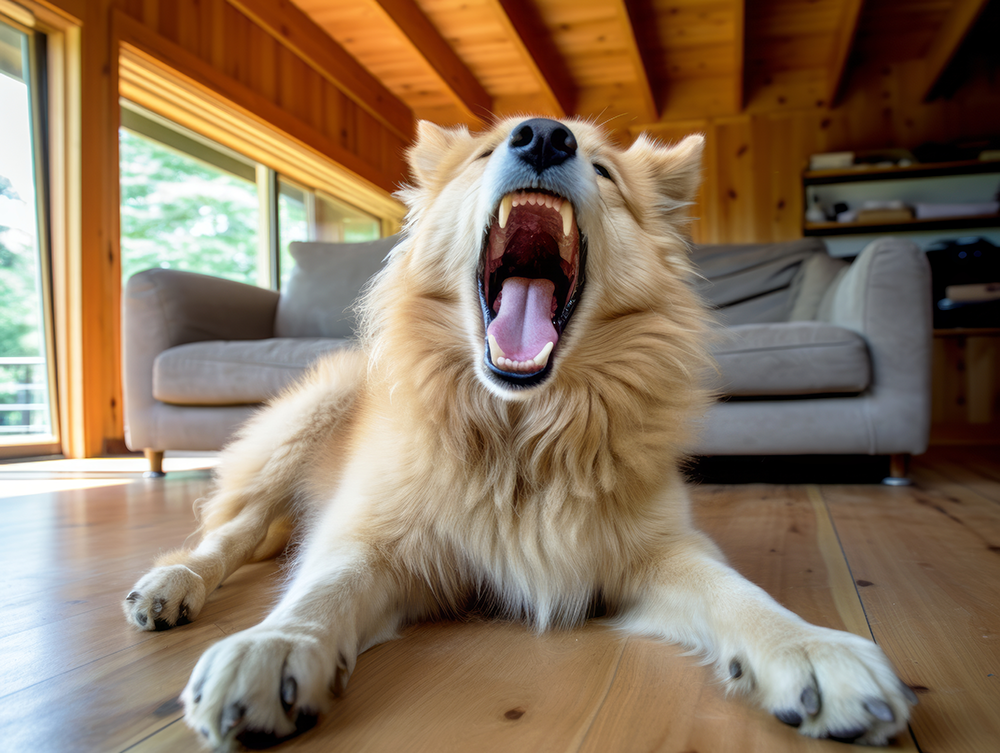
A growl is communication and an attempt to avoid conflict. photo: Vecteezy
When an animal growls, it’s unsettling and scary. Our brains immediately jump to: that dog is about to bite and I need to shut this down. But a growl is not an attack, or even the opening act of one. A growl is communication and, in most cases, it’s a dog’s attempt to avoid conflict rather than escalate it.
Of course, you’re right to be concerned because if a growl is ignored, it can escalate to a nip or a bite. That’s exactly why we need to listen to it, not silence it. Growling is your dog’s way of telling you there’s a problem while there’s still time for you to do something about it.
Unfortunately, most people hear a dog growl and focus all their energy on eliminating the growl itself rather than understanding what caused it. The growl is not the problem: it’s your dog’s report about the problem.
The Conversation Before the Growl
In behavioral science, there’s a concept called the “ladder of aggression,” a term I’ve never liked. It makes it sound like dogs are perpetually headed toward violence, when in reality, they’re doing the opposite. Each signal - or rung on the ladder - is a little louder than the one before, and all of them are attempts to be heard before things escalate. A better name for this might be the "ladder of please listen to me.”
This ladder of communication starts at the bottom with the subtle signs: a head turn, a lip lick, a yawn, a freeze. If those signals are missed (and they usually are), the dog has no choice but to get louder. A hard stare. A growl. A snarl. An air snap. And eventually, a bite.
Imagine this scenario: you’re in an elevator and a stranger is standing way too close. You shift away slightly, hoping they’ll take the hint, but they don’t. You take a full step back, and they inch closer. You clear your throat, give them a look, and say “Excuse me,” but they don’t get the hint. So you jostle them with your elbow because you’ve exhausted every polite option and you need them to stop invading your personal space. None of that is aggression. But if this creepy guy keeps closing in on you and you eventually shove him, would anyone blame you?
That’s the ladder in action. You didn’t want a confrontation; you just wanted some space. True aggression would be walking into the elevator and punching the guy in the face before he did anything intrusive, which most people wouldn’t do. Most dogs don’t do that either.
Behaviorists call this “ritualized aggression,” a fancy way of describing the noise and posturing animals use to avoid an actual fight. From an evolutionary standpoint, this makes perfect sense. In the wild, there are no veterinarians and no antibiotics. A real physical altercation, even a brief one, risks puncture wounds, infections, broken bones, and possibly death. Actual aggression (biting, fighting) is a last resort, not a first impulse.
Animals who developed elaborate warning systems (growling, snarling, raised hackles, air snaps) to resolve conflict without bodily contact have a massive survival advantage over animals who skip straight to biting. In other words, growling isn’t a design flaw; it’s one of evolution’s best safety features. As Jean Donaldson writes in The Culture Clash, aggression is so expensive and yet so necessary that all kinds of rituals have evolved to avoid it.
Consider this: when a dog air snaps but doesn’t make contact, that’s not because they missed. Dogs have sharp teeth and fast reflexes. They could have bitten, but they chose not to. An air snap, like a growl, is a warning delivered with remarkable restraint.
Most People Are Worse at Reading Dogs Than They Think
If you’re thinking, “Well, I know my own dog pretty well,” think again. The research suggests otherwise. A 2025 study found that people tend to judge a dog’s emotions based on the situation around the dog rather than the dog’s actual behavior. Another study found that 89% of dog owners believed they could identify fear in their dogs, but only 16% actually could (Guo et al., Applied Animal Behaviour Science 2024).
This matters enormously when it comes to growling because the moments leading up to a growl are packed with exactly the kind of subtle body language it turns out most people are terrible at reading.
The Bite You Didn’t See Coming (But Your Dog Warned You About)
Let me give you some common scenarios where bites seem to come out of nowhere but actually had a long preamble of ignored signals.
Photos and videos of kids hugging dogs are usually framed as adorable. A child has their arms wrapped around a dog’s neck, face pressed into fur, and everyone is smiling except the dog. Look closer: whale eyes with the whites of the eyes showing, ears pinned back, body stiff, mouth closed tight. That dog has been sending distress signals the entire time. When they finally growl - or, god forbid, snap or make contact - the adults are shocked. But the dog gave every warning short of a written letter.
Belly rubs are also often misread. Your dog rolls over, and you think, “Aww, belly rub time!” But an exposed belly isn’t always an invitation. Often, it’s an appeasement gesture, basically a dog’s way of saying, “I’m not a threat, please don’t hurt me.” Then we start rubbing their belly, and when they growl, we’re baffled. In fact, we just didn’t speak their language well enough to understand what they were saying. (Eileen Anderson has an excellent video worth watching on this topic: Does Your Dog REALLY Want to Be Petted?).
Here’s another example. A dog is happily working on a tasty chew and someone reaches in and takes it because they believe dogs should be fine with being messed with when they’re eating. The dog growls. This is resource guarding, and it’s a completely normal canine behavior, not a sign of dominance or disrespect. The dog is simply communicating: this is important to me, and I’d like you to back off. There are excellent, force-free protocols for addressing resource guarding, but none of them start with “ignore the growl” or “punish the growl.”
Then there’s the dog with nowhere to go, wedged against the armrest of the couch when someone leans over to pet them. The dog can’t move away (their preferred first option) so they jump to the next available tool in their communication toolkit: a growl.
Your Dog Doesn’t Owe You Compliance
What all these scenarios have in common is a belief that dogs shouldn’t growl at all - and that tolerance of whatever a human chooses to dish out is the baseline expectation for pet dogs.
There was a time, not that long ago, when everyone understood that if a dog was eating and growling, you left them alone. It wasn’t controversial. It was common sense. You wouldn’t stick your hand in a stranger’s plate at a restaurant, and you shouldn’t bother a dog with a bone.
Unfortunately, there’s now an expectation that we should be able to take food out of our dog’s mouth, wake them from a dead sleep by grabbing their face, stick our hands in their bowl while they’re eating, and have them be perfectly fine with all of it. We expect a level of tolerance from our dogs that we wouldn’t accept from our own kids, our partners, or even our coworkers (try taking a sandwich out of your coworker’s hand mid-bite and see how that goes for you).
These expectations stem from an outdated belief that dogs must defer to us at all times and that any resistance is a challenge to our God-given human authority. But dogs are not robots pre-programmed to obey. They are a completely different species sharing our living space, one that doesn’t speak our language. The fact that they communicate discomfort at all, rather than just skipping straight to a bite, is something we should be grateful for, not something to punish.
When we expect dogs to tolerate anything and everything without complaint, we set them up to fail. And when they inevitably do push back - because they are living creatures with preferences and boundaries, not stuffed animals - we blame them for it. The growl becomes evidence that the dog is “bad” or "aggressive," rather than evidence that we asked too much.
Read the Whole Dog, Not Just the Growl
While we’re busting myths, let’s talk about the wagging tail. A lot of people assume a wagging tail equals a happy dog. It doesn’t. A wagging tail means a dog is willing to interact, but the nature of that interaction could be anything. A dog about to bite is often wagging their tail.
What matters is the rest of the body. Is the wag loose and wiggly, with a relaxed body and soft face? Probably a happy dog. Is the wag stiff and high, with a rigid body and hard eyes? That’s a dog who is aroused and potentially on edge. Context and the full picture of body language are everything. A growl, like a wagging tail, means very little in isolation. You have to read the whole dog.
Play growling is not the same as a warning growl. Many dogs are vocal players, especially breeds like Huskies, Rottweilers, and Terriers. During play, you’ll see loose, bouncy body language, exaggerated movements, and play bows. The growling might sound ferocious, but the rest of the body is telling you this is a game. If you only heard the audio, you’d call animal control, but if you watched the video, you’d smile.
What Happens When You Punish a Growl
Let’s be specific about what “punishing a growl” looks like because it’s not always obvious. Sometimes it’s a verbal correction the moment a dog growls: a sharp “No!” or “Eh, eh!” or a leash pop. But in more extreme and disturbingly common cases, it involves tools designed to cause pain or discomfort: a sharp jerk on a prong collar, a shock from an e-collar, or an alpha roll where the dog is physically forced onto their back.
There are trainers out there - some of them with enormous social media followings - who will tell you that no dog should ever growl, period. They assert that a growl signifies defiance, disrespect, or a “dominance challenge,” and claim that the right response is an immediate correction. This advice is not just wrong, but dangerous.
Part of why that approach is popular is that it appears to work quickly, at least on the surface. It is remarkably easy to suppress a growl using aversive tools or punishment. A well-timed shock or a sharp leash correction can stop a growl instantly and that quick result feels like proof that the method worked. But speed and ease of suppression is not the same as resolution. This is like removing the batteries from a smoke detector because the beeping is annoying. The alarm stops shrieking, but the fire is still burning.
When we scold, physically correct, or shock a dog for growling, we might succeed in stopping the growling, and the problem appears to be solved. But we haven’t changed how the dog feels. We’ve just taken away their ability to tell us about it.
Worse still, when we use pain or intimidation to suppress a growl, the dog doesn’t just learn to stop growling. They often learn to associate the trigger itself (the child hugging too tightly, the other dog that’s making them nervous, the stranger reaching toward them) with the punishment. A dog who was already nervous around kids and gets punished for growling at one doesn’t become more comfortable around kids. They become more afraid and now they have no way to warn anyone. The dog learns that communicating discomfort leads to bad things, so they skip the warning entirely. The next time they’re pushed past their threshold, there’s no growl, no air snap, no escalating ladder of “please stop.” There’s just a bite, and everyone says it came out of nowhere.
A dog that has been taught not to growl is not a safer dog. They are a more dangerous one.
So What Should You Do When Your Dog Growls?
If your dog is growling, first step back and give them space. If they’re growling at another dog, calmly move away.
Then take stock. What was happening right before the growl? Was the dog guarding something (food, a chew, a spot on the couch, a person)? Were they startled by something unfamiliar? Were they being touched in a way they didn’t like or cornered without an exit?
Here’s the part that might feel counterintuitive. Say thank you to your dog - and not sarcastically. Thank your dog for telling you they were uncomfortable because now you can begin to create a plan to help them feel better in situations like this, so they don’t need to growl.
The goal is never to just eliminate the growl. It’s to change the underlying emotional state that made the growl necessary, whether that means working on resource guarding, building confidence in a fearful dog, or learning to read your dog’s earlier, quieter signals before they have to escalate.
When your dog growls, you have three options:
You can ignore it, make no changes, and hope for the best. This is how small problems become big ones.
You can try to eliminate it by whatever means necessary, scolding, correcting, or shocking your dog until they stop growling. This is how you create a dog that bites without warning.
Or you can take it seriously by trying to understand what caused it. Figure out what made your dog uncomfortable, and make a plan to address the root cause so they no longer feel the need to growl. If you’re not sure where to start, a qualified, force-free behavior consultant can help. This is the only option that actually makes everyone safer.
In short, a growl is your dog asking for help in the only language they have. It’s our job to listen to them.