Why Your Dog Listens to Your Trainer, Not You (And How to Get the Same Results)
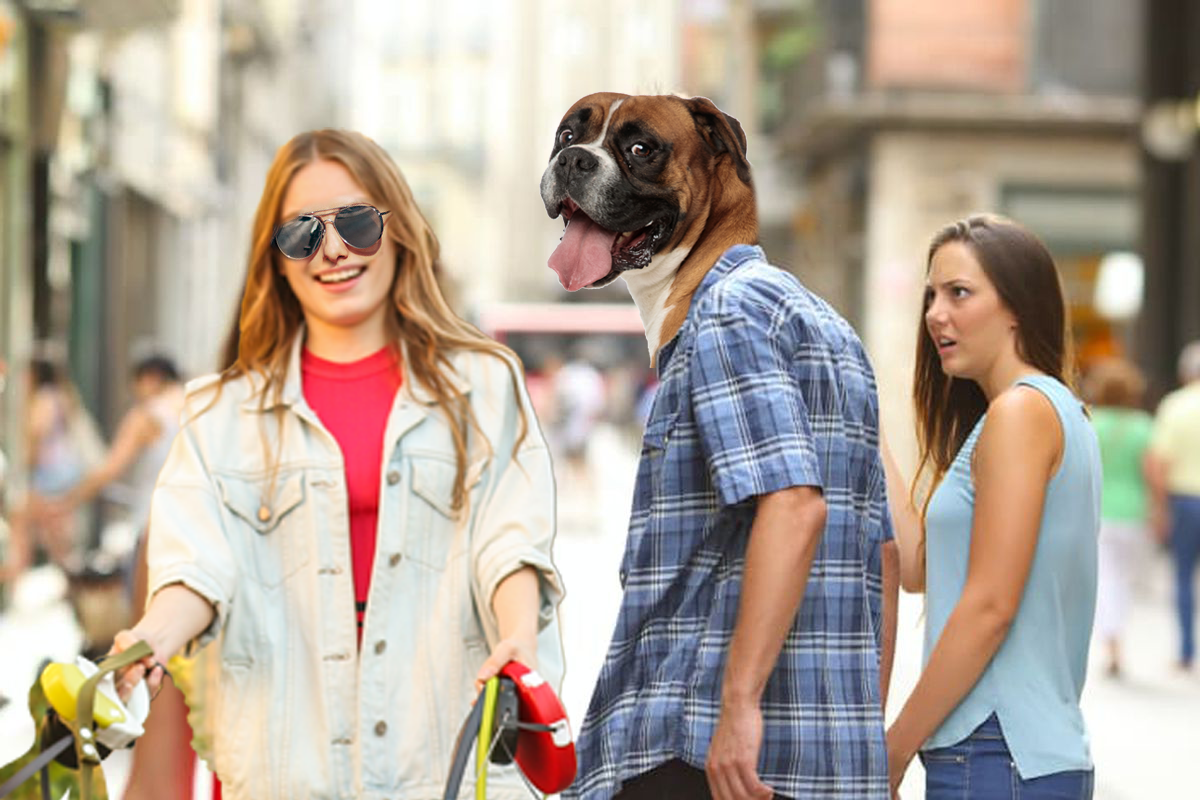
Are you competing for your dog’s attention? A good training relationship starts by building trust. image: popular meme (edited)
As a professional dog trainer, I hear it all the time: "Why does my dog listen to you, but the minute I take the leash, it all falls apart?"
From the outside, it may look like trainers have some special secret or that dogs just magically respect us more. But the truth is much simpler. Dog training is a skill set, and like any skill, it can be learned.
Trust and Relationship
Good training is about your relationship with the dog. It’s definitely not "listen to me or else." That’s why trust is such a huge component of successful training. It often takes me several sessions for a new dog to trust me. I can't overstate how closely trust is linked to a willingness to learn.
Back when I taught 4th grade, the first week of school wasn't about math or reading; it was about building trust and respect between me and a class full of small humans. Dogs are no different. If a dog has already experienced humans using leash pops, yelling, or making them wear prong collars or e-collars, the process of building trust can take even longer.
Speaking Dog Starts With Body Language
Understanding your dog's body language is one of the most essential parts of training. A good trainer notices subtle shifts such as a lip lick, head turn, or change in posture and adjusts in real time. That's why handling looks so smooth when it's the trainer on the other end of the leash.
But body language isn't just for professionals. Every dog guardian should know how to read it. When you can recognize stress, excitement, or frustration building, you can step in before things escalate. By observing body language closely, trainers know when to push a dog a little further and when to back off and give the dog a break.
Think of it like driving. You don't wait for a crash to learn how to read the road. You watch the signs, the traffic lights, the brake lights ahead, and adjust as you go. Reading your dog works the same way.
Handling Skills Take Practice
Animal training isn't instinctive. It's a learned skill, like playing guitar or hitting a baseball. Dogs often learn quickly, but unless their owners also master timing, mechanics, and consistency, training won't stick. That's why so much of dog training is really about teaching people.
Good dog handling takes practice. Walking, handling the leash, and delivering treats are already coordination challenges. Add in reading body language, ensuring good timing, and giving clear cues, and it's no wonder this takes repetition to get it right.
A trainer's job isn't just teaching the dog. It's coaching you on how to read your dog's body language, deliver rewards at the right moment, set up the training environment, and avoid reinforcing unwanted responses.
That’s why recording your training sessions is one of the fastest ways to improve. Compare your sessions to skilled trainers' videos, and you'll spot timing issues, unclear cues, or confusing body language.
How’s Your Rate of Reinforcement?
The rate of reinforcement means how often and how quickly you reward your dog during training. Most owners don't reward often or quickly enough, while professional trainers deliver a steady stream of well-timed rewards to keep dogs engaged, ensuring they can earn them easily and predictably.
When rewards are delayed or too difficult to earn, dogs become frustrated or bored. But when delivered quickly and reliably, dogs learn faster and stay motivated. Think of it like your paycheck: if it stopped coming on time, you'd probably quit, too.
That’s why it’s important to always have your training treats ready, start in low-distraction environments, give clear cues, and then deliver your dog’s reward immediately.
Understanding Food Motivation
Many clients insist their dog isn’t motivated by food. But if your dog eats food, they are definitely food-motivated. If a dog isn’t motivated by treat rewards during training, it’s usually due to free-feeding at home, training immediately after a meal, or using boring rewards.
I'm often called the treat lady, but I don't rely on Charlee Bears (the dull saltines of dog treats) or kibble, especially when teaching a new skill. I use real food, such as yummy boiled chicken or lean hamburger. I also keep a mix of options on me so the dog never knows what's coming next. That novelty keeps the dog’s motivation high.
Clients sometimes say, "Well, my dog listens to you because you're the treat lady." My answer: You need to become the treat lady.
And food isn't the only motivator. Trainers also use play, toys, praise, and real-world rewards, such as the opportunity to sniff, run, or greet another dog.
Which brings me to another critical point. Dogs won't take treats when they're overstimulated or scared. That doesn't mean they don't like food or aren’t interested. It means they're over their heads with outside stimuli. That’s why training should always begin in an environment where your dog feels safe and is calm enough to learn.
Words Don't Drive Behavior — Reinforcement Does
Words mean nothing to dogs on their own. You could teach recall on a whistle, a clap, or a phrase in another language. What matters is the reinforcement history behind the word. If a cue has been repeated hundreds of times with no reward or follow-through, it becomes background noise.
Human children can learn the meaning of words through repetition alone. If you point to a ball and say "ball" enough times, a toddler will start to connect the sound with the object. Dogs don't learn that way. Repeating "sit, sit, sit" doesn't make the word meaningful. Dogs only attach meaning to a cue when it is consistently followed by a reward.
Keep it simple: give a cue, wait for the behavior, then reward. If your dog doesn't respond, they aren't being stubborn. You've simply asked for something you haven't fully trained them to do yet.
Remember that you can't teach a dog not to do something. Saying "Don't jump" when guests come over gives them nothing to work with. Instead, teach them what earns rewards: sitting when people arrive gets them the attention they want. Similarly, for leash-pulling, yelling "Don't pull" is ineffective; but rewarding your dog for walking beside you is. When you make the correct behavior clear, easy, and rewarding, the unwanted behavior loses its payoff.
Breaking It Down Without Mistakes
Good training comes from getting granular; that means breaking behaviors into tiny steps. Asking for too much too soon is usually where things go sideways.
For example, when teaching recall, a trainer starts with the dog just a foot away and gradually builds distance in distraction-free environments before asking for the behavior in more challenging settings. Owners, on the other hand, will call from across the park while their dog is nose-deep in a fascinating smell and then wonder why nothing happens.
Good training aims for errorless learning. Dogs get good at whatever they practice - right or wrong. Just like a musician who practices the wrong notes, your dog’s mistakes become harder to undo the more they're repeated.
Trainers set up sessions so the dog succeeds repeatedly, keeping the challenges small and achievable, then gradually increasing the difficulty. This means managing three things: what's going on around you (distraction), how far away you are (distance), and how long the dog has to do the behavior (duration). And never increasing all three at once.
When teaching new behaviors, starting small is crucial. Trying to teach "Leave it" with delicious chicken bones on the sidewalk or "Drop it" with a savory bully stick already in the mouth sets a dog up to fail. Begin with easy setups and then gradually increase the difficulty. Success builds momentum, and repetition is what makes the behavior stick.
Why Repetition Is So Important
Repetition builds reliability. Just like people, dogs don't perform well under pressure unless they've practiced the behavior many times in low-key situations first. That’s how an airline pilot is able to default to trained responses if something goes wrong 30,000 feet up.
Think of your dog’s training as a savings account. Every time you reward a behavior in an easy, low-pressure situation, you're making a deposit. Later, when you need your dog to perform under stress - like moving away from another dog or holding a stay while guests arrive - you're making a withdrawal. That withdrawal only works if you've built up enough deposits first.
Mistakes also become muscle memory. If a dog keeps breaking a down-stay because you asked for too much too soon, that habit sticks. Trainers prevent this by stacking up correct repetitions until the right behavior becomes automatic.
The Value of Play
Trainers keep sessions short and light, often just a few minutes with plenty of breaks. Owners sometimes think they need to set aside an hour a day to drill until both the dog and the human are frustrated. It is more effective to sprinkle training in small chunks throughout the day.
Training shouldn't feel like a chore. It should feel like a game. If you're frustrated or impatient, your dog feels it. You can't sync up with another being when you're upset or angry. Both you and your dog should be having fun.
We know from research on kids that play makes learning stick better. Play reduces pressure and keeps motivation high. The more fun the training feels, the more your dog will learn.
Managing Expectations
It’s true that some dogs are just more challenging than others. Genetics, past experiences, and prior training all play a role. Breed tendencies matter. My German Shepherd learns new skills with a few repetitions, while my Chihuahua requires much more practice to get there. Stanley Coren's research on canine intelligence shows that some breeds learn cues more quickly than others. Neither is “better,” they're just different. But all dogs are capable of learning, regardless of age or breed.
Often by the time people call me, they want a quick fix, but there isn't one. Their dog may have spent months or years practicing unwanted behaviors, and now we're playing catch-up. Training takes time, patience, and practice.
Management is just as important as training. Baby gates, leashes, white noise, and calmer routines prevent dogs from rehearsing unwanted behaviors. Doggie boot camps might look impressive on video, but unless you learn the skills yourself and apply good management at home, the progress won't last.
A Few Guiding Principles
Good trainers generally rely on some basic guiding principles. Keep these in mind, and you'll avoid most of the common mistakes.
The animal is never wrong. Dogs do what works for them in the moment. If an unwanted behavior continues, it's being reinforced in some way. Our job isn't to blame the dog but to identify what's reinforcing the behavior and change the environment so the right choice pays off.
Break it down. If your dog isn't getting it, the step is too big. Make it easier and build on success. Start easy and then add more challenges. Once your dog is fluent with a behavior in a quiet room, only then add distractions, distance, or duration - and never all at once.
Repetition builds reliability. Dogs need many correct repetitions before they can perform under pressure. Keep practicing in low-stress situations even after your dog has learned a behavior.
Finally, remember that no one works for free. Praise and pats are nice, but food and play are what keep dogs coming back to work. People often assume there's something magical or innate about being a good dog trainer. There isn't.
I'm not a dog whisperer (hate that term), and I'm definitely not "alpha" or "dominant” or any of the other baseless phrases that have somehow crept into the popular vernacular. What matters for successful dog training is timing, mechanics, reinforcement, body language, and trust. Handler confidence, which comes with practice, also plays a role because dogs read our posture and tone. Clarity and calm go a long way toward effective training.
A good trainer has studied, practiced with hundreds of dogs, and honed these skills. If you want your dog to respond to you the same way they do to your trainer, the formula isn't magic. It's practice, timing, and trust - skills every dog guardian can learn.
So get started building trust with your pup today. And remember, you’ve got this!