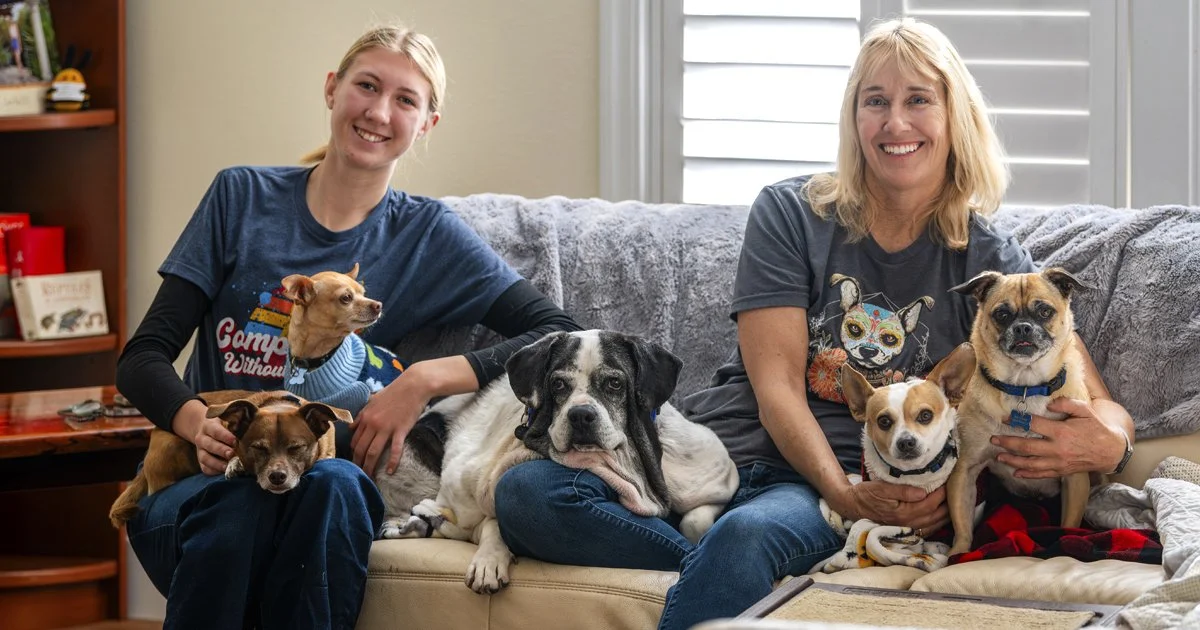
Nicholas (center) would likely agree that shelter families like the one where he lucked out are a real lifeline for dogs recovering from medical issues. photo: CWOB, Victoria Vonthal
A safe home, a nourishing meal, and clean water to drink. These are just a few of the things we - and our dogs - need to survive. As we enter this season of thanks, I’m reminded how grateful I am for these basics that can so easily be taken for granted.
But there’s another essential need, especially in the world of animal shelters. That’s love - and it can save lives.
Anyone who has ever watched a stressed or frightened dog begin to relax in a safe home knows that care is about more than just creature comfort. While it may not be as obvious a need as food, water, or critical care, love is a life-saving resource, one whose impact can be clearly seen in animal foster programs. It’s an idea that guides much of the work we do at Compassion Without Borders (CWOB).
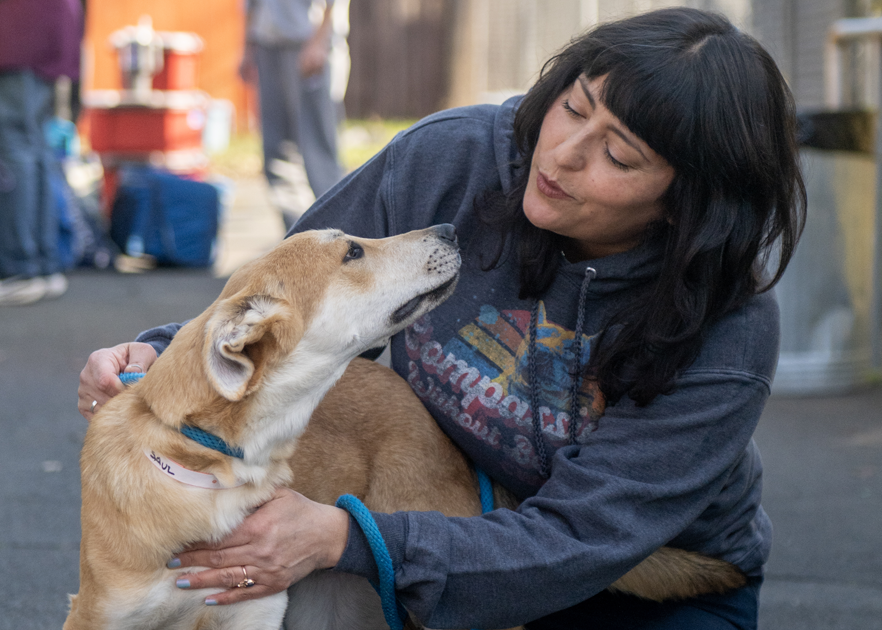
Foster manager Cristina Bellefeuille with a new intake friend. photo: CWOB, Victoria Vonthal
“Fosters are such an important part of helping dogs heal, both physically and emotionally,” says CWOB foster manager Cristina Bellefeuille. “For a lot of our dogs, the shelter is just the first step in their journey. Some come to us with medical issues that require ongoing care, recovery from surgery, or just a quiet place to rest and get healthy.”
Take Nicholas, for example, a senior Beagle mix who was found living on the streets, starving, emotionally shut down, and covered in melon-sized tumors all over his body. Once the tumors were removed, he was diagnosed with Ehlers-Danlos syndrome, a connective tissue disorder which presented in the form of large amounts of excess skin hanging from his body. Not only would his healing process require extensive recovery time and cleanings to avoid infection, but his condition also made it more likely he’d be at the shelter for a prolonged period of time.
For a senior medical case dog, the stress of a long shelter stay can add behavioral issues to the already long list of potential barriers to adoption. This compounding effect of one issue exacerbating the other can lead to heartbreaking outcomes. Fostering is one solution that can directly result in positive long-term outcomes for such dogs.
At the shelter, it was difficult to determine whether Nicholas had ever lived in a home before. At first, he was so emotionally shut down we weren’t sure whether shelter life itself was having a negative effect on him. But when foster volunteer Sylvia Neuweiler brought him home with her, his transformation really began to take shape.
At Neuweiler’s home, Nicholas got to live with four other dogs, a cat, and some livestock. He was able to sleep in a bed and snuggle on a couch. These experiences not only helped him heal, but they helped set him up for a successful adoption.
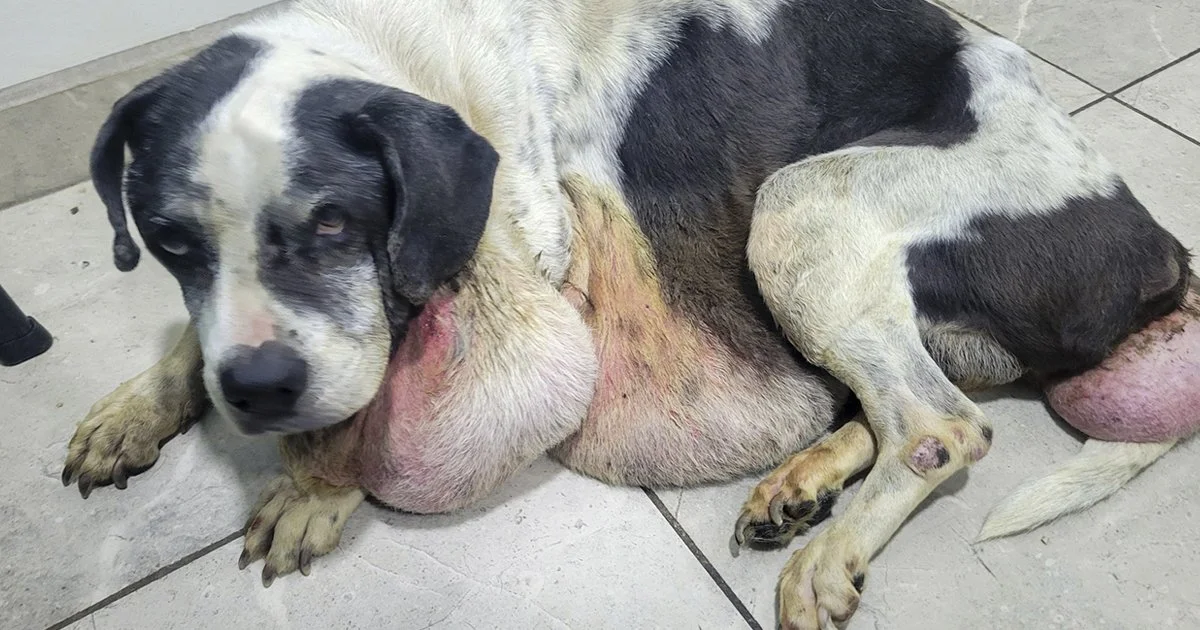
Nicholas was a sad and miserable pup before he found rescuers at Compassion without Borders who helped him with surgery and a wonderful foster family. photo: CWOB, Victoria Vonthal
“Nicholas was my special foster,” says Neuweiler. “His story was so sad until CWOB rescued him. His life literally turned around 100 percent thanks to CWOB. It was great to be able to welcome him into our family and watch him bloom into a happy, wonderful guy.”
It’s not just medical cases who can benefit from fostering. “Being in a home gives us the opportunity to learn so much more about a dog than we can in a shelter environment,” says Bellefeuille. “We get to see their personality come out, learn what makes them comfortable, and better understand what kind of home they need.”
This information can make the difference between a successful adoption and an uncertain future. Being able to communicate with potential adopters that a dog gets along with cats, for instance, or is already house-trained can be exactly the kind of thing that helps them find a forever home.
“Fostering isn’t always easy,” says Bellefeuille. “But simply giving a dog a safe place to land is enough to change their life. I’m especially grateful for the people who say yes to the dogs who are harder to place, who are patient with the shy ones, and who advocate for dogs who might otherwise get overlooked.”
With rescue dogs, there is often a lot of focus on the before and after: where they were found and where they were finally placed. But what happens in between is sometimes one of the most important parts of the story.
The love a dog feels in a foster home can make all the difference. It’s as basic as food and water - and it’s something we want to be sure to never take for granted.