Behind The Walls: How a Prison Program Is Raising the Next Generation of Service Dogs
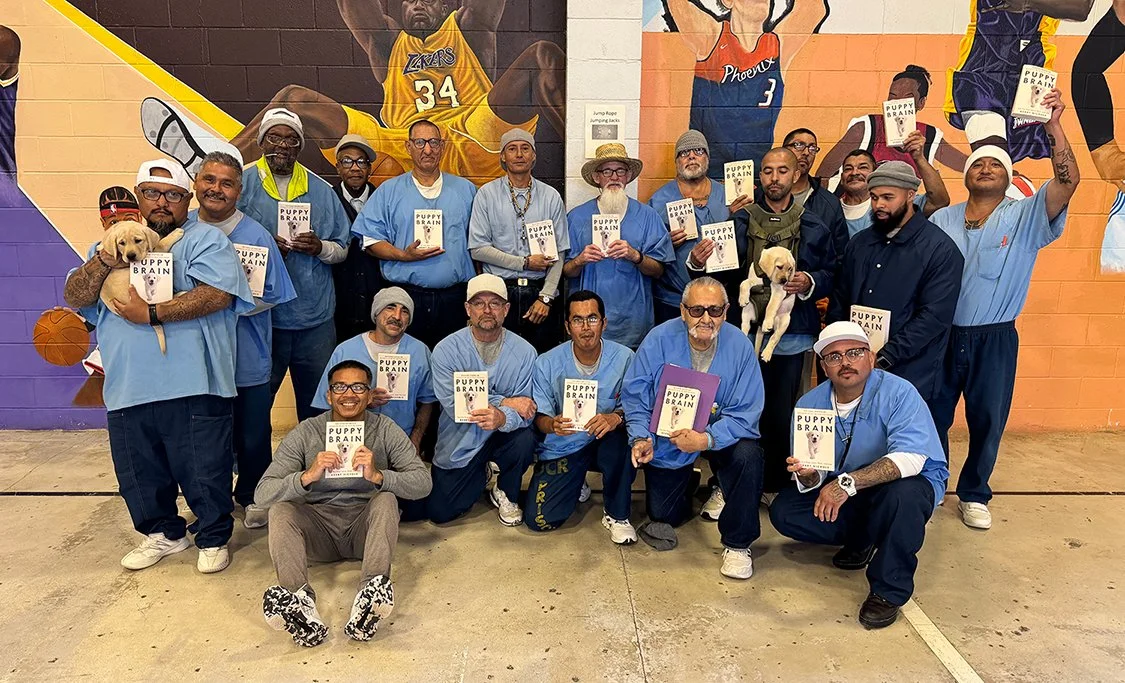
Residents at California State Prison, Solano, who participated in the dog training program. photo: Mark Ruefenacht
There is a particular kind of quiet that settles over a prison yard when a puppy walks in. Conversation drops to a murmur. Hardened routines pause. Grown men who have spent years guarding every flicker of feeling kneel on the concrete and let a wriggling, four-month-old Labrador Retriever climb into their laps. For the next several hours, the most important work happening inside California State Prison, Solano, will be the patient, deliberate shaping of a dog who may one day save a stranger’s life.
This is Paws on a Mission, the service-dog training program at CSP-Solano, created by the National Institute of Canine and Service Training (NICST). What began in 2021 with a handful of incarcerated participants has grown into one of the most robust prison-based canine programs in the state, building to as many as 50 participants.
At any given time, up to a dozen dogs may live inside the walls full-time. Each is cared for by a team of three participating inmates who share the round-the-clock work of feeding, training, and raising their dog, an arrangement that teaches teamwork as surely as it teaches the dog obedience.
Following Science From the Very First Breath
When most people hear the term “working dog,” they picture the finished product: the steady guide dog navigating a crosswalk or the medical-alert dog who signals a drop in blood sugar before its handler feels a thing. What they rarely see is where that work begins. In fact, it starts earlier than most of us imagine, before the puppy is even born.
Paws on a Mission's newest eight-week curriculum is built around the book, Puppy Brain, the national bestseller by canine educator Kerry Nichols. The book follows the physical, mental, and psychological development of a puppy from conception through eight weeks of age, the critical period when the architecture of a dog’s temperament, resilience, and capacity to learn is quite literally being wired into place. For a working dog, these weeks are everything. Get them right and you give a puppy the emotional steadiness a lifetime of service will demand.
The program’s litters - Labrador Retrievers, Golden Retrievers, and Lab–Golden crosses - are born at NICST’s training center in Concord, California, so puppies younger than eight weeks are never inside the prison. Instead, participating inmates follow each litter’s development in real time through a curriculum NICST has created to pair with Nichols’s book, a set of application questions, and hands-on exercises that turn the author’s science into practice.
The inmates study each milestone as it unfolds: the neurological leaps of the first weeks, the dawning of the senses, and the earliest lessons in handling stress and bouncing back from it. To practice the gentle, precise handling that newborn weeks require, the men work with small stuffed puppies until the real puppies are old enough to visit. This is rigorous material and the men meet it with a seriousness that would put many graduate seminars to shame. Nichols herself has become an enthusiastic champion of this work, lending her support and sharing the program with her own audience of thousands across her webinars and social media.
From the Whelping Box to the Working Harness
The program’s hands-on work builds in stages that mirror a puppy’s own growth. Between eight weeks and five months, puppies visit the prison once or twice a week on program days. This year, the program is expanding into a new section of the prison for puppies five to eight months old, where they will receive their foundational obedience training. These puppies will spend two weeks inside with their handlers, then two weeks in a NICST puppy-raising home learning house manners and experiencing the wider community.
At eight months, the dogs move into the prison full-time. That’s when the daily work of shaping a service dog begins in earnest: how to focus amid distraction, practice impeccable manners, and learn the specialized skills that point toward a future in service.
Because theory and practice are never far apart, a participant who has studied how a six-week-old puppy learns to recover from being startled will handle an adolescent dog with markedly more patience and insight. Throughout the program, science becomes second nature. The dog benefits - and so, unmistakably, does the human at the other end of the leash.
Two Kinds of Work
Let’s take a closer look at how the benefits run in both directions.
The dogs are training for the most demanding jobs a dog can hold. But the men training them are doing profound work of their own: learning accountability, patience, empathy, and the steady discipline of showing up, day after day, for a creature that depends on them entirely.
This effect radiates well beyond the handlers participating in the program. In fact, the dogs change the temperature of the whole yard. They’ve also measurably strengthened trust between the incarcerated population and the officers and administration who work alongside them. To date, the men who’ve participated in Paws on a Mission have a zero-percent recidivism rate.
A recently paroled participant, who had spent 30 years inside after being convicted at age 18, puts it plainly: “The guys in the program have no idea how beneficial Paws on a Mission is at preparing us for the real world on the outside.”
The dogs these men have trained are now walking out to the real world, too. At NICST’s Spring 2026 graduation, 6 of the 12 graduating dogs had been trained in part by the Paws on a Mission program. They’ve gone on to become service dogs for people with medical disabilities, partners for first responders living with PTSD, and facility dogs supporting police and fire departments across Northern California.
And that’s the real lesson here: development is never finished. With the right environment, the right patience, and the right understanding, growth is always possible - whether it’s for a puppy in a whelping box or for a person behind a wall.
Want to learn more and support this work? Join us for the NICST Annual Walk for the Dogs, on Saturday, June 27, at Lafayette Reservoir. Register to walk with your dog at www.NeverWalkAlone.dog and help us raise $100,000 to continue providing life-saving service dogs to our community.