The Art of Memory: Why We Keep Painting the Dogs We Love
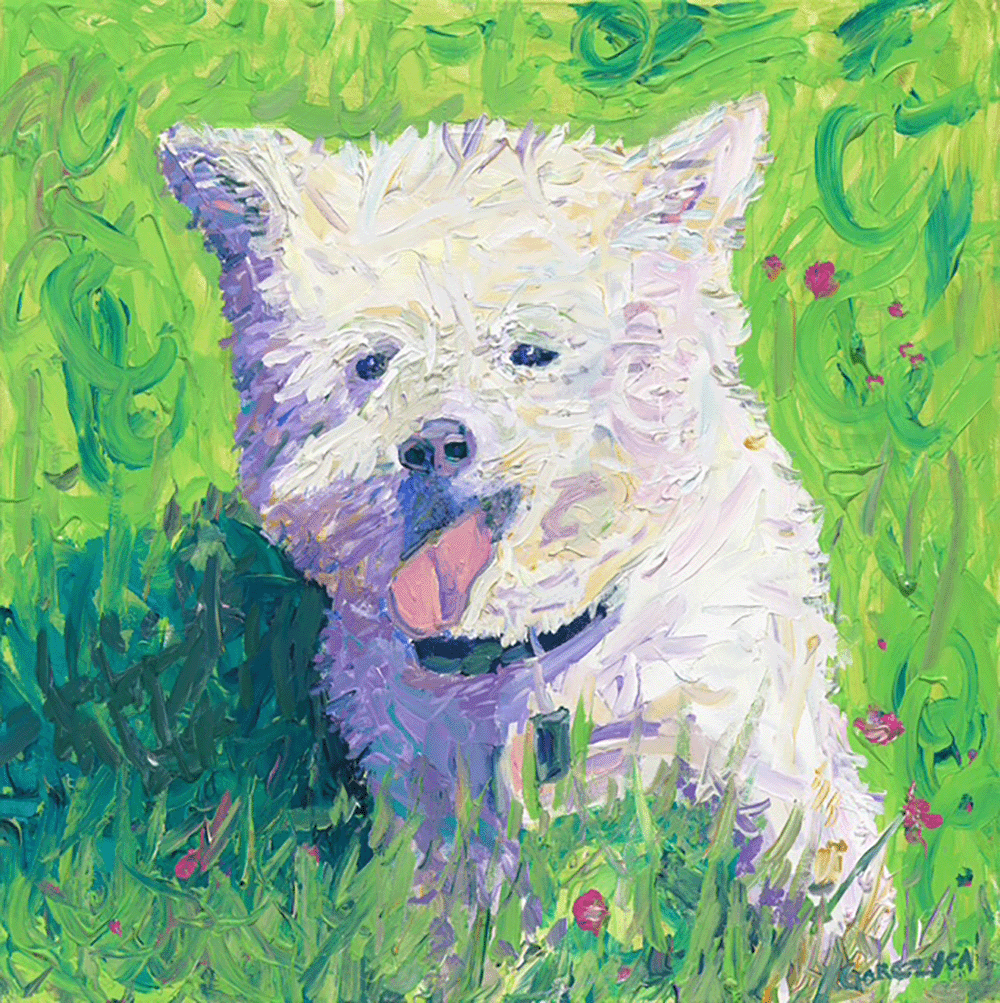
Teddy, by Dr. Ken Gorczyca
When people know they’re about to lose a beloved dog, they don’t start with facts. They start with stories: small, specific memories that would mean nothing to anyone else but mean everything to them. A dog’s habit, a look, a daily ritual. This happens almost instinctively, as if something in us recognizes that memory is the first step toward holding on to something so precious, even as we know we must let go.
That impulse - to preserve, to remember, to give shape to love - may be one of the oldest reasons dogs appear in art, as they have for millenia. In ancient Egypt, dogs were painted into tombs as companions for the deceased in whatever world came next. In early European paintings, they stood beside their people as hunters, guardians, and symbols of loyalty. By the Renaissance, dogs were included deliberately in portraits to signal fidelity and devotion. And by the Victorian era, they had moved to the center of the canvas, becoming emotional subjects in their own right. Across centuries, cultures, and styles, dogs have persisted in art, not simply because they are beautiful but because they carry meaning.
Dogs have long stood as a symbol for something deeply human: loyalty, protection, and companionship, a love that does not turn away. But symbolism only goes so far. What makes dogs different as artistic subjects is not just what they represent - it’s what they witness. Dogs live with us in a way few others do. They see the unguarded version of our lives: the quiet routines, the hard days, the moments we don’t share with the outside world. They are present through illness, loss, change, and joy. They become part of the emotional architecture of a household, the rhythm and feeling of home itself.
So when someone paints a dog, they are rarely just painting an animal. They are painting a relationship. A portrait becomes a stand-in for years of shared life. A photograph, a sculpture, a poem - each one carries something more than likeness. It carries memory. That may be why, even now, when we can take thousands of photos without thinking twice, people still commission paintings of their dogs. They frame images, save collars, press paw prints into clay, and keep ashes close. Because photography captures appearance, but art tries to capture presence - and those are not the same thing.
You can see this shift in contemporary work, where dog art has begun to move beyond traditional portraiture into something more layered and experiential. Artists are working across mediums - painting, sound, language, installation - to express not just how a dog looked but how they felt to be around. The goal is no longer simple representation but something closer to translation: converting memory, personality, and relationship into a form that can be felt as well as seen.
One example of this evolution can be found at Muttville Senior Dog Rescue in San Francisco, where I created the Canine Heart Songs Project. This installation pairs painted portraits of senior rescue dogs with original music and poetry, each piece shaped from the story of that dog’s life. The intention is not just to showcase the dog’s image but to allow the viewer to feel something of the dog’s inner life and spirit. A face on the wall becomes more dimensional when it is paired with voice, rhythm, and narrative, moving beyond likeness and into presence.
In that sense, the project reflects a broader shift in dog art itself. It is becoming less about documentation and more about remembrance; less about what was seen and more about what was shared. At its core, art has always been a way of saying: this mattered. And for many people, the relationship they have with a dog is one of the most meaningful they will ever know - not because their dogs are extraordinary in some grand way but because they are consistently, quietly there.
Dogs do not require performance. They do not ask us to be anything other than what we are. They meet us in the middle of our lives and stay. When they are gone, that absence is undeniable so we respond the only way we know how: we make things. A painting, a poem, a song, a small ritual that holds a memory in place just a little longer. Not to replace what was lost but to remain in relationship with it.
That is why dogs continue to appear in art generation after generation, not as a trend, but as a constant. Because dogs do something rare: they let us feel known. And once something has seen us that clearly, we want to remember it just as clearly. So we return to the canvas, to the page, to the song, and we say in the simplest way we can: you were here, you mattered, and you are not forgotten.