Gratitude, Guinea Fowl Style
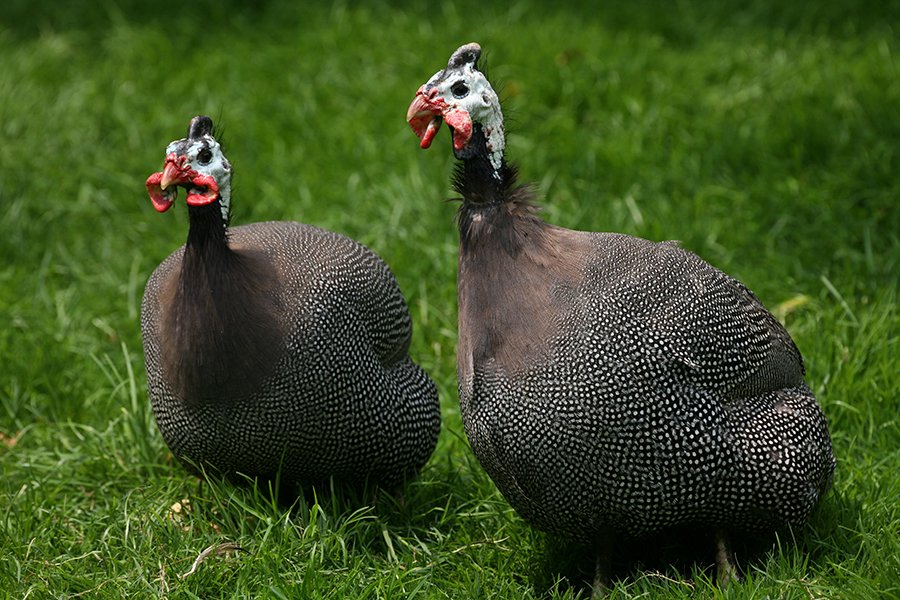
Guineas are highly social with their own kind; where one goes, they all go. photo: AdobeStock
You probably won’t find a lot of people using gratitude and guinea fowl in the same sentence. But at the Fenzi Dog Sports Academy Ranch (FDSA), where I’ve lived since February, we combine a dog training destination with a nascent collection of other domestic animals, including - I use the term loosely - a flock of guinea fowl. We’ll get to the gratitude part later.
So far on the ranch, we’ve learned that there is tick season, mud season, fly season, foxtail season, sticky weed season, and, most recently, hornet season. All that and we are only 10 months in! Needless to say, it’s been a steep land management learning curve, especially when employing a “working with nature” versus “against nature” philosophy.
Enter the guinea fowl. After weeks of research reading articles with dire titles like “Guinea Fowl, the Cons and the Cons”, Denise Fenzi and I decided to focus on the positive, namely the guinea fowl’s voracious appetite for ticks and other pesky insects that had been plaguing us. Ready to take the plunge, we voyaged to the Kat Piss Ranch in Grass Valley to procure our own flock.
Any road trip to a place called Kat Piss Ranch is bound to be a huge success in my book, and the lovely proprietress of the establishment did not disappoint. The three of us had a grand time coaxing guinea fowl into crates, and we left with 24 guineas, 9 chickens, and 1 rooster, aptly named Lieutenant Overkill.
Now guinea fowl are not truly domesticated birds so the challenge is giving them enough free roaming space so they can indulge in their natural behaviors (tick and pest eating), while keeping them on our property, birds often described as “annoying, loud, and dumb” not being likely to endear themselves to the neighbors. Of course, it’s also important to keep them safe from predators, particularly at night.
Thus, we began an intensive guinea fowl training program and, oh hey, did I mention our three dogs? Regular readers might recall our Border/Whippet mix Velo and his keen interest in bird chasing and Baloo the Belgian Tervuren is no slouch in the predatory behavior department himself. Luckily Dice, also a Border/Whippet mix, is an almost perfect dog with no predatory intent beyond his own dog toys.
So that’s where we were when we started our daily program of desensitization and counterconditioning with the goal of habituating our dogs to our new flock and vice versa. First, there were serious initial discussions with the dogs involving the “Leave It” cue. Now I know that some dog trainers think that the “Leave It” cue isn’t particularly useful, but I must disagree. In fact, Velo, who is a sensitive soul, took the “Leave It” cue so much to heart that he later shied away from my subsequent requests to assist with guinea fowl herding.
The guinea fowl, for their part, only had to learn their own recall cue and not to run from the dogs. We started their program in their pen with food reinforcement, saying “Chick, Chick, Chick” while tossing some delicious treats. In no time at all, I had mealworms on the Amazon “Subscribe and Save” program. I chose to call this progress.
Two months later, we tentatively had three dogs who understood that the guinea fowl fell under the “No Predatory Behaviors” ban, and it was time to give it a test run. Guinea fowl are terrific bullies and confinement exacerbates problematic behaviors so we weren’t sure what to expect. With fingers crossed, we opened the gates to their pen - be free, feathered friends!
The free part went well, but suffice to say that there was also a steep learning curve for recalling a couple dozen loose guinea fowl back into nightly containment. I quickly discovered I couldn’t do it alone, so I enlisted Dice, my safest recruit, for sentry detail. He was posted in a “Sit-Stay”position where his presence would deter the flock from heading away from the pen as I herded them toward the door with my “goose girl” stick. Luckily, guinea fowl are naturally susceptible to rear pressure as a survival mechanism. If they weren’t, the birds at the back of the flock would starve as they forage. The stick just helps nudge them along.
Did I mention the terrain here on the ranch is hilly and treacherous? As I was slipping and sliding and doing my goose girl thing, I glanced over to make sure Dice was holding up his end of the deal. The term “overtraining” came to mind as the guinea fowl, having spent two months learning Dice wasn’t a threat, were clustered in a circle, squawking, and reaching out to touch him. Dear Dice was holding his “Sit-Stay” while leaning as far away from them as he possibly could, still keeping his butt on the ground. Oh my. The best laid plans...
One might think this herding disaster would have been sufficient to inspire a thoughtful reassessment of my plan. But no. It was getting dark, and I was starting to panic. I could hear the hunting song of the local coyote pack in my mind, and I doubled down. Time for reinforcements.
On a wing and a prayer, I brought out Baloo, our wolfy-looking Tervuren, and stationed him in the vulnerable sentry position, while moving Dice to a less critical, but still useful location. Then I started again to herd the fowl towards the open door of their pen. The flock saw Baloo, stopped, squawked about it for a bit, and headed over to check him out. Oh no. I quickly cued Baloo into a position change just to demonstrate his extreme dangerousness. Baloo obliged with an intimidating “Sit” and the guineas froze. Great, I thought.
But just then, I slipped in the loose dirt and spooked the confused flock into flight. They flew right at Baloo! I experienced a huge surge of gratitude for Baloo’s Mondio French Ring training as he didn’t bat an eyelash when they flew right past his face. He clearly thought we were just proofing an absence (it’s a basic competition exercise - check it out here: youtube.
Ultimately, we managed to get the flock in that first night, no guineas or dogs were damaged in the process, and we’ve since perfected our evening routine. I still use one dog each night to block off the obvious exit. Luckily, the dogs seem to accept their nightly treat compensation as sufficient payment to make up for my initial poor planning.
As the days have grown shorter, it is darker each morning when I leave for work. On a recent morning, I debated opening the pen in the dark as I would be gone for a long day. The guineas were now used to freely roaming the ranch area and I could only imagine the problematic coop behavior if I left them confined all day. So I opened their pen and hoped for the best.
When I returned much later the ranch was eerily quiet. Normally, the guinea fowl vocally broadcast their ranch location. Silence. At their pen, I called and listened. Nothing. I called again. I waited about five minutes and with a sinking heart, resigned myself to a futile drive around the neighborhood looking for the missing fowl. As I was rounding the container barn, motion in my peripheral vision caught my eye. The entire flock of guinea fowl was racing down the dirt road from our back forty acres straight toward their pen, running so fast they kicked up little tufts of dust as they smoked home! They must have been far away when they heard my call as they were panting, hungry, and thirsty when we finally rejoiced in our reunion.
So where’s the gratitude in this crazy scenario? For starters, I truly enjoy developing relationships with all kinds of animals and am thankful to have been able to expand my interspecies communication to my new feathered friends. Though many consider guinea fowl to be noisy, disruptive, and not worth the trouble, our flock has provided us with hours of entertainment, many learning opportunities, and - we hope - far fewer insect pests.
For me, the chance to observe, appreciate, interact with, and yes, love all kinds of different critters is an acknowledgment of my own place in the wider natural world. And for that I will always be grateful.