Warding Off Doggie Dementia, Rescued Beagles Find Friends in High Places, Whither the Royal Pooches, and More!

Dante, an 11-year-old Bernese Mountain Dog, has been diagnosed with canine cognitive dysfunction. photo: Heather Ainsworth
Let’s Get Physical: Exercise May Ward Off Doggie Dementia
Want to help your dog pals keep their marbles as long as you can? Keep them moving!
That’s the nutshell advice of a new study by the Dog Aging Project, which looked at over 15,000 dogs and found the risk of canine cognitive dysfunction, otherwise known as doggie dementia, was far greater in pups who didn’t get enough exercise (we’re talking about you, cute couch potato). Signs of canine dementia may include walking into doors or walls, getting stuck behind objects, having difficulty finding food dropped on the floor, incontinence, pacing, walking in circles, or wandering with no purpose. As with humans, the likelihood of dementia in dogs increases with age.
The good news is the study also found that exercise may play a significant role in preventing cognitive decline. The finding mirrors a raft of human research showing that regular physical activity can significantly reduce the risk of developing dementia by roughly 30 percent, according to the Alzheimer’s Society.
The Dog Aging Project, which receives funding from the National Institute on Aging, currently has over 40,000 dogs enrolled and hopes to reach 100,000. The project’s ongoing research into canine illness and aging may provide insight into factors affecting the lifespan of humans, as well as the dogs who share our homes. To learn more about the Dog Aging Project, including how to enroll your dog, visit dogagingproject.org.
In the meantime, be sure to keep those daily walks and runs on the schedule for you and your pup. Your brains and your bodies will both be healthier for it.
Source: nytimes.com
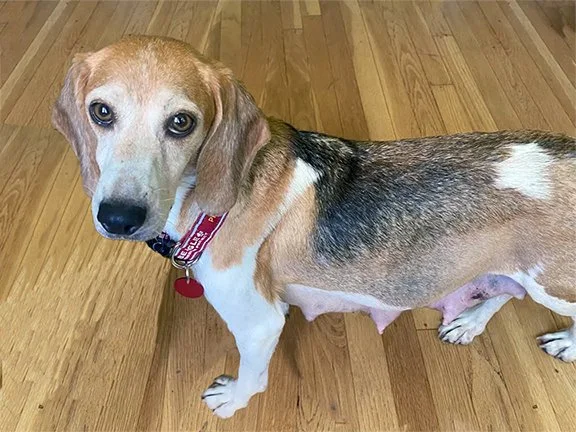
Momma Mia, one of 4,000 Beagles being rescued from the Envigo breeding facility in Cumberland, VA. photo: Beagle Freedom Project
Happy Endings Dept.: Mistreated Beagles Find Friends in High Places
Dog lovers were horrified earlier this year when 4,000 Beagles were rescued from appalling conditions at Envigo, a mass breeding facility in Virginia. Finding homes for the thousands of mistreated pups has been a gargantuan task that was headed by the Humane Society with support from countless rescue groups across the U.S., including the Beagle Freedom Project (BFP).
Now one of the rescued pups, a 7-year-old female named Momma Mia, has found a new home with a California couple you may have heard of: Meghan, the Duchess of Sussex, and Prince Harry.
The duchess, a known Beagle lover, had been a longtime supporter of the BFP. Still, the group was surprised to get a call saying she and Harry were interested in adopting one of the rescued dogs themselves. And while many people gravitated toward adorable puppies, Meghan said they’d be willing to take a dog in the most need.
Momma Mia certainly fit that bill. Used for breeding, she’d been forced to give birth to litter after litter her entire adult life. Many of the rescued Envigo dogs were afraid of sounds or didn’t know how to play, but Momma Mia quickly adapted to life on the outside and was eager to meet her new royal humans. “The second they walked in, it’s like Momma Mia knew,” said Shannon Keith, the founder of BFP. “She ran over to them. Her tail was wagging a million miles a minute.”
It turns out Momma Mia isn’t the only Envigo victim to wind up with a high profile family. Another rescued pup named Morty is now the First Beagle of New Jersey, joining Governor Phil Murphy, his wife Tammy, and their four kids. “They talked me into getting another dog, and I’m so glad they did,” tweeted the gov. “Welcome to the family, Morty!”
Source: nytimes.com
And Speaking of High Places…Whither the Royal Pooches?
The late Queen Elizabeth II was famous for her love of animals, owning more than 30 Corgis over the course of her long life (Princess Di once famously called them the “moving carpet”). But with three pups left behind on Her Majesty’s death, dog lovers around the globe were naturally curious about what would become of the Royal pooches.
Sadly, Candy, the Queen’s beloved Dachshund/Corgi mix, passed away this summer at Balmoral at age 18, just a few months before the Queen herself. But her two surviving Corgis, Muick and Sandy, will go to live with Prince Andrew and his ex-wife Sarah, Duchess of York. Despite their divorce years ago, the couple still share digs on his vast estate, the Royal Lodge in Windsor (and, of course, Andrew has time on his hands now that he’s been stripped of royal duties thanks to his past association with the late sex trafficker Jeffrey Epstein).
No word yet about Lissy, the Cocker Spaniel puppy Her Majesty adopted last February in a break from her lifelong Corgi tradition. The youngest of the royal pack, Lissy, whose official pedigree name is Wolferton Drama, is reportedly living with her trainer for now. Already a champion, she’ll undoubtedly find a happy home, whether it’s with her trainer or another one of the royals.
Meanwhile, Muick and Sandy made one last public appearance, observing the Queen’s funeral cortege on leashes held by pages in red tailcoats. Also present for the funeral procession was Her Majesty’s favorite pony Emma, whom she’d continued to ride well into her 90s.
Say what you will about the British monarchy (and there’s a lot to be said, much of it distressing). But when it came to animals at least, Her Majesty really was a pretty nice girl.
Sources: nytimes.com, theguardian.com, uk.style.yahoo.com
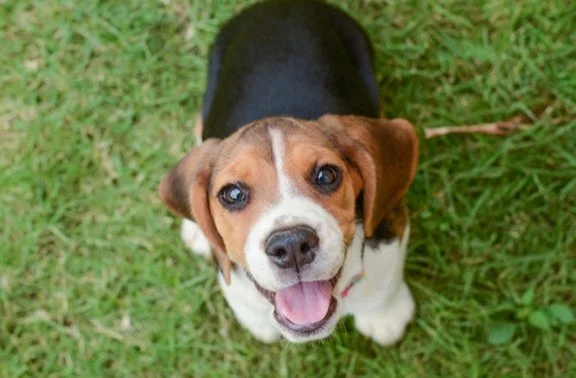
A new study says dog’s eyes might well up just like yours. photo: Shutterstock
Do Dogs Cry Happy Tears? New Study Says Yes
You know the excited gleam in your dog’s eyes when you finally walk in your front door after hours apart? What you’re seeing could actually be tears of joy.
A new study by researchers at Japan’s Azabu University found that dogs, like humans, appear to cry happy tears when experiencing positive emotions. One of the study’s authors first made the connection after noticing tears in the eyes of his own dog as she nursed her new puppies. This gave him the idea that tears in dogs might be prompted by oxytocin, a hormone that, among other things, can make you feel closer to a loved one.
Study authors already knew that oxytocin is released in dogs and their humans when they interact with each other. But to determine if oxytocin caused dogs to produce happy tears, the researchers first ran a test to measure the tears in dogs' eyes before and after they were reunited with their owners, then conducted the same test with people the dogs didn’t know. The result: tear volume increased when dogs were reunited with their owners but not with strangers.
Next, researchers added oxytocin drops to the dogs' eyes when their owners weren’t present and found that tear production also went up. The combined tests indicate that when dogs naturally produce oxytocin – as they do when they see their beloved humans after an absence – they also produce happy tears.
As part of the same study, researchers showed photos of dogs to human participants and asked them to rate which ones they liked best. Most preferred the dogs with teary eyes over those without, suggesting that teary eyes in dogs may help forge a stronger bond with people.
But really, who needs scientists to tell us how glad our pups are to see us at the end of a long day? Happy tears are just more proof of the love we already knew was there.
Source: discovermagazine.com

Thanks to the professional superheroes, Chloe was rescued from the mudslide zone. photo: San Bernardino County Fire
Muddy But Unbowed: California Pup Found Alive After Mudslide
When a small black furball named Chloe went missing in the mudslides that hit San Bernardino County last month, her family feared the worst. But after a two-day search, rescuers found the little dog miraculously alive in a void space surrounded by dense mud and debris.
Firefighters and the Urban Search and Rescue team wasted no time reuniting Chloe with her overjoyed family whose love and hugs were reciprocated with ecstatic face licks and all-over wriggling.
Can a tail really wag any faster than this muddy pup’s? We doubt it.
Source: people.com