Two Successful Sneak Outs, Fake Service Pups Cause Real Problems, Your Dog Is Listening, and More!

After repeated escapes from the shelter to the senior center, Scout worked himself into a live-in job at the place. photo: Ryan Garza, Detroit Free Press
Successful Sneak Outs, Part One: Dog Chooses Seniors Over Shelter
A couple of pups made national news recently for their successful sneak outs.
First, there’s the tale of Scout, a Michigan shelter dog who escaped by climbing over the shelter’s two tall fences and crossing a busy highway. His goal? A nearby nursing home where he entered through the automatic doors, hopped onto a lobby couch, and peacefully snoozed the night away.
After a surprised worker discovered Scout the next morning, nursing home staffers promptly returned him to the shelter. But a few nights later, he escaped a second time and was back on the nursing home’s couch. Once again, staff members returned the wandering boy to the shelter.
But when Scout turned up on the nursing home’s couch a third time, the humans involved decided to write a different ending. To the delight of staff and residents alike, the home formally adopted Scout, who now has free rein of the premises (he also knows which residents keep treats in their walkers for him).
“I’m a person who looks at outward signs, and if it’s meant to be, it’s meant to be,” said Marna Robertson, the nursing home’s administrator. “He did that one time, two times, three times, and obviously that’s something you should pay attention to.”
While it was clear from some old injuries that Scout had been abused in his previous life, no one knows where he came from or why he was so intent on getting himself to the nursing home. “He certainly has a penchant for the elders,” said Robertson. “He’s very in tune with what they need, especially our very vulnerable population….He must have just felt like he needed to be here.”
Source: usatoday.com
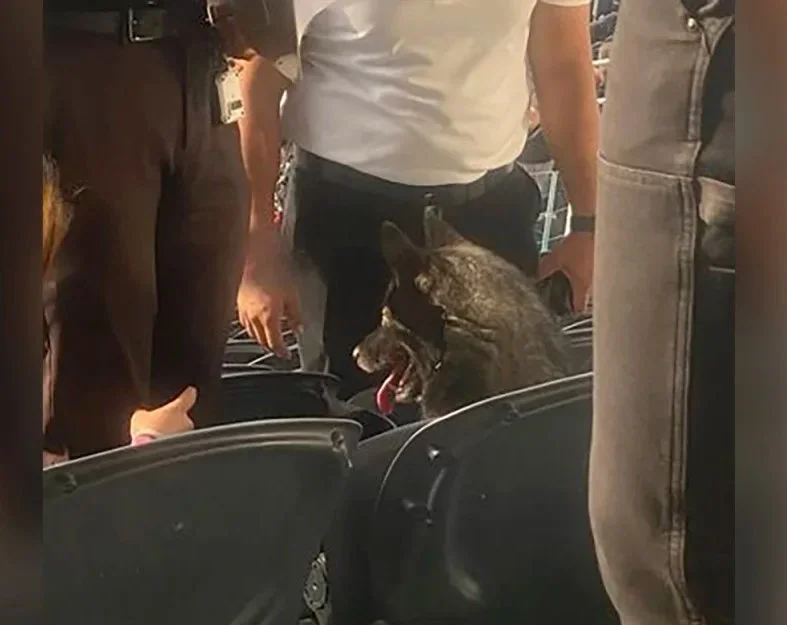
Storm was found seated at a Metallica show before being returned to her family. photo: Metallica
Successful Sneak Outs, Part Two: Another Mutt for Metallica
Following in the footsteps of rebellious teens everywhere, a metal-loving pup named Storm snuck out – and in! – to a sold-out Metallica show in Los Angeles.
Storm’s home is next to SoFi Stadium where the show was being held so at least the four-legged fan didn’t have far to go for her fix of head-banging classics. After enjoying the concert, she was escorted to a nearby shelter and reunited with her family the next day, no doubt with her pointy ears still ringing.
Despite Storm’s happy ending, Metallica isn’t encouraging any more canine fans at its shows. “You definitely shouldn’t bring your furry friends to the #M72 World Tour,” the band posted. “But this dog sure did have her day.”
Source: cnn.com

Service dogs doing their jobs are hampered by tighter regulations.
Don’t Be That Human: Fake Service Dogs Cause Real Problems
In recent years, airlines have grappled with a growing number of passengers trying to pass off untrained pets as service or emotional support animals. After numerous reports of these furry imposters defecating on flights or attacking crew members, passengers, or legitimate service dogs, the U.S. Department of Transportation issued new regulations in 2021. These revised rules tightened the definition of service animals (sorry, Fifi – no more emotional support pets) and allowed airlines to require passengers to complete forms about their service dogs’ training at least 48 hours before a flight.
But now disability rights advocates say some airlines are interpreting the rules inconsistently and rejecting legitimate service dogs for simple mistakes on the form. In particular, blind travelers have found the required forms difficult to fill out because they’re often not compatible with the screen reader technology that converts text to speech. In fact, the Department of Transportation’s own data shows the number of service animal complaints from people with disabilities has more than doubled since the new regulations took effect less than two years ago. Some blind fliers have been prevented from boarding flights with their service dogs, effectively grounding both dogs and humans.
Unfortunately, all this still hasn’t stopped others from lying or trying to pass off untrained pets as service animals. Nor do the new rules help airline staff tell the difference between legitimate service dogs and the growing number of fake wannabes. “It’s a gigantic mess,” says Albert Elia, a board member at the National Association of Guide Dog Users and staff attorney for a nonprofit legal organization focused on disability justice.
In large part, that’s because there is no national industry standard for service animals and no shortage of misconceptions. Even so, over half of U.S. states, including California, have laws that make it a crime to fraudulently represent that a person has the right to be accompanied by a service animal, which may simply involve the unauthorized use of a harness, vest, or leash to falsely identify a pet as a service animal.
The Department of Transportation says it’s begun investigating complaints about its current regulations and is open to feedback for improvement. But that’s little immediate help for the blind fliers who already have a tough enough time navigating the increasingly unfriendly skies.
In the meantime, what can you do to help? Just don’t be part of the problem.
You know if you have a disability, just as you know if your dog is trained as a service dog. If they’re not, please don’t insist on flying with them. It’s as simple as that. Actual service dogs will thank you.
Source: washingtonpost.com

Is your sleeping dog listening in? Turns out - yes. photo: Natalie Dupin
Watch What You Say: The Dogs Are Listening
Have you ever noticed your dog’s ears twitching at the sound of your voice while they’re apparently out cold on the couch? Now a small pilot study in Hungary has found that dogs may be able to hear us even while they’re fast asleep.
For the study, researchers first connected 13 dogs to machines that would record their “event-related brain wave reactions.” They then played various recorded vocalizations by humans and other dogs while the test dogs were fully awake, semi-conscious, and in deep sleep. All sounds played were non-threatening vocal expressions like laughter, yelps, or whines, with no distressing noises that might wake the study dogs.
Researchers found the dogs were generally able to discern the source and emotional tone of the sounds and detect whether the underlying emotion was positive or neutral, whether asleep or awake. Study authors call this the first evidence of complex auditory processing during sleep in dogs.
Researchers who have conducted similar studies in humans say people are more likely to wake up if they hear a stranger’s voice, theorizing that an unknown voice is more apt to pose a threat. Though the Hungarian study is just a start, it appears dogs may share that same ability to monitor the sounds around them - even while they’re busy catching rabbits in their dreams.
Source: upworthy.com

Fenton, a conservation canine with Working Dogs for Conservation (WD4C), is trained to detect animals such as bear, cougar, and kit fox, as well as plants like pepperweed, salt cedar, and woad. photo: WD4C
Too Intense? Not For This Job!
Many dogs who wind up in shelters are there because they turned out to be too something for their owners. Too hyper, too obsessed, too intense, too strong willed – all characteristics that also make them less likely to be adopted out as family pets.
Luckily, the folks at Working Dogs for Conservation see these traits as a plus. In fact, most of WD4C’s current pack of 45 working dogs came to them from shelters. Now these same dogs are helping to save their fellow creatures around the world.
Tigee was a seven-year-old Shepherd mix who’d been seized by animal control for being too aggressive. But he was smart with an intense attachment to his toys, making him an ideal candidate to become a conservation canine trained to sniff out endangered species. After being rescued by WD4C, Tigee now lives with his human handler in Zambia where he uses his extreme drive and keen snout to protect the region’s wildlife, including the threatened pangolin.
Another shelter dog, Tobias, was a nine-year-old Labrador found wandering alone in 2016. Too hyper for family life, he became a successful WD4C dog, happily sniffing out invasive mussels in Montana’s Glacier National Park in exchange for toys and treats.

Zoey, a stray Shepherd mix on the streets of Texas, went to work tracking wildcats in the wilds of Montana. photo: WD4C
Pete Coppolillo, the executive director of WD4C, looks for dogs with intense toy drives, strong work ethics, and lots of energy – the kind of pups who become fixated on a task and won’t rest until it’s done. Each dog the group adopts is paired with a human handler who loves and trains them and then works with them on the job. In addition to monitoring wildlife or detecting invasive species, some pairs help combat wildlife crime by detecting guns and ammunition or tracking poachers.
“There are lots of great dogs in shelters that don’t need to be there,” says Coppolillo. Especially not when there’s a whole wide world out there just waiting to be saved.
Source: washingtonpost.com