Help Ukraine Pets, Dog Aging Project, Sausage Drones to the Rescue, and More!

Stray puppies in Ukraine. Animal shelters are working to house stray animals across the country. photo: Sean Gallup/Getty Images
Pets in Wartime: Ukraine Struggles to Care for Animals
As the tragedy in Ukraine continues to unfold, residents of that war-torn nation struggle to care for pets and other animals in the face of ongoing horrors. In response, many countries have temporarily lifted restrictions on incoming animals to accommodate refugees fleeing with beloved pets. At press time, these included Poland, Latvia, Hungary, Romania, Czechia, Slovakia, Italy, Germany, Belgium, and Finland, with more likely to follow.
In addition, several organizations are collecting donations to augment dwindling food supplies and offer other support for animals left behind in Ukraine shelters or zoos.
UAnimals accepts donations and provides daily English language updates on the status of Ukraine animals at patreon.com/uanimals
Happy Paw, a Kyiv-based nonprofit, also supports shelter animals throughout the Ukraine.
If nothing else, please hold the people and animals of Ukraine in your thoughts during this grievous time.
Sources: mercurynews.com, eurogroupforanimals.org

The goal of the Dog Aging Project is to understand how genes, lifestyle, and environment influence aging. photo: DAP
Canines for Community Science: Is Your Pup Ready for the DAP Pack?
The Dog Aging Project (DAP) is a years-long study tackling questions about canine longevity - and it’s not too late to enroll your own pup as a canine community scientist.
Founded in 2018, the project aims to compile a powerful open-source data set that will give vets and scientists tools to assess how well an individual dog is aging, while also setting the stage for further research that could eventually help both dogs and humans.
Researchers hope to identify specific biomarkers of canine aging, but because older dogs experience almost every functional decline that humans do, they believe their findings may be relevant to the human aging process as well. One part of the study will analyze the DNA of unusually long-lived dogs - the so-called canine super-centenarians – which we wish all our dogs could be.
Expected to run for at least 10 years, DAP has already enrolled over 32,000 dogs and is still recruiting all ages, sizes, and breeds, including mixed breeds, from across the U.S. Owners must agree to fill out annual surveys and take measurements of their dogs for the length of the project, and some may be asked to collect cheek swabs.
Want to sign your pup up for the DAP Pack? Learn more and enroll at dogagingproject.org
Source: sciencedaily.com
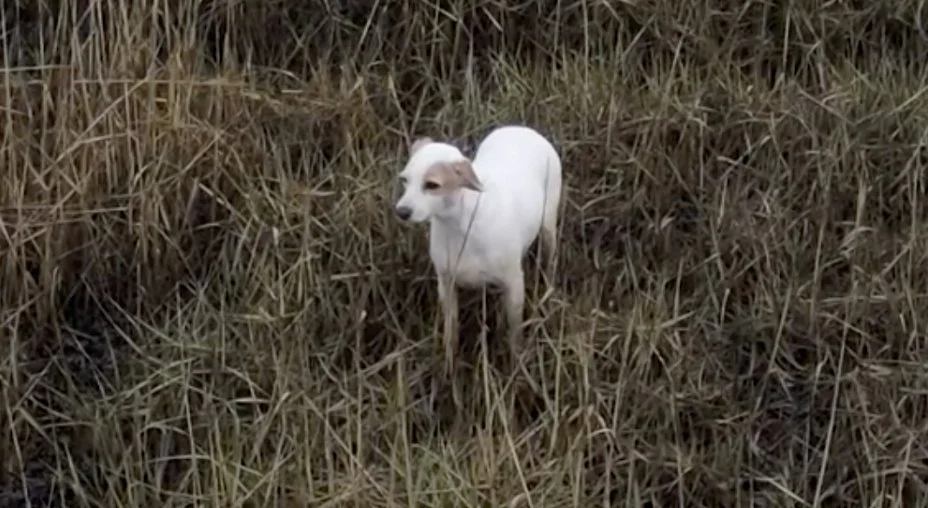
Volunteers have rescued a runaway dog from dangerous mud flats by luring her to safety with freshly cooked sausages tied to a drone. photo: CNN
Sausage Drone to the Rescue! How Millie Got Her Meat
Millie, a small Jack Russell/Whippet mix, recently slipped her collar while out for a walk and became stranded on dangerous mudflats in southern England. The coast guard, fire department, local police, and volunteers all tried to catch her over several days, but she was so spooked that efforts to save her only pushed her further out toward drowning territory.
Finally, on Day Three, one of her would-be rescuers had the bright idea of tying a sausage to a drone to lure her to safety. A nearby neighbor volunteered to cook the meat treats (“obviously very tasty”) and supplied string to attach them to the drone.
Once the sausage took flight, Millie began sniffing the air and trying to catch it, almost taking down the drone in the process. But she eventually followed the low-hanging links to safer ground and, after a bit more chase, was finally reunited with her human.
Happy outcome notwithstanding, let’s hope Millie finds an easier way to snag her sausage in the future.
Source: abc7ny.com
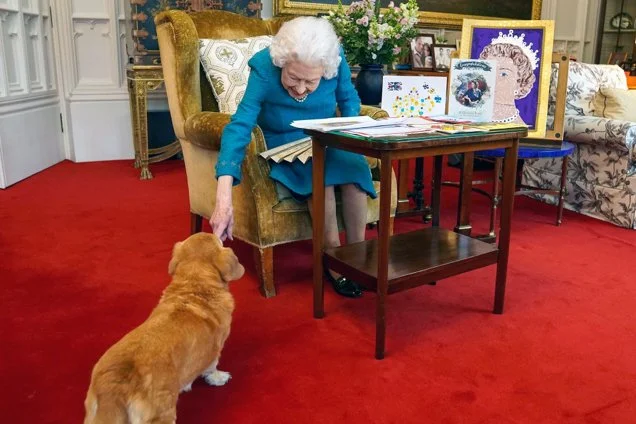
Queen Elizabeth II is joined by one of her dogs, a Dorgi called Candy, 2022. photo: WPA Pool
No More Corgis: The Queen’s New Pup is a What?
In other news from across the pond, royal watchers were surprised by Queen Elizabeth’s recent choice of a new dog. A well-known Corgi aficionado since the age of 18, Her Majesty had branched out to Dorgis (a Corgi/Dachshund mix) in recent years, indicating at least some desire to mix it up. But stiff upper lips dropped all across the UK when news broke that she’d thrown tradition to the winds and adopted…a prize-winning Cocker Spaniel named Lissy?
Rumor has it the Queen’s choice was influenced by the Duke and Duchess of Cambridge (Wills and Kate to you) who recently acquired a new Cocker Spaniel pup after the death of their beloved Lupo in 2020. In fact, Kate Middleton’s brother James breeds Cockers and it’s believed he may have had a role in supplying the Queen’s new dog. But, whatever the source, Her Majesty is reportedly delighted to be celebrating her Platinum Jubilee with her newest four-legged friend.
To bereft Corgi lovers everywhere, all we can say is at least it’s not a cat.
Source: apple.news

Sheryl Blancato of Second Chance Animal Services carries two-month-old Presley, who just flew from Mississippi to Massachusetts. photo: Evan Angelastro for TIME
Location, Location, Location: How Moving Dogs Saves Lives
It’s not just true for real estate. Location and the laws of supply and demand apply to pups, too. States like Massachusetts, Delaware, New York, and Washington have too few dogs available for adoption, while Mississippi, Oklahoma, Louisiana, and Tennessee have too many.
Not surprisingly, shelters in cities and suburbs generally have more resources for pet population control, as well as larger pools of willing adopters. Meanwhile shelters in rural areas struggle with too many animals, too few adopters, and not enough funding for responsible spay/neuter programs.
Enter the dog relocation networks, which work to connect shelters and transport abandoned animals where they’re wanted and welcomed. The ASPCA runs the largest of these networks and will celebrate its 200,000th animal moved this month. But that’s just one of many nonprofits and ad hoc volunteer groups working to bring dogs (and, yes, cats) to locations where their chances of adoption are exponentially better.
And the numbers prove it’s working. Back in the 1970s, as many as 20 million dogs and cats were euthanized each year in the U.S., a figure that was still hovering around 2.6 million as recently as 2011. Today, the ASPCA estimates euthanasia numbers are down to 390,000 dogs and 530,000 cats annually – still far too many, but definitely progress.
Source: time.com

Pampered pups are big business. photo: via Instagram / @itsdougthepug
Pampered Much? Meet the Pet One Percenters
Humans with far too much time on their hands recently compiled a list of the world’s richest pets – and, not surprisingly, it’s a lot about luck and who you know.
Topping the list is Gunther VI, who famously inherited his estimated $500 million from a late German countess’s multimillion-dollar trust and currently resides in a mansion formerly owned by Madonna.
In the second spot is Nala Cat, with a net worth of roughly $100 million. Unlike Gunther, Nala at least sort of works for her money, holding the Guinness World Record for Instagram followers for a cat, and clawing in hundreds of thousands per year from appearances and product endorsements.
Moving down to the eight-figure column, we’ve got Taylor Swift’s Scottish Fold Cat, Olivia Benson, an Instagram star with a net worth of $97 million. Jiffpom, a Chicago-based Pomeranian, holds two Guinness records for speed (hey, at least he’s got an actual talent) and has roughly $25 million in the bank, earned through social media and sales of his own book, calendar, and line of emojis. And don’t forget Choupett, Karl Lagerfeld’s stylish Birman kitty worth a cool $13M.
Bringing up the rear in the relatively modest seven-figure group, we’ve got Pontiac, Betty White’s adored Golden Retriever who inherited $5M on her death in 2021, and Doug the Pug, the reigning king of online Pug culture, who’s earned $1.5M to date. Meanwhile, Oprah’s five fur babies – Sadie, Sunny, Lauren, Layla, and Luke – stand to split $30 million when she dies for a payout of roughly $6M apiece, though they haven’t actually got their paws on it yet.
Not that we begrudge these pampered pets their wealth, obscene as it may be. We just hope they’re all donating to their local shelters on a regular basis.
Source: apple.news