Yo-Yo Go To: An Indoor Game for A Rainy Day
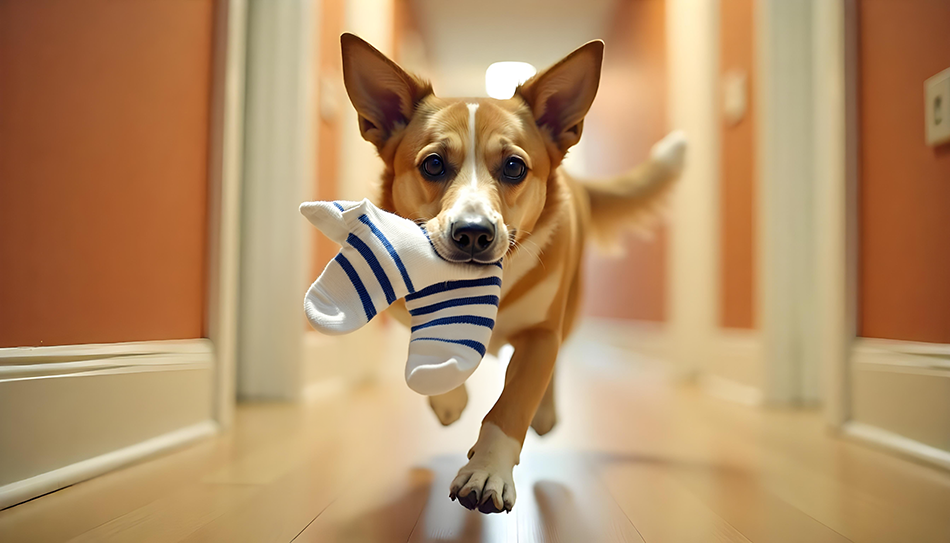
Jessie uses a stinky sock to level up the game. photo: Vecteezy
Back in the 1980s, when off-leash lure-reward training was still a new concept for most trainers, I designed a slew of indoor games for Obedience, Agility, and Schutzhund, primarily for hunting, herding, and sled dogs. These exercises were designed to accelerate the teaching of vital verbal instructions for each sport or activity and to test the dogs’ comprehension.
For example, did a sled dog really know Gee (right) from Haw (left)? What about Steady (to slow down), another useful instruction for sharp bends, to conserve energy, or to slow the team before a Whoa (stop and stand-stay)? I once saw a musher in Truckee “Heel” his whole team to the starting line of a race and instruct them all to Whoa, which they promptly did. It was glorious to see such well-trained dogs.
But my all-time favorite exercises and games were those I created for Search and Rescue (SAR) dogs. As with many working dogs, practicing these skills can take an inordinate length of time. For example, practicing a single “track” or “search” can take most of a day, which most everyday dog owners don’t have the time or interest to do.
Luckily, the basic directive to find a person, or to find a specific person, may be taught indoors, which makes it an ideal inside game for a rainy day. And you don’t have to aspire for your pup to become an official SAR dog for you and your dog to enjoy it. Here’s how.
Start with a “Yo-Yo Go To” exercise between two people sitting in armchairs with an afternoon cup of tea if you like. Only one person may give instructions at a time. This is to avoid confusing the dog, countermanding the other person's instructions, or trashing the other person’s self-esteem (very important with children and men).
In this training exercise, the first person - let’s call her Sue - calls the dog by name: "Jessie, come,” which means “Come, sit in front and watch me.” Once the dog is sitting in front of her, Sue says, "Jessie, go to Denise" and then remains perfectly quiet and still. Immediately, Denise - the second person in the exercise, then says, "Jessie, come." Once Jessie is with her, and after a few appreciative words and pats, Denise then says, "Jessie, go to Sue.” After a few repetitions, Jessie should be running back and forth between Sue and Denise as instructed.
At this stage, all Jessie has learned is that when one person says, "Go to…,” she should run to the other person. That’s when we add another person or two so that the exercise becomes a “Round Robin Go To.” Dogs love to anticipate what's coming next but now they must wait, until the “Go To” person is named.
For example, Sue says, "Jessie, go to Ian,” after which Ian says, "Jessie, come" and offers lots of praise and the occasional food reward. But the next time, Ian may say, “Jessie, go to Denise.” If the dog improvises or anticipates incorrectly, everyone remains quiet and still and ignores any antics, while Ian reinstructs. Each person in the training game tallies the number of correct “Go To’s” following a single request, as well as the number of attempts where the dog had difficulties.
After a few trials, Jessie should learn that as soon as anyone says "Go to Ian," Ian always calls her so she’s just going to high-tail it to Ian right away and not wait for him to call. In this exercise, anticipation facilitates training.
Next Level, Anyone?
Once Jessie has all this down, we can take the game even further if we like, spreading out the search area to different rooms of the house or even to our fenced yard. At this level, all the humans hide in silence; and instead of a verbal “Go To” cue, we give Jessie a used sock (kept in a Ziploc bag) of the person we want her to find by scent. As she becomes more adept at this higher level of the game, we can eventually expand the search area to a park or other leash-free outdoor setting.
Voila! After all this practice, we now have our very own unofficial SAR dog, which can really come in handy in everyday life. Let's say Grandpa is confused and wanders out the front door. We can say, "Jessie, go to Grandpa" if she knows him by name (if not, we can present his used sock or other item of clothing) and Jessie can come to the rescue because she fully understands the task at hand. Or maybe Sue's family is having a picnic and, as dusk approaches, little Katie is nowhere to be found. With the “Go To” command or Katie’s cast off jacket, Jessie can locate her down by the stream, happily corralling frog spawn into a plastic bottle.
The bottom line? When dogs understand the task at hand, the task itself is usually easy for them, thanks to their extraordinary senses of smell and hearing. The challenge is teaching them to understand the task in the first place. So if your dog is bored on the next rainy day, why not start with some indoor “Yo-Yo Go To” training? While they may not become a full-fledged SAR dog, it’ll be a good brain and body exercise for you both.