Working Dogs and Performance Dogs: What These High Achievers Can Teach Us
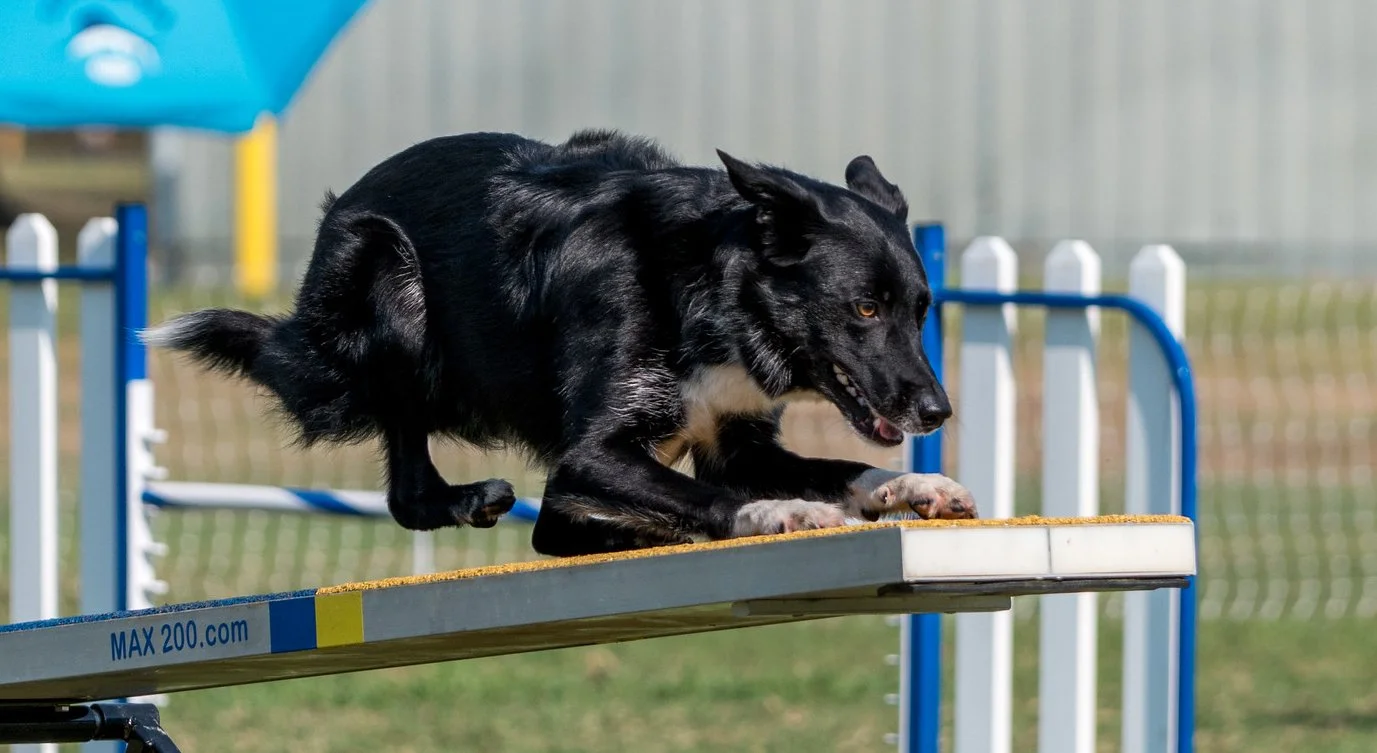
Tux on the teeter-totter. photo: Katy Robertson
When most people think of working dogs, they think of police dogs, military dogs, search and rescue dogs, detection dogs, hunting dogs, and dogs trained in protection work. In other words, dogs with an important job title.
By contrast, performance dogs are generally considered any dog that participates in one or more of the many different kinds of dog sports. Of course, because I make my living teaching dog agility, I consider my performance dogs’ jobs to be very important. My dogs are my calling cards for my business, so to speak.
Both working dogs and performance dogs are well-trained high achievers, and understanding what they have in common can help you learn how to be a better trainer for your own pup. In fact, the performance trainer, the working dog trainer, and the dog owner at the beach or park all share a similar goal: to teach reliable skills to an individual dog.
Dog trainers who teach working and performance dogs don’t just know how to teach the dogs what to do. They also know how to keep their skills sharp as time passes. That’s why these dogs get better and better at what they do, and their behavior does not deteriorate over time as it can for so many other dogs.
So how do we achieve reliable behaviors in dogs? Think of it as a multi-part puzzle.
Breeding
First, there’s breeding. Evidence shows that dogs have been selectively bred for working traits as far back as 9,000 years ago. Ancient arctic dwellers bred dogs to pull sleds, but that was, ahem, just the tip of the iceberg.
Today, dogs hold the record as the world's most diverse land mammal, according to Elaine Ostrander, a geneticist who studies dogs at the National Institutes of Health. The largest dogs are 40 times the size of the smallest ones, and they come in an astonishing range of colors, coats, head shapes, snouts, and behaviors. All those differences can make some dogs really good at some jobs or really lousy at others. So breeding or getting the right dog for the right job - even if that dog’s job title is Couch Potato Extraordinaire - is important.
Early Training
Breeding plays a key role but so does early training. Many service dog agencies start training early to weed out unsuitable candidates and to allow them to place the most well-trained reliable working dogs. But temperament is important, too, and, in some cases, early training is not always necessary. A dog with a natural aptitude for the desired skill (likely due to breed traits) can still become a working rockstar even if their training begins when they are adults.
Still, teaching a dog bred to pull sleds for 9,000 years to be a chilled-out couch potato is like trying to put a square peg into a round hole. That’s why the earlier training starts, the better the odds that it will be as effective as possible.
Everyday Living
Living with a dog that must have high-level reliable skills is different from life with an average dog. My performance dogs are bred to have very high energy and their needs for physical and mental fitness must be met every day. In fact, some dogs that require a lot of energy to do their jobs well are not able to relax enough to be welcomed into most people’s homes. These dogs are actually happier in kennels than living with the constant and difficult restrictions of not ripping the couch apart or bounding around table tops.
That said, many working dogs have what is known as an “off switch,” especially as they mature. These dogs are able to handle two jobs, one as a family member and one as a professional.
Ongoing Training
Dogs that require reliable skills are trained by, and live with, people who understand how the dogs’ daily experiences influence their natural and trained behaviors. These dogs’ lives are navigated in a way that enhances their abilities and, as a result, their behaviors are strengthened, rather than deteriorating, over time. Their training criteria is always maintained, either naturally or with specialized lessons, and usually both. This constant fine tuning helps the dogs maintain the skills they need for work or performance.
These are some factors that make for successful working dogs and high-achieving performance dogs. But they are not the single most determining factor. What matters most in creating reliable skills in any dog is having a dedicated, loving person who is always invested in that dog’s learning.
Anyone can become invested, or more invested, in a dog’s learning journey. It’s the commitment to communication with the dog that brings joy to both the dog and the human teacher. Even if your dog will never sniff out a bomb or run an agility course, these are lessons any dog lover can use.