Work to Eat: Why Food Puzzles Are a Dog’s Best Friend
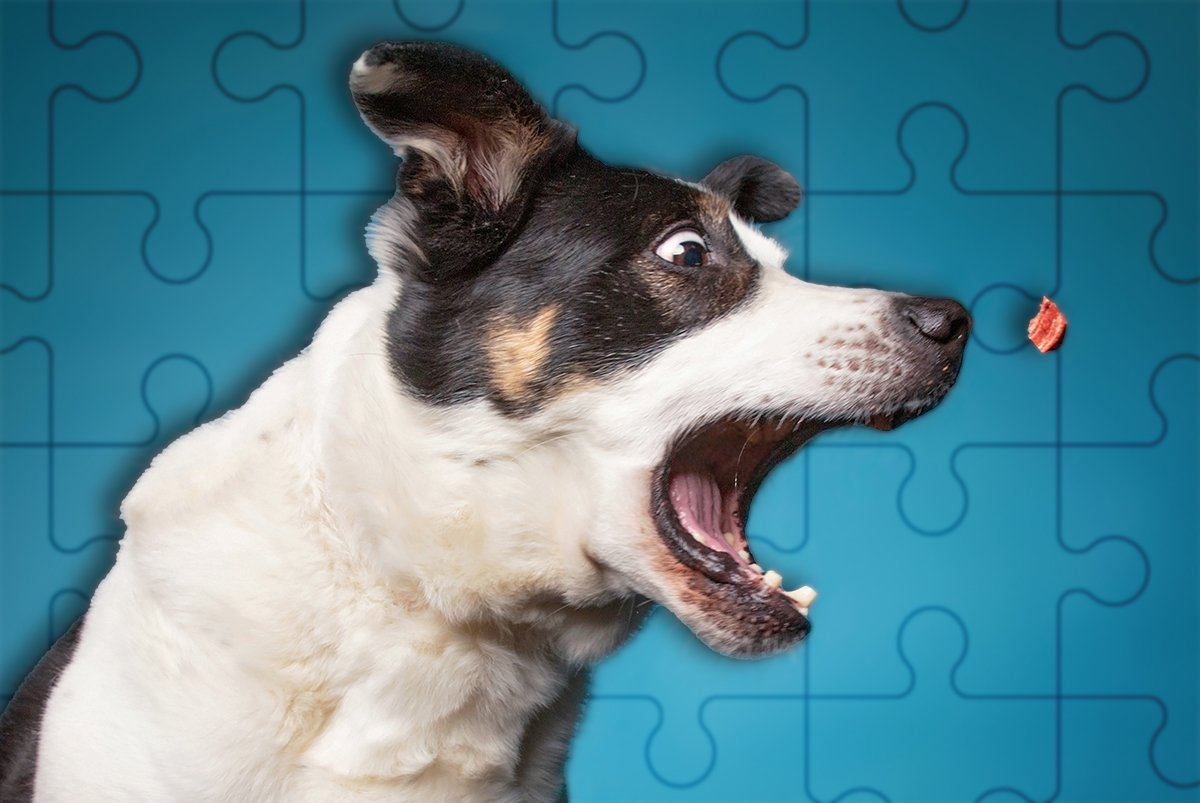
Puzzle toys can be a helpful tool in treat training. art: Bay Woof photo: AdobeStock
Have you ever left your dog alone for the day and come home to an unpacked garbage can, with remnants of food and packaging strewn across your kitchen floor? Or perhaps you’ve returned home from a hard day at work only to find the innards of your favorite slippers adorning your living room couch?
If the answer is yes, you’re not alone. But there are ways to manage and prevent your dog from redecorating your house with last night’s takeout boxes and torn up shoes. How do you keep your dog occupied and mentally stimulated when home alone? The answer is work-to-eat puzzle toys.
Dogs are genetically programmed to hunt for their food. This means one big reason for behavior problems in pet dogs is that they have so little work to do and so few mental challenges. Their food is given to them for free.
Before domestication, dogs worked very hard to eat. This predatory behavior is indicated by a sequence of distinct behaviors: hunting (sniffing, tracking, searching, scanning, waiting for prey); stalking; the attack sequence; and finally, the consuming. Dogs’ wild ancestors might have had to go for days without eating. Even if they successfully caught their prey, another animal higher up the food chain could come along and take their kill. Then the pack would have to start the entire sequence again.
Shelters and zoos have had success in decreasing behavior problems and improving the quality of life of many of their animal occupants by giving them problems to solve in order to obtain their food. This same environmental enrichment concept can be applied to domestic dogs, who thoroughly enjoy finding hidden food and dissecting their stuffed chew toys. If you’ve ever watched your dog tear apart a stuffed toy, ripping it to shreds and pulling all the internal fluff out, you’ve witnessed the predatory sequence in action.
Now let’s look at what our domesticated dogs normally do to eat. They often wait alone at home for hours on end until their people return from work. Then kibble is poured in a bowl. They eat it. The end. Does that sound like a satisfying predatory sequence to you?
Instead, we need to take advantage of our dogs’ natural instinct to solve problems and work to eat. There are many wonderfully creative, enriching ways to feed our dogs, and it doesn’t take much time or energy to give our dogs something to do when we leave them alone. What’s more, when we provide our dogs with appropriate outlets to practice their hard-wired predatory urges, we come home to our slippers and garbage cans intact and happy, enriched dogs, who have been busy all day and are ready to relax.
Some Work to Eat Options
We’ve all probably heard of Kongs at this point: the red or black rubber cone toys that can be filled with treats, food, peanut butter, or cream cheese. Kong was the originator of the rubber work-to-eat toys, and they deserve a lot of credit for that. But today there are a slew of other options for enriching your dogs’ life through work-to-eat methods, which are now available wherever you buy your pet supplies.
For example, West Paw Designs makes eco-friendly toys in all sorts of sizes and shapes. Personally, I like these a little better than Kongs because they are initially easier for a dog to unpack, an important feature for pups just discovering the joys of solving puzzle toys (for ideas about stuffing work-to-eat toys, check out this video).
LickiMats are another great choice. These are flat rubber mats that you can fill up with your dog’s food and then smear wet food or canned pumpkin on top. You can also freeze these overnight to make the food last longer for your dog the next day.
Snuffle mats are fun options that don’t take much pre-planning. Just sprinkle kibble or treats throughout the mat and let your dog use his natural tendencies to sniff and find the rewards. These mats harness the canine drive to investigate their world using their sense of smell so it’s easy to understand why dogs love them so much.
Treat balls are another fun toy if your dog will be free in your house all day, not crated. Dogs learn to push the ball around with their nose or paw and chase the kibble or dried treats that spill out.
Finally, there are the more elaborate work-to-eat toys by Nina Ottosson, which take food puzzles to a whole new level. These are available in beginner, intermediate, and advanced levels so that your dog can progress to greater challenges as he becomes more proficient at puzzle-solving.
Stuffing Suggestions
Many people insert a few dog cookies into a food puzzle and call it a day. But that’s just scratching the surface of the creative challenges you can cook up for your dog. Here are a few pointers and principles to take your toy-stuffing prowess to the next level.
The level of difficulty should be appropriate to the dog’s experience and temperament. Is he the persevering type or a “giver-upper?” Any increases in level of difficulty should be done gradually, so the dog succeeds while developing perseverance. In other words, start easy and then make it tougher.
For easier stuffing, pack the toy loosely with small, easy-to-fall-out pieces.
For a greater challenge, pack the toy more tightly with some big pieces of food that take concerted effort (and hole-squishing) to extract.
Use softer foods like peanut butter, cream cheese, canned food, or baby food to hold the smaller bits inside the toy.
Wrap a stuffed food toy in an old sock or clean rag, or enclose it in an old margarine or other food container to increase the level of difficulty by “nesting.”
Hide stuffed or nested puzzle toys around the house so your dog has to hunt to find them before unpacking them.
Give him all of his meals using food puzzles, especially if he is a particularly “busy” dog.
Stuff meat, mashed potatoes, or other foods into the toy and then freeze the whole thing for longer-lasting enjoyment. Or plug a Kong’s small hole with peanut butter and fill the cavity with broth, then freeze this to make a “Kong-sicle” (this can be messy – it’s best to give it to your dog outside!).
Remember to clean your work-to-eat toys regularly with a bottle brush and/or in the dishwasher.
Other Benefits of Work to Eat Toys
ALONE TIME TRAINING. Work-to-eat toys are a good way to turn your every departure into something positive for your dog. I like to stuff multiple work-to-eat toys ahead of time and place them in my freezer so that every time I leave, it predicts a fun day of unpacking stuffed toys for my dog. He’s not only distracted when I leave him home alone, he’s eagerly awaiting my departure because he knows it will be puzzle time for him!
Puppy Play Biting/Mouthing
If your puppy or young dog is chewing inappropriate objects, work-to-eat toys are a great alternative. If your pup has lots of “legal” outlets - like stuffed toys for protracted chewing and exercising their jaws - they will be much less likely to gnaw on valued items in your house or to use those needle-sharp puppy teeth on your hands during play sessions.
Behavior Management When Guests Come to the Door
Another way to incorporate puzzle toys into your dog’s life is to use them for polite door greetings. Cue your dog by saying “Go to your bed,” then lure him there and reward him with an enrichment toy for lying on his bed. Barring any resource guarding issues, a tie-down or tether can be helpful when first introducing this ‘down time’ - and with a tightly stuffed enrichment toy, you’ll have a dog who’s happy to stay on his bed for the duration. This is also a great strategy for family meal times when you’d like to prevent your dog from begging at the table. Set him up on his bed with his own meal stuffed into a toy and let everyone eat in peace.
Crate Training
If you’re helping your puppy or adult dog adjust to being confined in a crate or a long-term confinement area, providing him with an enrichment toy to unpack in this “safe zone” is a great way to build positive associations with being confined or alone.
In short, you’ll find a gold mine of enrichment opportunities by just feeding your dog’s meals through work-to-eat toys. So stow away that dog bowl and pick up a puzzle toy for your dog instead. Once you become used to feeding your dog’s meals through puzzles, you’ll find it doesn’t take that much more effort on your part, but provides a wealth of enrichment for your pet. Remember, a tired, enriched dog equals a well-mannered dog…and a happy dog at that!