The Smile Effect: How Dogs Unlock the Joy in Strangers
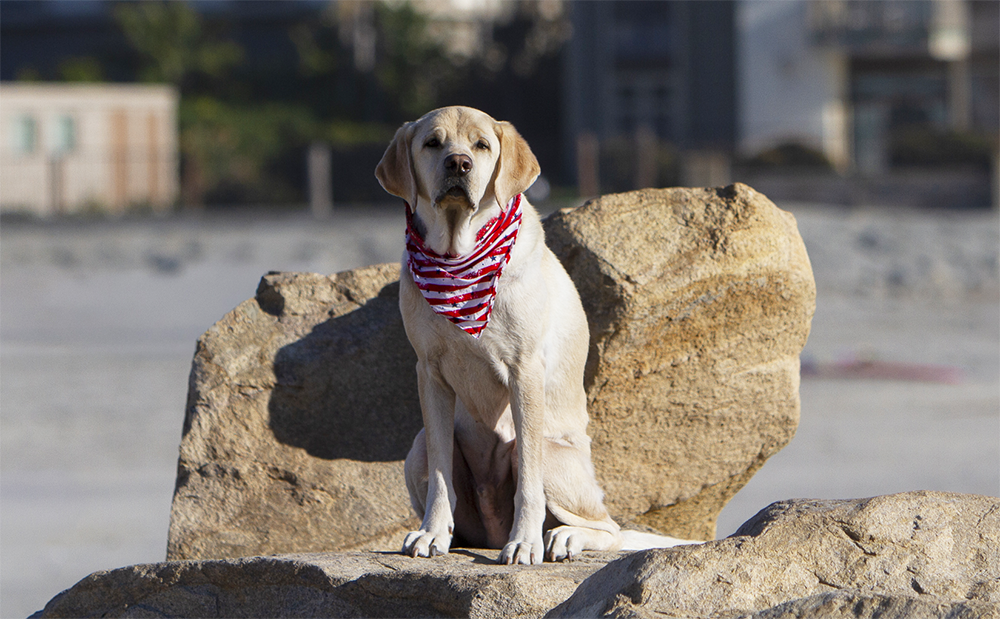
Hollis garnered smiles everywhere he went. photo: Mark Ruefenacht
San Francisco’s Fisherman’s Wharf is a place built for sensory overload. The snap and sizzle of crab pots, the bark of sea lions on the docks, the salt-laced wind off the Bay. It’s a stretch of the city where everyone seems to be looking somewhere else, wandering to the next tourist attraction, lost in their own orbit. It is not, by any measure, a place where strangers make eye contact. And it is definitely not a place where strangers smile at one another.
Which is exactly why I chose it.
I wanted to prove a hypothesis I’d had for years as a service dog handler, something anyone who’s ever walked with a dog already knows in their bones: that a dog beside you changes the way the world sees you. Not in some vague, feel-good way, but in measurable reactions.
A Weekend of Smiles
On the Saturday and Sunday of my experiment, I selected a roughly 500-foot stretch of Fisherman’s Wharf and walked it repeatedly, wearing a discreet action camera so I could later review the footage in slow motion. The protocol was simple: walk at a casual pace, offer a genuine smile to the people I passed, and count who smiled back. I did this five times each day without my service dog, and five times with her walking calmly at my side. I excluded anyone who was already smiling or laughing in conversation with a companion. I was only interested in smiles that were returned to me, a stranger in the crowd.
Over the two days, I passed 893 people. When I reviewed the footage, the results were striking - and honestly, even more dramatic than I had expected.
Walking alone with a smile, approximately 3.7 percent of people returned my greeting. That’s roughly one out of every 27 strangers, a lonely ratio on a crowded waterfront. But when my service dog walked beside me, that number leapt to approximately 58.6 percent. More than half the people I passed broke into a smile.
Let that sink in for a moment. The same person. The same smile. The same stretch of sidewalk. The only variable was the presence of a dog - and it shifted the human response by more than fifteenfold.
Now, I’m a scientist by profession. I work in the measurements of forensic sciences so I’ll be the first to admit this was an informal study, not a controlled laboratory experiment. But even with generous margins of error, the gap between those two numbers is enormous. Something powerful was happening, and it wasn’t subtle.
The Invisible Bridge
A dear friend of mine who is visually impaired once described the difference this way. When she navigated public spaces with her white and red cane, people moved out of the way, then kept moving away from her. The cane cleared a path, but it also cleared the space around her of human warmth. Strangers stepped aside the way they might step around a puddle: politely, reflexively, without engagement.
But when she began working with a guide dog, everything changed. Instead of parting around her, people were drawn toward her. They said hello. They asked about the dog. They lingered. The dog didn’t just guide her through crosswalks and around obstacles. It guided strangers toward her, across the invisible gulf that disability so often creates between people.
Her experience isn’t an outlier. It’s a pattern, and science has been documenting it for decades.
What the Research Tells Us
In a landmark 1987 study published in Anthrozoös, researchers Hart, Hart, and Bergin found that wheelchair users accompanied by service dogs received dramatically more friendly approaches from strangers during shopping trips, averaging eight social greetings per outing compared to just one without the dog. The participants didn’t just report more smiles and conversations; they reported going out more. With a dog beside them, they ventured out in the evening more frequently, reclaiming public spaces they had once avoided.
A follow-up study by Mader, Hart, and Bergin in 1989 extended this finding to children with disabilities, observing the reactions of passersby to children in wheelchairs in shopping malls and on school playgrounds. The pattern held: friendly glances, smiles, and conversations were all substantially more frequent when a service dog was present.
In 2000, researchers McNicholas and Collis at the University of Warwick took the question further, using a highly trained dog that was deliberately taught not to solicit attention from passersby. This was a key design choice; it ensured that any increase in social interaction was driven by the dog’s presence alone, not its behavior. The results were clear: simply being accompanied by a dog significantly increased the frequency of interactions with strangers, regardless of the setting. Even the handler’s clothing - smart or scruffy - mattered less than whether a dog was present.
More recently, a 2015 study published in PLOS One by researchers from the University of Western Australia and the Harvard T. H. Chan School of Public Health found that pet ownership - and dog walking in particular - was a significant driver of neighborhood friendships and social support networks. Dog owners were far more likely to have befriended someone they met through a pet-related connection.
The collective weight of these studies points to something researchers now call the “social catalyst” effect. Dogs don’t just make us feel better. They change the social physics of a room, a sidewalk, a park. Dogs lower the invisible barriers that keep strangers strange.
Why Dogs Work This Magic
What is it about dogs that flips this switch? Why does a four-legged companion transform a person from invisible to approachable?
Part of it is biological. Research has shown that when humans and dogs gaze into each other’s eyes, both experience a surge in oxytocin, the same hormone that floods a mother’s brain when she holds her newborn. This is the chemistry of bonding, and it doesn’t stop with the handler. When a stranger sees a person with a dog, something softens. The dog signals safety, warmth, and approachability. It’s a wordless social credential that says: this person is trustworthy. This person is kind. You can approach.
Part of it is also conversational. A dog gives strangers something to talk about. It’s an instant shared interest, a ready-made icebreaker. In a culture that is increasingly isolated - where we walk through crowds staring at our phones, earbuds sealing us off from the world - a dog cuts through the noise. It gives people permission to connect.
And part of it, I believe, is something simpler and harder to quantify. Dogs are joyful. They carry this in their gait, in their easy attention to the world, in the way their presence seems to announce that right here, right now, things are okay. People respond to that joy the way they respond to sunlight - instinctively, gratefully, with a warmth that surprises even themselves.
More Than a Smile
I’ve been partnered with service dogs for the past 25 years. My current partner, Empress, is my fifth service dog. Empress provides both medical alert and guide work, and I can tell you that the tasks she performs are extraordinary and life-changing. But I can also tell you that the smiles she brings - from strangers on a sidewalk, from a child in a stroller, from a tired traveler in the airport - are their own kind of medicine.
We live in a time when loneliness has been declared a public health epidemic. Researchers warn that social isolation carries health risks comparable to smoking 15 cigarettes a day. In that context, the humble dog walk starts to look less like a chore and more like a public health intervention - one that costs nothing, requires no prescription, and comes with a wagging tail.
Back at Fisherman’s Wharf, what I measured was smiles. But what I witnessed was something bigger: nearly nine hundred small moments in which a dog’s presence determined whether two strangers would remain strangers or, however briefly, become neighbors. Fifty-eight percent of the time, the dog tipped the scales toward connection.
Dogs bring joy. The numbers prove it. But you don’t need numbers to know that. You just need to walk down the street with one furry friend and watch the world open up.