Sacred Idleness: Why Teaching a Dog to Chill is the Best Gift You Can Give
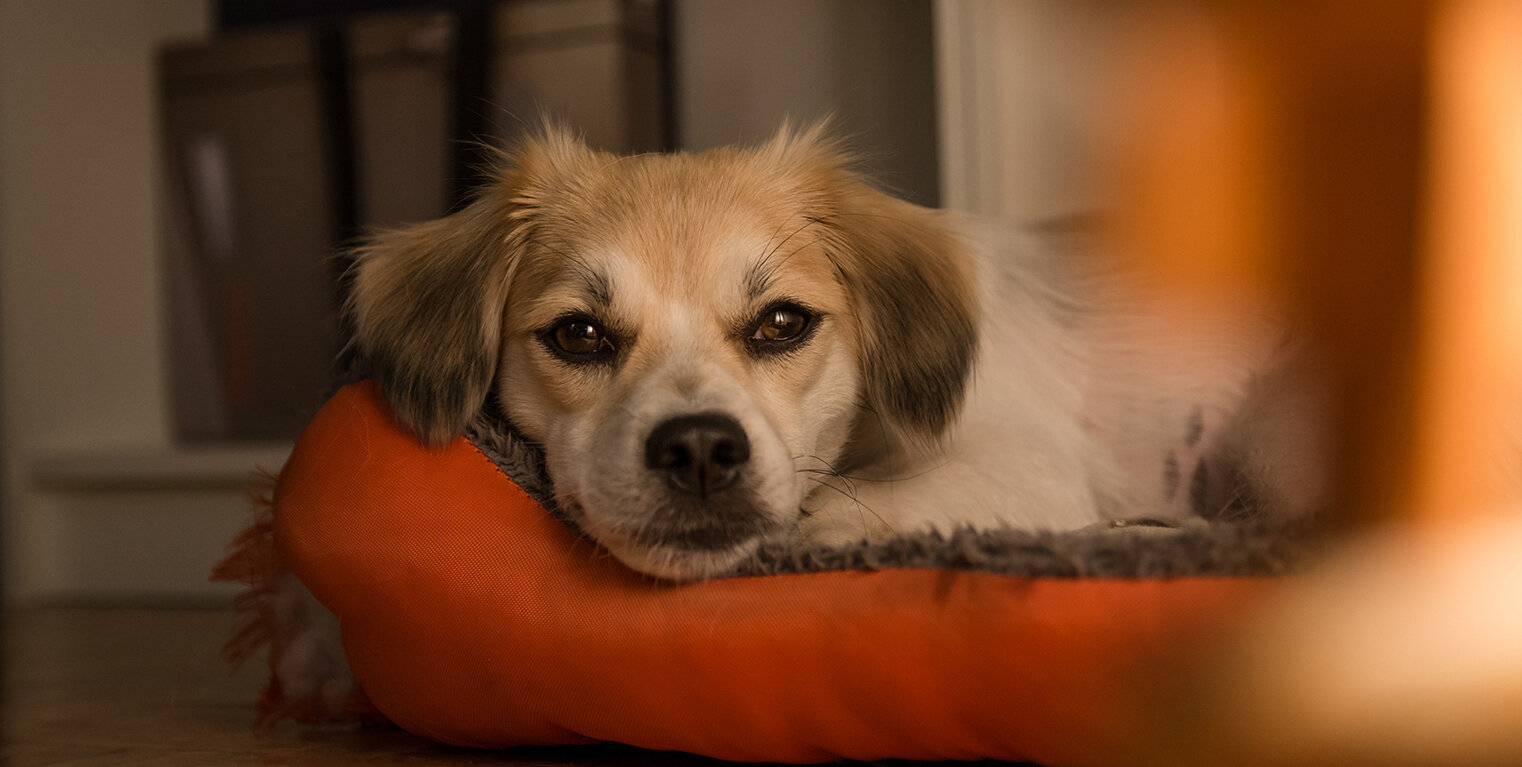
Teaching your dog to chill out will be a skill for a lifetime.
There is a cool, blue-gray light outside and a hint of fog hovering over the field as I sit down to write, just before sunset. I am reclined in a comfy chair, with a cup of spicy hot chocolate by my side, my lap desk resting on my legs, my feet warmed by a fire. My computer is on, but I gaze out the window, watching deer stroll by in the dusky mist, helping themselves to apples from my tree. All is quiet and calm as my canine crew of four laze about the room. My heart fills with joy as I watch them snuggle and snooze in their favorite spots. I am in my happy place, doing what I love doing best, surrounded by my favorite furry beings. As I soak up the scene, a favorite quote comes to mind.
“Work is not always required. There is such a thing as sacred idleness.”
~ George MacDonald
Ahh… sacred idleness. A quality too often overlooked by many dog lovers.
I have four young, energetic dogs who are active in everything from hiking to competing in dog sports. We get out and move nearly every day. I work hard to keep them in peak physical condition, and I work their brains, too. Playing with and training my dogs is a joy. Part of the reason I love having dogs in my life is because they keep me active.
That said, whenever I’m coaching new puppy owners, one of the first things I tell them is that puppies require a lot of down time. And I mean a lot. A young puppy will sleep up to 18 hours a day, sometimes more, which is exactly what he needs. So put that puppy down and let him sleep.
Most people are very aware that they should socialize and exercise their pups. Often when a puppy or adolescent dog won’t settle down, the inclination is to spend more time running him ragged - sign up for more training classes, buy more toys for mental enrichment, keep that pup busy, tire him out so he can sleep. In fact, what that puppy probably needs is rest.
Not only do pups need rest, they need to actively practice down time so they become good at it. Chilling out is a skill. All that time running around, meeting new people, seeing new things, going new places may actually be overstimulating your puppy or exhausting him to the point of overtiredness. Worse, it may be building a habit not to relax.
And guess what? An overtired, overstimulated puppy looks a lot like a puppy who needs to burn off some energy. So if your puppy is biting and mouthing all the time, or cranky when you pick him up, or constantly on the go and getting into things, he may just need a passive stuffed rubber chew toy (the equivalent of a canine pacifier) and a long nap. Give it a try for several days in a row and see if you don’t notice a difference.
Yes, I am a fan of early training, environmental enrichment, and socialization. And yes, my puppy school popularized the idea that a young pup should meet 100 people by 12 weeks of age. But enriching socialization and the need to chill out are not mutually exclusive. Most puppies thrive best when they have one or two short outings a day, no longer than 10 minutes each, over the course of a week at first. As your pup grows, you may extend the length of these field trips and meet-and-greets, but keep in mind that, at some point, you cross the line from enriching and exercising your pup to unintentionally creating a social junkie or crazed marathon runner.
You do not always have to keep your dog busy. In fact, it can be detrimental to their wellbeing if they don’t know how to settle down and relax. Latent time between training sessions also seems to help dogs absorb their lessons better. A relaxed dog is happier, both physically and mentally.
One of the best things you can do for your dog is to teach him to lie quietly on a mat while you work. Start with a few minutes at first and increase the length of chill time gradually. Give your dog a chew project, such as a knuckle bone, one or two days a week, rather than going for that run or to the park. Balance your dog’s activity with down time, just as you would for yourself.
As H. M. Tomlinson wrote: “There is precious little hope to be got out of whatever keeps us industrious, but there is a chance for us whenever we cease work and become stargazers.”
So take a break from industry. Sit back with your pup and look for the Dog Star in the night sky. Remember, for dogs and for humans, there is more than one way to shine.