Fueling the Working K9 on a Budget: How to Feed Your Active Dog Without Breaking the Bank

Java atop Mt. Tam during a traing session. photo: Yvette Skinner
As a Search and Rescue K9 handler, I need to feed my dog like the canine athlete he is. With his physically demanding job and search deployments that can last up to seven hours a day in punishing conditions, his nutritional needs far exceed those of less active companion animals. So how do I fuel my K9 for success without putting a strain on my family’s limited budget?
For those of you with very active dogs at home, here’s how I did it.
Show Me the Science!
First, I followed the science to learn about a recommended macronutrient profile including proteins, fat, and carbohydrates. The most helpful scientific paper that I found in my research was “Nutrition for Working and Service Dogs” by Joseph Wakshlag, DVM, PhD, and Justin Shmalberg, DVM. Containing over 100 citations for dog food and performance studies - all published in reputable, peer-reviewed journals - this paper is one of the few studies that fleshes out the optimal nutritional requirements of “intermediate distance” canine athletes, such as hunting dogs or Search and Rescue K9s.
It’s All About “ME”: Metabolizable Energy
To understand the science of a working dog’s nutrition, you first have to understand the language. Dog food manufacturers report nutritional information in terms of “guaranteed analysis” such as “crude protein 28%.” Unfortunately, that’s not the way that dog food scientists express protein and fat levels. Instead, they use “%ME from protein” and “%ME from fat” - meaning the percent of metabolizable energy from protein and percent of metabolizable energy from fat. Metabolizable energy is the amount of energy in food that’s available for the body to use after accounting for energy losses in urine and feces. Still with me?
It’s also important to know that proteins and carbohydrates provide 3.5 calories per gram whereas fat provides 8.5 calories per gram. So if a dog is eating food with 20% crude protein and 20% crude fat, the fat is obviously contributing way more calories than the protein component.
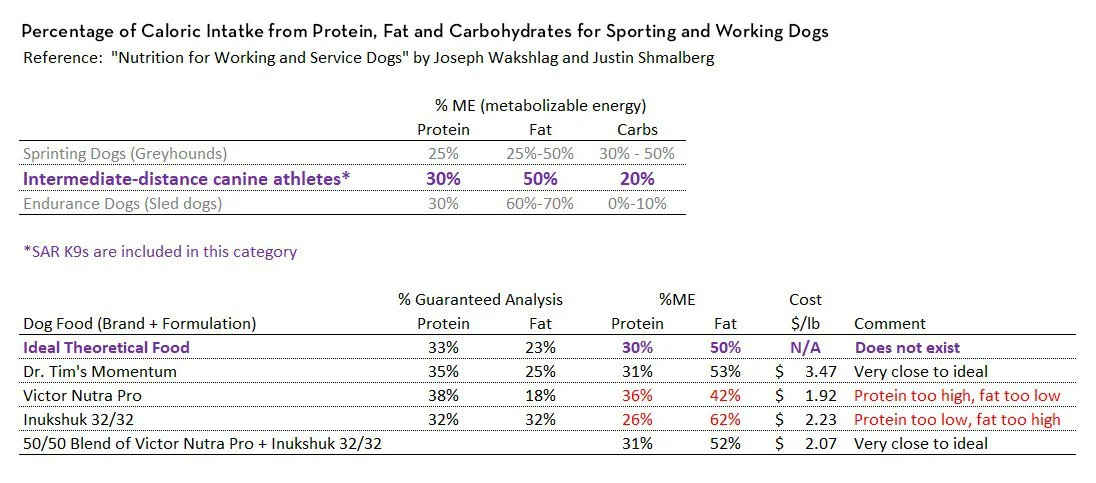
Comparing macronutrients can help you decide what foods are best for your athlete. image: Yvette Skinner
Finding Foods that Fit
Once I had the science under my belt, my next challenge was finding the right diet at a price that fit my budget.
For “intermediate distance” canine athletes like mine, Wakshlag and Shmalberg recommend a diet with 30% ME (metabolizable energy) from protein, 50% ME from fat, and 20% ME from carbohydrates, which is equivalent to a dog food with a guaranteed analysis of 33% crude protein and 23% crude fat.
Unfortunately, I wasn’t able to find a single commercial dog food that exactly matched these proportions. In fact, the vast majority of commercial dog foods contained too little protein and fat and too many carbohydrates.
During my search, I also got price quotes from a couple brands specializing in commercial raw diets, freeze-dried raw diets, and fresh food diets. The price difference was shocking compared to commercial kibble, especially looking at the lifetime costs, assuming a 10-year lifespan. Those foods were definitely out of my price range.
The commercial dog food I found that was closest to my pup’s recommended ratios was Dr. Tim’s Momentum but that still carried a hefty price tag of $138.79 for a 40-pound bag, or $3.47 per pound, which is expensive for a kibble type dog food. Could I find an alternative that would be kinder on my wallet? With a little math and creativity, I could.
By mixing a high protein dog food with a different food high in fat, I was able to very closely match my dog’s ideal macronutrient profile. A combination of Victor Nutra Pro (crude protein 38%, crude fat 18%) and Inukshuk 32/32 (crude protein 32%, crude fat 32%) produced a food with 31% ME (metabolizable energy) from protein, 52% ME from fat, and 17% ME from carbs. Close enough!
But What About the Price Breakdown?
Victor Nutra Pro costs $76.69 for a 40-pound bag, or $1.92 per pound. Inukshuk 32/32 costs $97.95 for a 44-pound bag, or $2.23 per pound. That means a 50/50 blend of the two works out to $2.08 per pound, a veritable bargain compared to the alternatives - and all without compromising my dog’s nutritional requirements. (Of course, getting the macronutrient profile right was just the first step. To feed an optimal diet, I also needed to add supplements like fish oil, UCII collagen, and psyllium husk powder to provide other health benefits. But that’s a topic for another day.)
It took some research and a little math on my part, but that’s a small price to pay for a healthy, active Search and Rescue K9 like my dog