Cone of Shame or Halo of Healing? Managing Your Pet’s Attitude - and Your Own

The "halo of healing" is an inexpensive way to ensure unobstructed wound-healing after a veterinary procedure. photo: AdobeStock
When I was 13, my family took care of a Great Dane named Benchley while his owners, our friends, were overseas for a year. Benchley soon developed a painful condition called happy-tail, a chronically bleeding tail tip caused by hitting walls while wagging.
After bandages and antibiotics failed, the vet recommended amputation, but my mom said not yet. She devised a contraption of protective metal rods that we taped to his tail, enclosing the wounded tip like a cage around a workshop light bulb. Not only did this 120-pound force of nature now wield a two-foot plastic cone around his head, but he swung a metal mace on the rear end. Still, it kept the tail wound clean, open to the air, and away from his tongue, allowing it to finally heal.
This took six weeks. Our legs were bruised, our living areas reduced to sturdy furniture only, but we triumphed. I learned then that we could not have won the battle if we’d allowed him to remove his plastic cone even for a moment. Benchley was sly and fast. Without the protective cone, he could chew his tail raw in the time it took us to scoop his kibble.
Why Are Cones Necessary?
Also known as an Elizabethan collar or Cone of Shame, this simple plastic protector is the cheapest insurance there is to promote a faster recovery after surgery or any other wound to your pet. That’s why I prefer to call it the Halo of Healing.
The problem is that dogs and cats often want to lick or chew at incisions or wounds. While it may seem like licking is just nature taking its course, we know that wounds heal more quickly and with less pain if left alone. But this knowledge does not erase the emotional distress we humans feel when we see our pets bumbling around the house in such an awkward piece of plastic.

An inflatable Elizabethan collar placed first will help prevent the cone from sliding down on the neck so that paws cannot be licked. photo: Dr. Lissa Richardson
As a veterinarian for 38 years, I have brainstormed with hundreds of pet parents about how to manage their dogs when they need to wear a cone. But it turns out, we must manage ourselves first.
We feel like bad pet parents. We feel sorry for our pets because we remember that their lives were different without the cone. But what do our pets know? They live in the moment, one day at a time. And this day is the day they wear the funny cone. They do not know that most other dogs are free of these collars right now. Nor do they remember that they didn’t always have to wear it. And if they did, would they care?
In fact, dogs have never had an explanation for anything and are not expecting one. It doesn’t occur to them to wonder why things have changed and how long this might last.
As a dog parent, you get to set the rules. You have already given them the rules of housebreaking, leash walking, and not jumping up on strangers. This time, you set the rule that for two weeks they will have a funny collar on. Remind yourself that you are doing the right thing, the best thing for their health, and let yourself really feel that. Animals are very intuitive and can pick up on what we are feeling. Do not be sad or apologetic, be upbeat and firm. This is the way it will be for a short time only.
Acclimate Your Pup First
If possible, the best way to minimize their upset is to familiarize them with the Halo of Healing before it is needed. Have a cone at home, place it on them for 10 minutes, give lots of treats, and then take it off. Slowly increase the amount of time they wear it. Place it on them before meals or walks so they will associate it with good things.
This is easiest for puppies, but any aged dog can learn new things. If you know your dog will be needing surgery, take home the recommended plastic cone collar right away and get them used to it before the procedure. Give them lots of praise and treats. Make this fun!
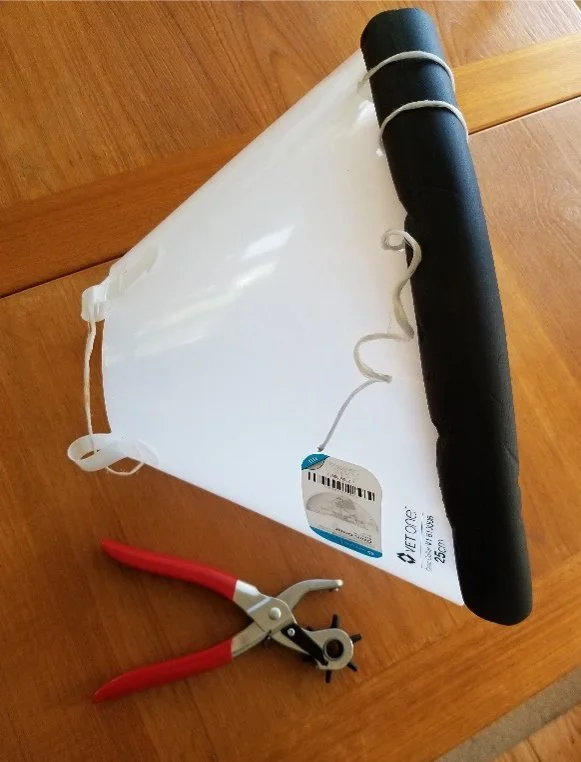
Pipe insulation can be placed over the end of the cone to soften the edge. Hold it in place with tape or soft twine threaded through holes made with a leather punch. photo: Dr. Lissa Richardson
Troubleshooting Cone Issues
Here are a few tips for troubleshooting common cone-related issues:
If your dog is able to pull off the cone, place a harness on them and attach the cone to the harness.
If they can still get to their injured area even in a large cone, put on an inflatable Elizabethan collar first, then the cone. In a pinch, you can put a rolled-up towel secured with duct tape around their neck, then place the cone over that (see illustration).
If your dog is using the edge of the cone to rub the wound, place pipe insulation around the edge and tape it on or secure it with some soft twine threaded through holes punched in the plastic (see illustration).
Raise your dog’s food and water dishes and move them out if they’re in a corner so that your dog can position his head directly over the bowls.
Inflatable Elizabethan collars can work but only for wounds on the body. Dogs can still reach any wounds on their legs in these.
Fabric Elizabethan collars are not reliable. Some dogs will crumple them to get to their wounds.
Onesies and fabric covers are not reliable as dogs can chew through them.
Despite all the training and tricks, there are some dogs who simply do not tolerate Elizabethan collars, though I have only met approximately five in my many years of veterinary practice. If you own one of these dogs, talk to your veterinarian about heavy sedation and pain management following any surgery or other wounds.
As always, if you encounter any problem with your dog, ask your veterinarian for help and be as specific as possible about the issue.
Remember, most animals are adept at managing life’s changes without any explanation whatsoever. So say goodbye to your guilt and embrace the Halo of Healing. It’ll help them get better more quickly with less pain - and isn’t that what we all want for our pets?