Beyond Love: Building Bonds With Your Dog
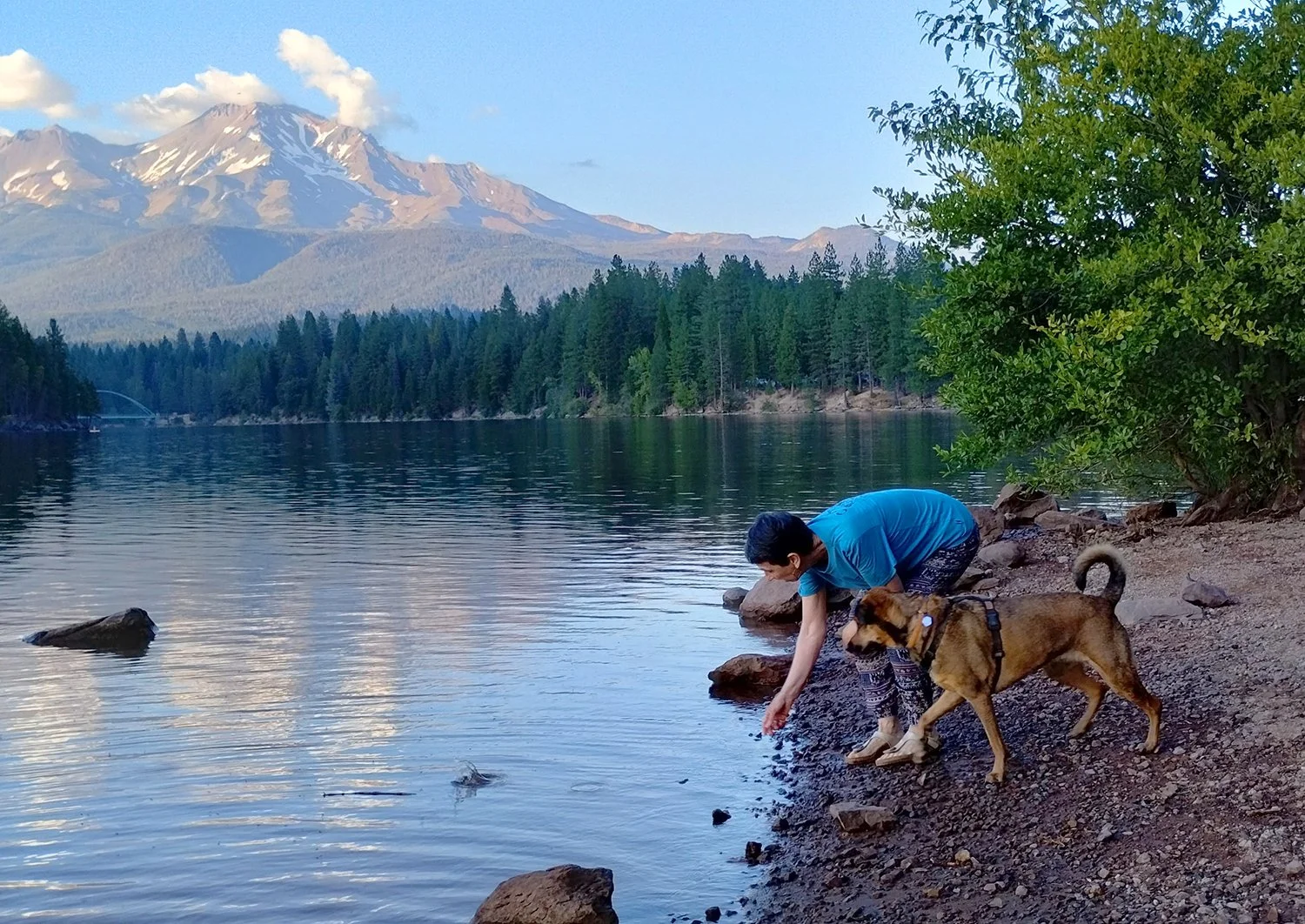
Judy & Leah at Lake Siskiyou. photo: Judy Shevelev
Often my wife and I start the day with a big dog love fest on our bed. When our pups hear the alarm buzzer or our waking voices, that’s their cue to get up from their own beds, enjoy a delicious downward-dog stretch, and make their way up onto our bed with us.
Our younger dog jumps up effortlessly, curling into a ball between us as close to our pillows as possible. She’s a fanatic about cushions and loves nothing better than to nestle in between several and rest her head on another.
Our older dog delights in stretching again as he slowly makes his way onto the bed, then lies down and rolls onto his back with his front legs reaching upwards. We softly scratch his entire underside over and over again. Despite being a well-known glutton, he chooses to stay put and soak up this attention even after one of us gets up to prepare breakfast.
This special time is unique in our day for many reasons. We are all rested, present, and relaxed; the bed is warm and inviting; and the energy is one hundred percent loving. It’s a precious moment when the bond between us and our dogs grows exponentially.
Most of us dog people experience times like this with our pups regularly. After all, that’s a big part of why we have dogs in the first place: they accept us unconditionally and offer a never-ending supply of love whenever we’re ready to receive it.
The Difference Between Love and Bonds
My dictionary defines love as an “intense feeling of deep affection” - and deep mutual affection is certainly present in our early morning love fests. But it defines bond as “a relationship between people or groups based on shared feelings, interests, or experiences.” Love and bonds are different, but both are important. The presence of love contributes to strengthening bonds, but lasting bonds cannot be built on love alone.
So how can we create strong bonds with our dogs? Playtime and outdoor adventures are great places to start, and we’re fortunate in the Bay Area to have such a wide variety of beautiful places to enjoy with our dogs.
But unfortunately, the activities we choose to share with our dogs are not always the same ones they would choose to share with us. Last summer, we attended a community festival where many people came with dogs. There was loud music, the street was crowded, and the sun was beating down on all of us. But many of the people seemed oblivious to what their dogs were experiencing. We couldn’t help but wonder if most of those dogs would have preferred to be lying at home resting quietly on a cool floor or a shaded, grassy lawn.
While we share many emotions and needs with our canine companions, we must recognize our differences, too. After all, we are humans; they are canines. When we pay attention to our dog’s needs and emotions from a species-oriented perspective, we create the conditions for our bond to grow stronger.
For example, we often get frustrated when our dogs stop to sniff everything while we’re walking them. We want to keep moving, but from the dog’s perspective, sniffing is the best part of the walk. That’s a difference worth honoring even if it does slow us down a bit.
Positive reinforcement training is another excellent way to build bonds with our dogs. They may not need further training, but dogs do enjoy learning new things at any stage of life as long as the process is stimulating, fun, and rewarding. Consider training your dog to do something useful, like picking up light objects you drop at home. Your dog will have a job and your back will thank you for it!
Know How to Communicate
How well do you understand your dog’s body language and the emotions behind it?
How does your dog manifest pain, or feelings of contentment, anxiety, or confusion? Though dogs can’t speak, they communicate with us through their behaviors and their body language. It’s our job to pay attention to what they’re telling us.
Good communication is a key to any solid relationship and is also essential for developing a strong bond with our dogs. When we know what our dogs are trying to tell us and respond accordingly, that builds their trust in us and helps them feel secure. Similarly, when we communicate appropriately with them, it avoids confusion and fortifies our bond. They learn that they can count on us, and they will feel good in our presence.
Having a strong bond with our dogs improves our daily lives in many ways. It eases potentially unpleasant activities, such as vet visits, because our presence helps them feel safer. Training a solid recall is much simpler when a strong bond exists because our dogs want to come to us. A strong bond makes virtually any activity we do with our dog easier and more pleasurable.
When the bond with our dogs is built on mutual respect and clear, loving communication, it relieves their stress because they know what to expect and can depend on us to be their guide.
That trusting bond leads to more love for everyone.
And isn’t that what we’re all longing for, anyway?