Mother Earth and the Mother’s Building: Where Art and Conservation Converge

photo: NASA's Goddard Space Flight Center
Friday, April 22, is Earth Day, meaning it's high time for all of us to pay our respects to Mother Earth.
Let's face it. We’ve been acting like a bunch of rude tourists for too long now. In fact, humans would average zero stars if the universe had a Yelp-like rating system. But I’m hopeful we can change, and Earth Day offers an opportunity to reset our intentions.
Let's start by acknowledging that Mother Earth is a rare gem with no habitable planets within driving distance. Then, let's take some actions to preserve what we have.
How Rare is Earth?
This past winter, I took a course called "The Wonders of the Universe" at the University of San Francisco Fromm Institute For Lifelong Learning. Taught by Dr. Andrew Fraknoi, a born educator capable of distilling complex physics and astronomical concepts into everyday language, it helped me understand (mostly) our planet’s history and place in the universe.
Spoiler alert! Earth is rare. It took over 4.5 billion years to get where we are today. Our planet and its life forms evolved slowly, first forming a protective layer to shield emerging life from ultraviolet radiation, as well as a magnetic field to protect us from other hostile solar nonsense (did I mention I’m not an astrophysicist?). Additionally, our weighty planet is held steady by a single heavy moon, providing us just the right tilt for four seasons. I could go on, but you get the point - we’re pretty darn rare here.
So while I applaud and encourage efforts by NASA scientists to make essential discoveries, we can’t use space exploration as an excuse to turn our back on Earth and all the species that call our planet home. There's a role for each of us in this effort. I found mine at the San Francisco Zoo and Gardens, thanks to my volunteer gig as a city Animal Commissioner.
Another Rare Gem at the Zoo
When I joined the Commission in 2015, I also agreed to serve as an advisor on the Joint Zoo and Recreation and Parks Committee. My role is simple: to attend joint committee meetings and advise on animal welfare issues that involve the San Francisco Zoo and our city’s parks.
At one such meeting, I met the remarkable Richard Rothman, a passionate advocate for the arts, who was there to update the committee on preservation efforts at the Mother’s Building, a shuttered historic building on zoo property. At first, I wasn't sure how such a building fit with the zoo's mission to connect people with wildlife and to inspire caring for nature to advance conservation action. Then I took a peek inside. The Mother’s Building, like Earth, is a rare gem. Could this nearly 100-year-old building be a space to inspire future generations to take action? I think so.
How Rare is the Mother’s Building?
First opened in 1925, the Mother's Building was part of Herbert and Mortimer Fleishhacker's ambitious plan to build a zoo and a swimming pool for the residents of San Francisco. The Fleishhacker brothers designed the Mother’s Building in honor of their late mother, Delia Fleishhacker. This tribute to one mother became a gift to all mothers.
Designed as a place for women and children to escape the sun and fog while enjoying the tranquility of the gardens and zoo, the Mother’s Building was a place of employment as well for matrons who doled out milk, sandwiches, bandages for minor injuries, and even parenting advice to zoo visitors.
In 1934, the Mother's Building also became a venue for women artists to showcase their talents. Five underrepresented female artists enhanced the space with intricate murals and mosaics funded by the Federal Arts Project as part of the New Deal program. Today, the Mother's Building remains the only large-scale New Deal-era art project created solely by women. Rare indeed.
Art and Conservation Converge
The exterior entrance to the Mother’s Building includes two elaborate mosaics, one featuring St. Francis among the animals and the other showing children enjoying animals and the park. The interior features striking New Deal murals depicting the story of Noah's Ark and its animals, which may be the first tale to highlight the importance of species preservation. Despite some water damage on the west wall, the murals remain exceptional.
Reimagined and Relevant
Over the last few years, Mr. Rothman, Recreation and Parks, the Arts Commission, SF Heritage, and countless allies have developed a set of ideas for the building's use. I'm pleased to report we're making headway. In February, we met with Supervisor Myrna Melgar and Supervisor Gordon Mar, their legislative aides, and Recreation and Park Commissioners to tour the building. As a result, Supervisors Melgar and Mar declared their intention to help secure funding for an economic feasibility study.
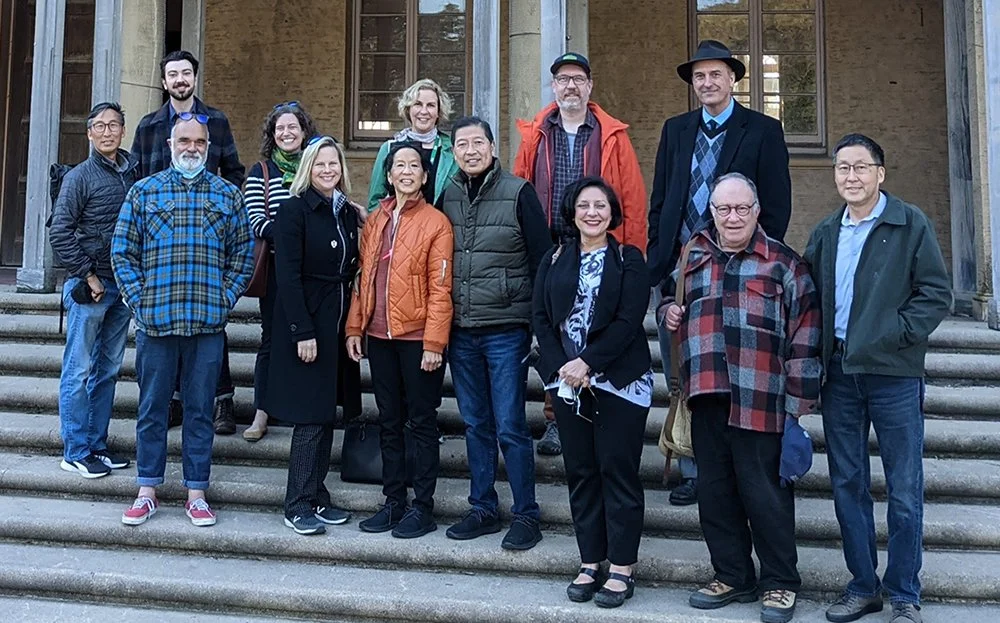
Bottom Row (L to R)- Artist/Gallery Owner John Lindsey, Rec and Park Commissioners Kat Anderson, Vanita Louie, and Austin Louie, Supervisor Myrna Melgar, Richard Rothman, Supervisor Gordon Mar. Upper Row (L to R): Former SF Supervisor Eric Mar, Legislative Aide Edward Wright, Rec and Park Director of Capital Planning Stacy Bradley, Animal Welfare Commissioner Jane Tobin, Rec and Park Planner Brian Stokle, and SF Heritage Woody LaBounty, Vice President of Advocacy and Programs. photo: Beverly Ng
Join us!
I leave you with no more spoilers, just an invitation to join us at the next Animal Commission meeting on Thursday, April 14, at 5:30 pm. We’ll present ideas about what's in store for the Mother Earth Building, and we are excited to hear what you think. We can also use your support. After all, whether it’s a building or our planet, Mother Earth needs all the champions she can get.
Please be aware that the views and opinions expressed in this column are those of Commissioner Tobin and do not necessarily reflect the official policies or positions of the Commission of Animal Control and Welfare.