All About Coyotes: What We Know and Don’t Know
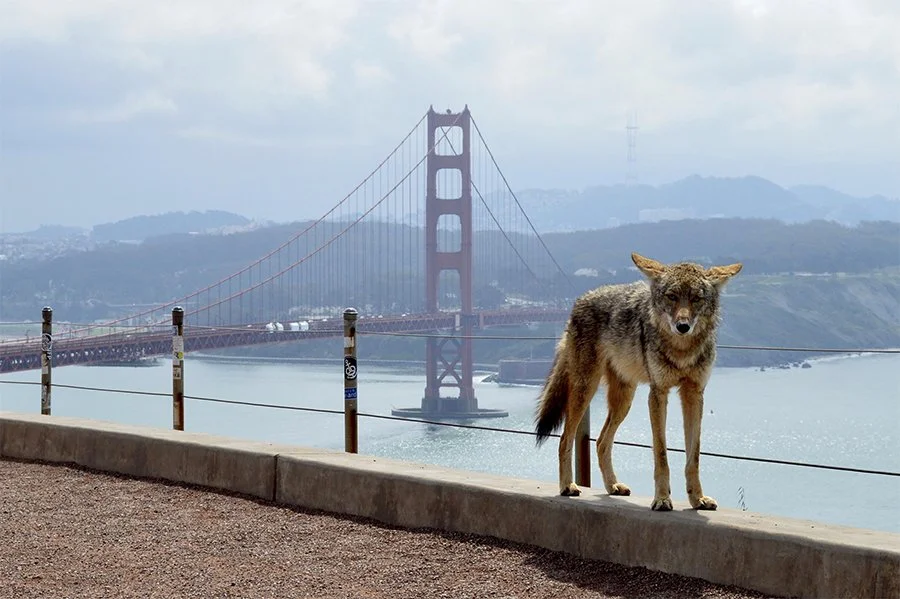
A coyote hanging out near the bridge during Covid lock down, 2020. photo: chicho1989, Reddit
Coyotes are a hot topic in the Bay Area these days. You may have wondered, is it just me, or do there seem to be more coyotes than usual? Are they a serious danger or has that threat been exaggerated?
Back in May, the Animal Commission invited Sarah Killingsworth to share Project Coyote’s efforts to raise awareness of our four-legged urban neighbors and strategies for coexisting with them. Her presentation was informative, but there’s still much work to be done to educate the public about these wild creatures who share our city and nearly every urban area in the country.
For this month’s Commission Tails, I’m providing information from Project Coyote, and I have also borrowed heavily (with his permission) from my fellow commissioner, Dr. Brian VanHorn, and his June President’s letter to the San Francisco Veterinary Medical Association (SFVMA). Dr. VanHorn has been sounding the alarm recently about the fact that our local coyote population has indeed increased. Our coexistence campaign with them isn’t entirely working, and, based on the recent shooting of three coyotes in the Botanical Gardens after a bite incident, our response to coyotes clearly needs work, too. In his letter, Dr. VanHorn also explains the disease risks of coyotes and raises some important questions.
Unfortunately, we’re a little late to the game on the thoughtful response part as this year’s new coyote pups are already weaning and venturing out, making interactions with people and pets more frequent. But before we go any farther, let’s take a step back and see how we got here.
Where Did They Come From?
San Francisco actually went almost a century without any coyotes in the city. Then around 2002, an ambitious pair became the first known coyotes to cross the Golden Gate Bridge and take up residence in the Presidio. Fast forward a couple decades, and we now have over a hundred of them in the city limits - possibly two hundred, if you include the overflowing population that has moved south of the city. Coyote parents generally put up with their offspring for a year or two, then tell the young ones to grow up and find their own territory. Since San Francisco is surrounded by water everywhere but to the south, that’s where most of the burgeoning population is going.
What Are the Concerns?
According to Commissioner VanHorn, we don’t have a lot of current data on how this particular population of unvaccinated, free-roaming apex predators is impacting the domestic and wild animals whose habitat they share. But he urged his colleagues and the public to consider a few topics of concern, which I’ll recap here.
Diseases
Any time we’ve touched on the tracking of vector-borne diseases in San Francisco, whether at commission meetings or in past Bay Woof articles, Dr. VanHorn has noted that San Francisco does a pretty poor job of surveying for vector-borne diseases. Based on his discussions with officials last year, the city does the bare minimum required to comply with state recommendations in this regard. For example, we only monitor for Aedes aegypti mosquitos due to concerns over West Nile Virus, but we don’t attempt to control or eradicate them.
The state does do some tick surveillance, but it is minimal. Meanwhile, veterinarians practicing in the Outer Sunset or Richmond districts and pet guardians who frequent those areas know that those grasses on the beach have become prime tick habitats. I don’t know what variety of tick we are seeing in the city (and I fervently hope it’s not the Ixodes, also known as the deer tick, spreader of the dreaded Lyme disease), but no one seems to be seriously monitoring the tick situation so it will inevitably be up to the veterinary community to watch for vector-borne diseases in our area.
At this point, I must give props to the Presidio Trust, which does significant surveillance of vector-borne diseases in the national park. But that news is not good. In the last few years, they have caught competent vectors for canine heartworm and human malaria.
Unfortunately, there is now convincing evidence that the re-emergence of Babesiosis and other tick-transmitted diseases are associated with expanding coyote populations in California. This raises legitimate concerns about the hundred-plus free-roaming coyotes that share fleas, ticks, and mosquitos around our city’s 49-square-mile habitat.
Other infectious diseases may be an issue as well. Parvovirus is a very rare concern in the Bay Area, but coyotes in Marin have been diagnosed with it. It has also been hypothesized that the spread of Leptospirosis and Distemper in the Bay Area is associated with our coyote population. In fact, when it comes to diagnosing diseases that have previously been uncommon in our region, our companion animals may be equivalent to canaries in a coal mine. Personally, I don’t believe Dr. VanHorn’s concerns are exaggerated, and I am nervously checking my leg for ticks even as I type this.
Predation on Pets and Wildlife
Dr. VanHorn and Project Coyote both note that, yes, coyotes will eat domestic animals when they get really hungry. Our best evidence indicates that only one percent of coyote meals are made up of domestic felines, which sounds comforting until you realize that is still one out of a hundred dinners that could be made out of your indoor/outdoor pet. Project Coyote strongly urges pet guardians to keep cats indoors, walk dogs on leashes, and never place food outdoors in neighborhoods where coyotes live.
Regarding wildlife, we now have an interesting environmental experiment going on in San Francisco with the increased coyote population. Coyotes are the undisputed most successful predator on the planet when it comes to habitating around humans. Animals like lions, tigers, and bears tend to conflict with people, which is one reason why you don’t see them strolling in an urban park after dark. Coyotes, however, do a good job of just blending in and minding their own business. Plus their favorite foods are rodents and garbage, with gophers and rats being a main staple. Sadly, it’s not surprising that rodenticide ingestion is a common way our San Francisco coyotes die.
As regular readers will recall, we’ve discussed the topic of poisons at numerous Animal Commission meetings, most recently when RATS (Raptors Are the Solution) shared the downstream effect of rodenticides. Along with our native raptors, humans are inadvertently killing coyotes with highly toxic rodent baits that stay in the animal’s system and go on to poison other animals higher up the food chain. In short, poisons are a risk inside and outside the home.
Another Voice: The Coyote Lady
Dr. VanHorn is always quick to acknowledge another voice in coyote discussions, Janet Kessler, so I shall do so here as well. While she refers to herself as a “self-taught naturalist,” Dr. VanHorn says Ms. Kessler’s documentation of the coyotes in San Francisco is some of the most exhaustive and professional work he has seen on the species. Visit her website coyoteyipps.com for more education on all things Canis latrans.
The Human Response
In case you’re wondering why we can’t just get rid of coyotes, know this about them: once they establish residence, they’re here for good. Coyote populations have remained unchanged over many years even in places where they put bounties on them to reduce numbers. In fact, Project Coyote notes that when the population is stressed, as it would be in an aggressive extirpation response, the coyotes simply respond with more pups. Extirpation won't work.
For a while, the San Francisco Police Department had a policy of shooting coyotes indiscriminately. There were also a few in the city that had to be euthanized because they had grown too used to people and became aggressive. More recently, three were shot at the Botanical Gardens after a coyote bit a child there. But shooting hasn’t changed the overall population or encouraged them to leave.

Coyote repelling vests save lives. This one is reviewed here. photo: Dog Gear Review
So What Can We Do?
Our only option at this point is to learn to cohabitate and continue to observe what impact coyotes have on our urban ecosystem. As an example of how Dr. VanHorn coexists and models good dog guardian behavior, look no further than the ridiculous, life-saving, Fury Road-inspired jacket that he makes his dog wear on off-leash trails. He knows people laugh at them, but he doesn’t care. The risks are real for both his dog and the coyotes.
The bottom line? Coyotes are here to stay. If you care about your pets, please keep them indoors or on a leash in areas coyotes are known to frequent and don’t put food outside. As for off-leash adventures, take a page from Dr. VanHorn and deck your dog in a life-saving vest even if it does look silly. With a little common sense and some basic precautions, we can learn to share our city safely with all the animals around us.
* * * * * * * * * * *
The next meeting of the Commission of Animal Control and Welfare will be held at 5:30 p.m., Thursday, August 8, in Room 408 at City Hall (1 Dr. Carlton B. Goodlett Place, San Francisco, CA 94102). Information concerning remote access to meetings is available on our website at https://sf.gov/animalcommission. Agendas for upcoming meetings are published 72 hours prior to that meeting.
* * * * * * * * * * *
Please be aware that the views and opinions expressed in this column are those of Commissioner Tobin and do not necessarily reflect the official policies or positions of the Commission of Animal Control and Welfare.