Accountability, Oversight, and Moving Forward
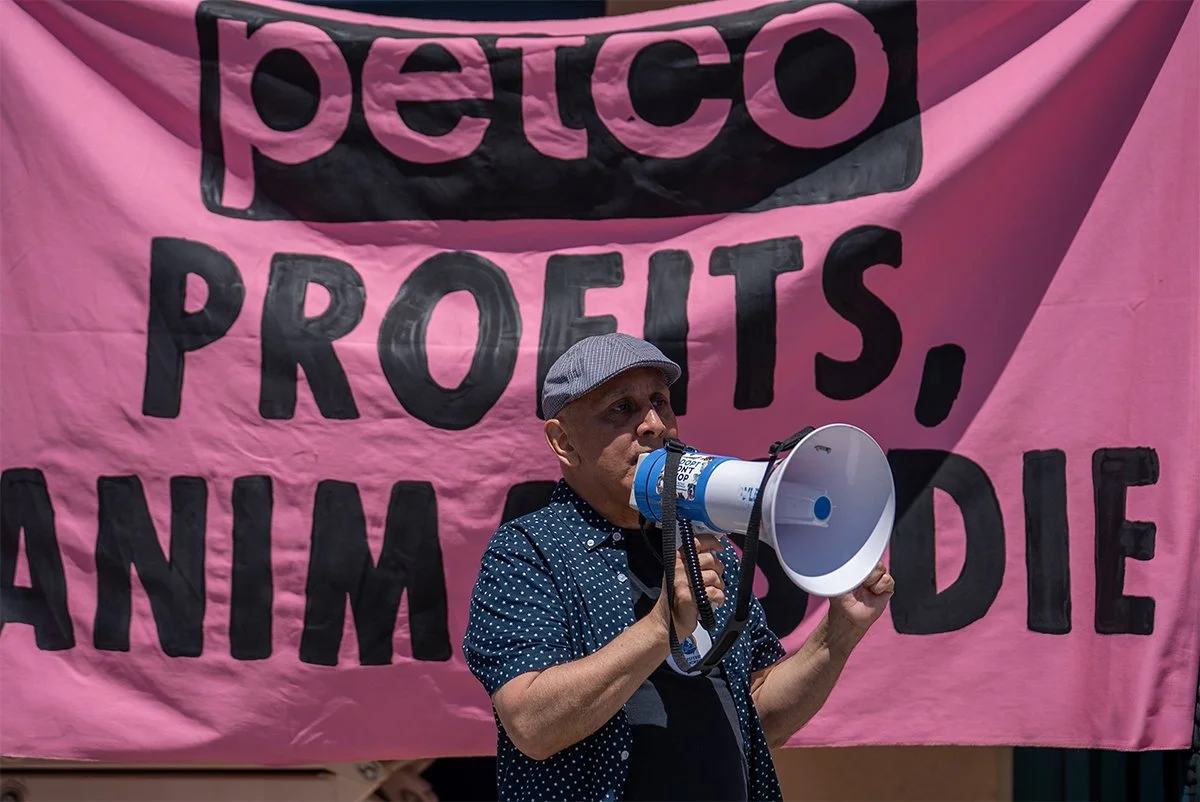
Author Michael Angelo Torres speaking about the animal retail sales ban outside of a Petco. photo: Carla Cabral
As spring makes way for summer and the days grow longer, June can be a time of new beginnings and renewed possibilities. The sunny weather (or at least “sunny” by San Francisco standards) adds to a feeling of optimism that makes progress seem just around the corner - or at least that’s the hope.
Meanwhile, it’s been another busy period for animal issues in San Francisco with the media attention to prove it. And without a doubt, the city’s most covered animal-related topic continues to be the San Francisco Zoo.
Last month, the long-awaited audit of the San Francisco Zoo conducted by the city and county Budget and Legislative Analyst Office was released. This audit had finally been performed after years of concerns raised by community members, animal advocates, reporters, and current and former zoo employees.
It was no surprise that the audit identified significant issues involving finance, transparency, and management practices. The report also included dozens of recommendations intended to address the zoo’s longstanding problems.
Specifically, the audit found concerns about spending practices and broader questions involving governance, oversight, and decision-making. To be clear, these are not minor administrative issues. They go directly to how public institutions operate, how trust is maintained, and how accountability and oversight is exercised — or not exercised — within our city’s governance.
These issues did not emerge overnight. For years, concerns had been raised by members of the public and advocates who repeatedly urged City Hall to take a closer look at the San Francisco Zoological Society, how it was running the zoo, and how it was caring for the animals there.
It is also worth noting that the San Francisco Zoological Society — the organization responsible for managing the zoo — did not fully participate in the audit process for months, according to the audit findings and public reporting. To me, that level of non-cooperation during an independent review is as revealing as the audit’s findings.
Yet immediately following the release of the audit, the Board of Supervisors approved an $8.5 million loan to the San Francisco Zoological Society, despite ongoing concerns about the zoo’s financial stability and ability to repay it.
That decision raises important questions. Should city officials extend public funds to an organization following documented concerns about governance, financial oversight, and cooperation during the audit process? If public resources are being committed after findings of this magnitude, shouldn’t there first be proof that the conditions that led to those failures have been addressed? Shouldn’t accountability come before funding, not funding before accountability?
There is much more I could write about the San Francisco Zoo’s model and direction, but I’ll continue that discussion in a future column, including my thoughts on why a more conservation-focused approach would better serve both animals and the community and why the proposed giant panda plan is both cruel and misguided.
But I will share one last thought on that topic now. If the zoo matters to San Francisco as much as city officials say it does, shouldn’t its accountability matter just as much? Institutions should not be protected from scrutiny simply because they’re popular or long-lived. In fact, their continued existence demands that they should be held to the highest standards.
Moving on, but still on the subject of scrutiny, the commission also took a look at another important issue last month: the retail sale of animals in pet stores.
At our May meeting, commissioners heard a presentation from Kitty Jones, an animal rescuer and volunteer with Compassionate Bay, and Liz Cabrera Holtz, the senior campaign manager with World Animal Protection U.S. The presentation and discussion covered a range of concerns: breeding practices and the realities behind “exotic pet” supply chains; the long-term burden that surrendered and abandoned animals place on rescues and shelters; and the limited legal protections for many species that are sold through pet stores in the Bay Area.
Following the presentation and discussion, the commission voted unanimously to support a recommendation prohibiting the sale of all animals in San Francisco pet stores. California already has a statewide law that bans the sale of dogs, cats, and rabbits in pet stores, and the commission would like to see San Francisco extend those same protections to all animals.
If San Francisco were to adopt this ban, it would be the largest city in the U.S. to do so, but it would not be alone. The city would be joining progressive communities like West Hollywood; Cambridge, Massachusetts; and Washington, D.C., among others. Other Bay Area communities are also considering similar actions, including the cities of Albany and Emeryville. Over 60 local and national animal protection organizations support such bans.
As always, we look forward to hearing your thoughts regarding these issues and any others related to animals in our city. If you are interested in helping or want to learn more about the retail sales ban or the SF Zoo, please reach out to us.
See you at City Hall!
* * * * * * * * * * *
The next meeting of the Commission of Animal Control and Welfare will be held at 5:30 p.m., Thursday, June 11, in Room 408 at City Hall, 1 Dr. Carlton B. Goodlett Place, San Francisco, CA 94102. Information concerning remote access to meetings is on our website (agendas for upcoming meetings are published within 72 hours prior to that meeting).
* * * * * * * * * * *
Please be aware that the views and opinions expressed in this column are those of Commissioner Torres and do not necessarily reflect the official policies or positions of the Commission of Animal Control and Welfare.