All’s Fair in Love and Bromance: Social and Mating Preferences in Dogs
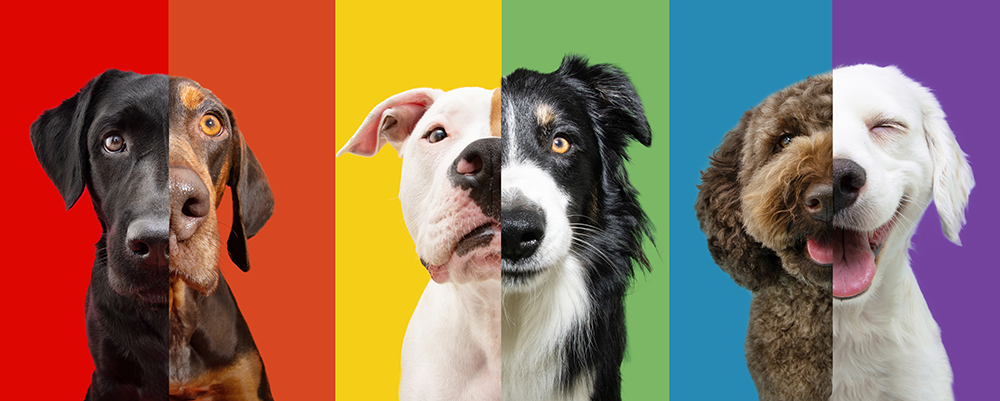
Studies show that dogs are as varied in their preferences as we are - only with less hang ups. photo: AdobeStock
Back in the early 1970s, Dr. Jane Goodall came to visit the renowned animal researcher Dr. Frank Beach at UC Berkeley where I was involved in Beach’s ongoing dog behavior studies. During her visit, the three of us attended a behavior conference, where the discussion became rowdy when several laboratory researchers ridiculed Dr. Goodall for giving her chimps and baboons names.
Dr. Beach raised his hand, stood up, and made the point that lab rats are clearly individuals and that individuality is even more apparent among chimps, baboons, and other animals studied in the wild. He further noted that the dogs in his own ongoing behavioral study were all named.
An attendee then asked whether using animals’ names when recording their behavioral interactions would distract them from what they were doing and so bias the data. Dr. Beach was ready with a snappy reply, "We study mating behavior; little distracts dogs when they are mating.” An understatement if there ever was one. (That said, please see this video on Facebook as an example).
Not Just Any Guy Will Do
Dr. Beach’s research spanned a period of 30 years, but at one point in his dog mating behavior studies, he made an accidental discovery. One of the females at the height of true estrus repeatedly refused to allow a very handsome male dog to mount her. After observing this, Dr. Beach said, "Get Broadus,” the most persuasive courter in the pack. The female instantly allowed Broadus to mount her repeatedly. Moreover, when Broadus became tired, the female actively solicited him to mount some more. Hmmm! Everyone had the same thought: even in heat, she just wasn’t into that first guy. Thereafter, every estrous female was tested with six males to get a truer picture of mating preferences.
Overall, Dr. Beach’s study found that approximately 50% of estrous females would accept mounting from any male (or female) who tried, but the other 50% were highly selective regarding prospective mating partners. They would gladly allow mounts from some males but never from others. Moreover, these strong mating preferences were stable over several heat periods.
Doris and Ken
In addition to the hundreds of tests we conducted - observing two dogs, all males, all females, single litters, all puppies, and all puppies and dogs with a single meaty oxtail - our Berkeley study team performed two other tests designed to tease out complex social relationships.
The first was the Living Enclosure Test. Every hour on the hour, we marked the position of each of the study’s 24 puppies and dogs on a map of their two-acre living enclosure. Our observations revealed that the closest dog to Ken, the pack’s top dog, was always Doris, a middle ranking female, and that the closest dog to Doris was always Ken. Obviously, we concluded, these two just really liked hanging out together.
(Discussing that particular test with my farmer grandfather brought a predictable response: "Coulda told you that 50 years ago, boy." And it’s true that science often comprises proving the obvious, in this case, that dogs have special friends and special enemies and that many bitches have preferred mating partners. However, thinking and believing is one thing. Proof is another.)
The second part of our social relationships study was the Tether Test. Each participating female dog was observed for 15 minutes while she wandered loose in a one-third acre enclosure with six males, each of whom was tethered on a three-yard line to a stake. Each female was tested once a month over three years, during which she underwent roughly six heat cycles.
Remember that devoted pair, Doris and Ken? Normally, Doris would greet the other male dogs - Joe, Eddie, Cerberus, Whip, and Cassius - with a quick hi/bye and then enter Ken's tethered circle, settling down next to him for the duration of the test.
But when Doris was in proestrus and estrus (a total of about 20 days over the course of the tests), Doris would greet Eddie, Joe, Cerberus, Whip, and Ken, but then enter Cassius's tethered circle where she would prance and twirl for the rest of the test, displaying her attractiveness, proceptivity, and eventual receptivity. But only for Cassius, not her old pal Ken.
When Doris came out of heat, she would revert to her former social behavior, greeting the other males casually as before, then settling down next to Ken, as if to say, "Hi Ken. I've been away for a while. Missed you." Hormones…what are you gonna do?
An Odd Couple's Bromance
My favorite finding in our dog behavior studies was confirming that many male dogs have long-lasting social preferences (or antipathies) and develop enduring, solid friendships.
In our study pack’s living area, the closest dog to Joe was always Cassius and vice versa. Yet nearly three-quarters of all growls and squabbles in the pack were also between Cassius and Joe - and nearly all were initiated by Cassius, who was permanently on edge and besotted by rank even though he was only the third-ranking male. Fortunately for Cassius, he’d discovered a tolerant and calming best buddy in Joe. Joe was California cool, a true Sir Wags-a-lot, perturbed by nothing.
Joe and Cassius were born four days apart and remained besties until Cassius died. Many of the researchers thought that Joe was actually higher ranking than Cassius because on two occasions, we saw Joe shut down Cassius's tantrums with a glance and then proceed to lazily chew the oxtail that Cassius had relinquished, while Cassius grumbled and goose-stepped and high-leg urinated all around the enclosure. My view? Joe just didn't want to argue, especially not with the irascible Cassius. Joe certainly loved that oxtail, but he loved Cassius more.
As our Berkeley research showed, both male and female dogs can have pronounced, long-lasting social preferences and some female dogs have pronounced, long-lasting sexual preferences. Yet their individual social and sexual preferences may vary depending on the circumstances.
In Doris’s case, these obviously varied a lot. So this Valentine’s Day, spare a thought for poor Ken. As science shows, it’s not just humans who can be stranded in the friend zone.